Cal. 565 Seamaster - crown & stem failed, never serviced. Sa

Posts
5
Likes
1
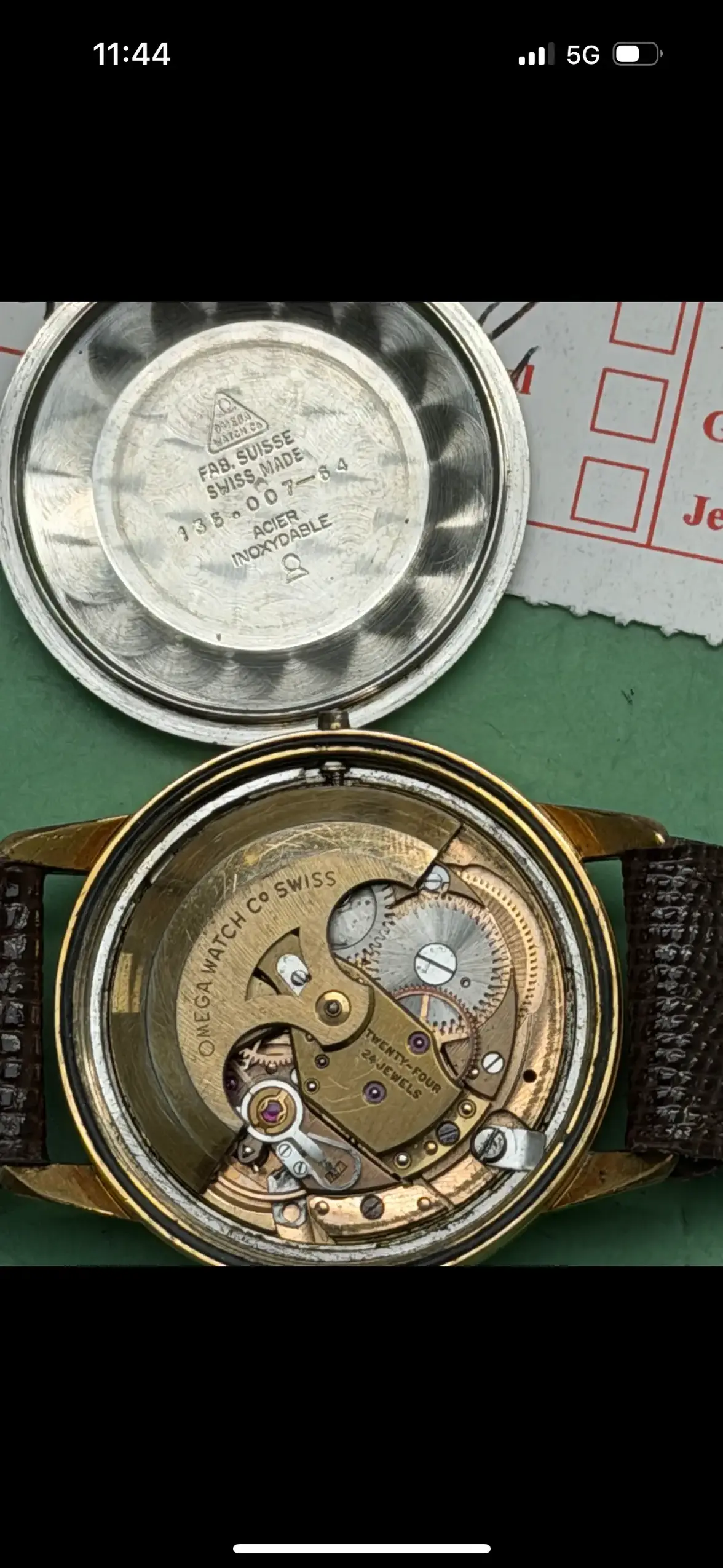
Picked up a gold-capped Seamaster automatic (caseback stamped 135.007-84, though the movement's a 24-jewel auto so I suspect a service-swapped back - happy to be corrected). Bought it running, wore it ~3 weeks. Crown always felt slightly loose when winding; I ignored it, and eventually the crown came off entirely while taking a jacket off. It had also been running about a minute fast per day. Never been serviced as far as I know - likely decades of old oil.

Took it to a local shop (jeweller that also does watch work, not a vintage specialist). They opened it, confirmed genuine Omega parts, said the movement was "poor," and quoted £600–700 for the repair, later suggesting it might be better sent to Omega for a full inspection (+£70 to authorise).

That number feels steep to me for a 56x, which I understand is a common, well-supported movement. So, two questions:

1. Is £600–700 realistic for a full service plus keyless-works/stem/crown repair on this calibre, or am I right to be wary?
2. Can anyone recommend a trusted UK independent who does vintage Omega work?

Thank you !
 
Posts
30,153
Likes
77,862
Was that an all in price, including whatever parts are required?
 
Posts
2,561
Likes
2,746
700 for a service is quit a lot... I suspect a good watchmaker could do it for way less. He's right that movement looks dirty though. And the clamps aren't all the way in..

As far as your crown, it looks like it came unscrewed from the stem (or the stem broke?), you can still see the stem sticking out in that photo. You can get that out without disassembling anything, and some loctite + maybe a new stem would get you running again.
 
Posts
5
Likes
1
Was that an all in price, including whatever parts are required?
Yes, everything was included in the price. However, I didn't get a full report from him on what part needed replacing/servicing; hence, I was hesitant to go forward with the quote.
 
Posts
5
Likes
1
700 for a service is quit a lot... I suspect a good watchmaker could do it for way less. He's right that movement looks dirty though. And the clamps aren't all the way in..

As far as your crown, it looks like it came unscrewed from the stem (or the stem broke?), you can still see the stem sticking out in that photo. You can get that out without disassembling anything, and some loctite + maybe a new stem would get you running again.
Thank you so much for the feedback!
 
Posts
2,323
Likes
1,448
Curious, but what’s that metal piece under the balance by the swan neck screws?

Also. Why is one clamp sitting on top of the outside case lip and other sitting under?

If the movement was running and keeping proper time. What parts need to be replaced except the mainspring?
 
Posts
30,153
Likes
77,862
Yes, everything was included in the price. However, I didn't get a full report from him on what part needed replacing/servicing; hence, I was hesitant to go forward with the quote.
I did a quick look at the watches I've serviced so far this year. My average invoice for servicing the 55X/56X/75X series movement watches has been about 800 pounds (converted from Canadian dollars), with the highest one being around 960 pounds.

Very often the price of replacing all the parts these need will exceed the labour that I charge. It didn't used to be that way, but Omega has been raising prices on the parts for these so parts are often now the bulk of the cost. When a new Omega acrylic crystal costs nearly 100 pounds, a typical train wheel is 30 pounds, a pallet fork is 70 pounds, the costs add up fast depending on what is required.

So if the watchmaker is Omega certified, and is replacing all the parts required to make it run well, make it seal again, etc. it may be that the price is right in the normal range. What needs replacing and what is included is key, because despite all the people telling you if it's high or low, they don't really know until we know what needs replacing.

Hope this helps.
 
Posts
2,561
Likes
2,746
I did a quick look at the watches I've serviced so far this year. My average invoice for servicing the 55X/56X/75X series movement watches has been about 800 pounds (converted from Canadian dollars), with the highest one being around 960 pounds.

Very often the price of replacing all the parts these need will exceed the labour that I charge. It didn't used to be that way, but Omega has been raising prices on the parts for these so parts are often now the bulk of the cost. When a new Omega acrylic crystal costs nearly 100 pounds, a typical train wheel is 30 pounds, a pallet fork is 70 pounds, the costs add up fast depending on what is required.

So if the watchmaker is Omega certified, and is replacing all the parts required to make it run well, make it seal again, etc. it may be that the price is right in the normal range. What needs replacing and what is included is key, because despite all the people telling you if it's high or low, they don't really know until we know what needs replacing.

Hope this helps.
THAT is very interesting! Thanks for that Al!

I've only done a handful of those (and as a home-gamer). I'll say my projects tend to be in better-than-ops-but-not-running shape (I guess that is meaningful in some way?). My labor is obviously not included because I'm not professional, but I'm usually a crystal + mainspring + maybe a wheel or 2. So probably ~$150-$200 US in parts (and usually from ebay, and also, sometimes used parts)?

Obviously I have lower 'standards' than you do I'd assume, so I replace less... so that is probably meaningful as well.
 
Posts
30,153
Likes
77,862
THAT is very interesting! Thanks for that Al!

I've only done a handful of those (and as a home-gamer). I'll say my projects tend to be in better-than-ops-but-not-running shape (I guess that is meaningful in some way?). My labor is obviously not included because I'm not professional, but I'm usually a crystal + mainspring + maybe a wheel or 2. So probably ~$150-$200 US in parts (and usually from ebay, and also, sometimes used parts)?

Obviously I have lower 'standards' than you do I'd assume, so I replace less... so that is probably meaningful as well.
Not all of them are really expensive. On the low end one was just over 500 pounds.

But I often have to replace every wheel in the automatic system if the watch has jewels there (if not I am replacing all the bushings) plus the rotor pinion. I'm already up to $200 on that without even looking at the rest of the movement or case.

And there's probably a good chance that I am not letting stuff go that you might. I inspect every part under the microscope for wear, and if worn they get replaced. I can sometimes burnish pivots or polish them, but most times they get replaced. Omega has standards for what is acceptable wear or not, and I follow those pretty closely. I do find lots of "recently serviced" watches come in with parts inside that are already worn, because people simply don't want to spend the money to replace them.

My goal isn't just good performance right after the service, but 5+ years down the road.
 
Posts
46
Likes
168
Obviously great advice from Al already. Given your local shop sounds more like a jeweller than a watchmaker, perhaps their suggestion to send it to Omega highlights a lack of expertise/confidence on their part?

If you did want a second opining from a watchmaker in the UK, then you could try Mitka (Mitka.co.uk) who is also a member here.
 
Posts
13,503
Likes
23,432
Before you consider spending a significant sum on a service it would be worth showing the rest of the watch. The movement and caseback don’t match so if there are other issues, it may not warrant spending more money.
 
Posts
5
Likes
1
I did a quick look at the watches I've serviced so far this year. My average invoice for servicing the 55X/56X/75X series movement watches has been about 800 pounds (converted from Canadian dollars), with the highest one being around 960 pounds.

Very often the price of replacing all the parts these need will exceed the labour that I charge. It didn't used to be that way, but Omega has been raising prices on the parts for these so parts are often now the bulk of the cost. When a new Omega acrylic crystal costs nearly 100 pounds, a typical train wheel is 30 pounds, a pallet fork is 70 pounds, the costs add up fast depending on what is required.

So if the watchmaker is Omega certified, and is replacing all the parts required to make it run well, make it seal again, etc. it may be that the price is right in the normal range. What needs replacing and what is included is key, because despite all the people telling you if it's high or low, they don't really know until we know what needs replacing.

Hope this helps.
Hey AI, thank you for taking the time. Your point lands: everyone (me included) was guessing at a typical price, but until someone lists the actual worn parts, it's all just noise. That's exactly why I hesitated on the jeweller's quote, not because £600–700 is impossible, but because he never itemised what I'd actually be paying for.


As it happens the watch is at Omega right now for that very inspection, so I should get a proper parts list and condition report back soon. When it comes, I'll be able to compare like-for-like against an independent rather than guessing.


One thing that's come up here, and I'd value your view on, is that a couple of people have flagged that the caseback (135.xxx) doesn't match the automatic movement, so the back's likely a replacement. Does one non-original part like that make you more cautious about what else might have been swapped over the years - or is a service-replaced caseback common and nothing to read too much into on a watch this age?
 
Posts
2,561
Likes
2,746
Hey AI, thank you for taking the time. Your point lands: everyone (me included) was guessing at a typical price, but until someone lists the actual worn parts, it's all just noise. That's exactly why I hesitated on the jeweller's quote, not because £600–700 is impossible, but because he never itemised what I'd actually be paying for.


As it happens the watch is at Omega right now for that very inspection, so I should get a proper parts list and condition report back soon. When it comes, I'll be able to compare like-for-like against an independent rather than guessing.


One thing that's come up here, and I'd value your view on, is that a couple of people have flagged that the caseback (135.xxx) doesn't match the automatic movement, so the back's likely a replacement. Does one non-original part like that make you more cautious about what else might have been swapped over the years - or is a service-replaced caseback common and nothing to read too much into on a watch this age?
Not Al, but I'll help:

The caseback not matching just means 'another watchmaker has been here'. At that age, if there isn't 6 watchmakers already in there, I'd be shocked.

Movement parts replaced like-for-like: no one cares about. IF an authentic Omega replacement wheel is installed, I'm not aware of anyone who would care. Bridges are slightly more troublesome, but in general I don't think anyone makes a HUGE deal over that.

The caseback being swapped WOULD be something that some buyers care about (value-wise), but not as huge of a deal as many would think. IMO the most important 'correct' parts are: Movement, Dial, Case, Hands in order, and caseback only comes into 'would I pay "collector" money for this'. But if it is a watch you just want to wear, a correct caseback wouldn't matter to me.

Side note: I notice a bunch of rotor-rub on the movement, so its good this is going in for a service!
 
Posts
5
Likes
1
Not Al, but I'll help:

The caseback not matching just means 'another watchmaker has been here'. At that age, if there isn't 6 watchmakers already in there, I'd be shocked.

Movement parts replaced like-for-like: no one cares about. IF an authentic Omega replacement wheel is installed, I'm not aware of anyone who would care. Bridges are slightly more troublesome, but in general I don't think anyone makes a HUGE deal over that.

The caseback being swapped WOULD be something that some buyers care about (value-wise), but not as huge of a deal as many would think. IMO the most important 'correct' parts are: Movement, Dial, Case, Hands in order, and caseback only comes into 'would I pay "collector" money for this'. But if it is a watch you just want to wear, a correct caseback wouldn't matter to me.

Side note: I notice a bunch of rotor-rub on the movement, so its good this is going in for a service!
Hey Erich, thank you for taking the time. The "6 watchmakers have already been in there" framing makes total sense; I was honestly treating an age flag like a red flag. And the priority order (movement/dial/case/hands first, caseback only for collector money) is genuinely useful, and tbf, this is a watch I bought to wear, not to vault, so I can stop worrying about the back.

Good spot on the rotor rub, too; that actually ties my symptoms together, since it was running about a minute slow a day. Appreciate you taking the time.
 
Posts
2,561
Likes
2,746
Hey Erich, thank you for taking the time. The "6 watchmakers have already been in there" framing makes total sense; I was honestly treating an age flag like a red flag. And the priority order (movement/dial/case/hands first, caseback only for collector money) is genuinely useful, and tbf, this is a watch I bought to wear, not to vault, so I can stop worrying about the back.

Good spot on the rotor rub, too; that actually ties my symptoms together, since it was running about a minute slow a day. Appreciate you taking the time.
'rotor rub' would be noise during the automatic, it wouldn't be timekeeping. But a minute-a-day is DEFINITELY "this is a dirty/sick watch" symptom.