Blue SM60 166.0062 rebuild

Posts
29,674
Likes
76,836
Hi Jim

It'll be nice in the end but the plates were very dirty and scratched around the edges, from the rotor and some heavy handedness at the case clamps.

I think they are from the French but my French is not brilliant….

DU (Dial up) = CH (“Cristal Haute”) or Crystal high in English.

DD (Dial down) = CB (“Cristal en Bas”) or Crystal down in English.

They also use FH which is equal to CB. This is “something haute” but I’m not sure what the “F” stands for. I suspect it’s something to do with “Fermeture” which would be “closing” in English so, it would mean closing piece high? We need Francois!

Cheers, Chris

Hi Chris,

I think you will find that the C in CH and CB is for Cadran - dial in French. So they still both mean dial up and dial down - one in English and the same in French.

Cheers, Al
 
Posts
2,219
Likes
4,952
How I wish I had the skills necessary to do this kind of work.
Unfortunately, previous attempts have resulted in disaster and only confirmed that I am a clumsy oaf !!
It's lucky that I've found a great local watchmaker.
Great job on a lovely watch.

It isn't easy to do this but with research and working on big cheap reliable calibres, you can make a success of it. We all struggle to some extent at the start and I think my formal training helped a lot but, if you want to have another go, dive in.

Just start with an ETA 6497/6498 and work up from there. These 550 series are not that complex in comparison to some older auto three handers such as the 500 and 330 series but they're not for a beginner.

The clumsiness does go away...😁

Cheers, Chris
 
Posts
2,219
Likes
4,952
Still an issue with the postal service so, no case specific parts yet....

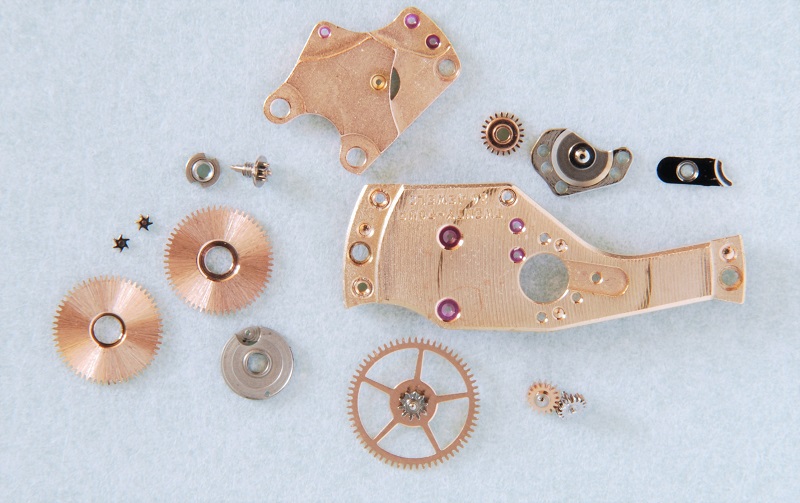
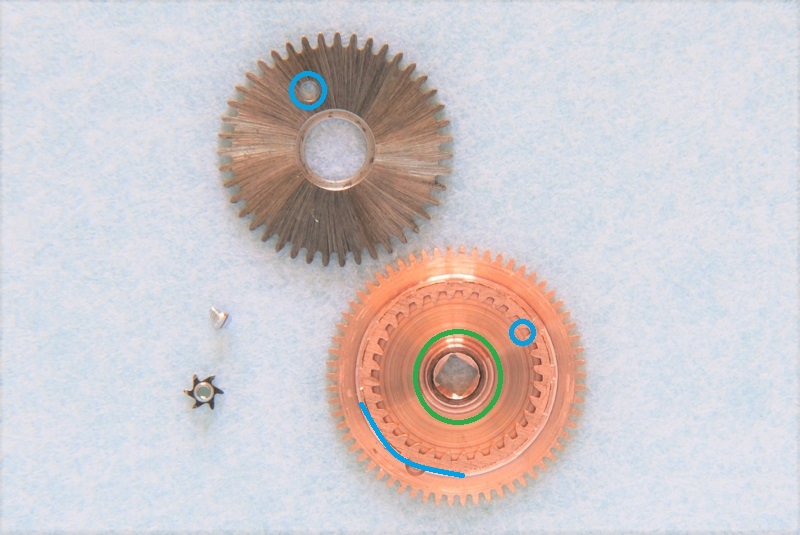
Put the auto mechanism back together. These are the parts (plus rotor and screws) that make it up.
On the left, the winding (reversing) wheel is seven parts. These see a lot of wear as they're often not stripped down during services. This one will be fine.
At the lower are another three intermediate wheels, the largest will connect to the automatic ratchet wheel on the movement and at the upper are the rotor bush, rotor axle (I've accidentally shown the worn one) and the gib for the rotor that will hold the rotor on.


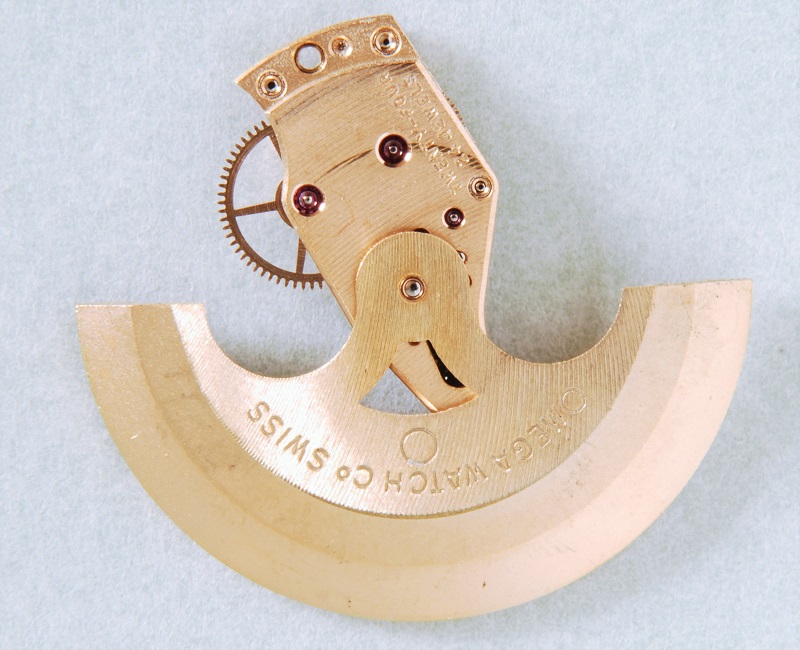
Put together they make this assembly that attaches to the movement with two screws.

Can't do anything about the scoring you can see on the rotor bridge due to the worn axle but, it's all fine now.

Cheers, Chris
 
Posts
17,942
Likes
37,521
What are the lube requirements for this assembly Chris?
 
Posts
2,219
Likes
4,952
Hi Jim

I don't think Omega publish an oiling chart for these so, you're not going to get a definitive answer but, here is what I use.

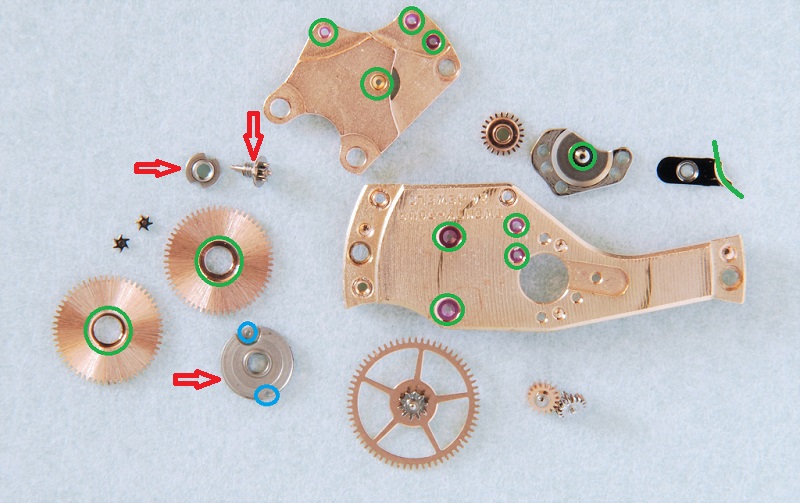
Green is HP1300
Blue is 9020


I use a small amount of oil on the gib (right hand side) on both upper and lower surfaces. The rest of the pivots and so on seem clear except for the reversing wheel.

The reversing wheel assembly is not that complex, it just looks it. The three parts with the red arrows screw together and due to a square in two of them, they don't rotate relative to each other. I think the centre bearing surfaces for the big wheels will be obvious to you but, I also oil the teeth in those big wheels that mesh with the tiny satellite wheels - it's a very small amount and I do this by oiling every four to six teeth.

Except for the big obvious pivots and bearing surfaces, these are very small quantities. If you see photos of a service on the web and this reversing wheel (strictly, 5501464 is called the winding gear) is not stripped then, in my opinion, it gives an indication of how much effort is going into a service. They do wear if you don't strip and oil them and I think are $150-200 so an expensive item.

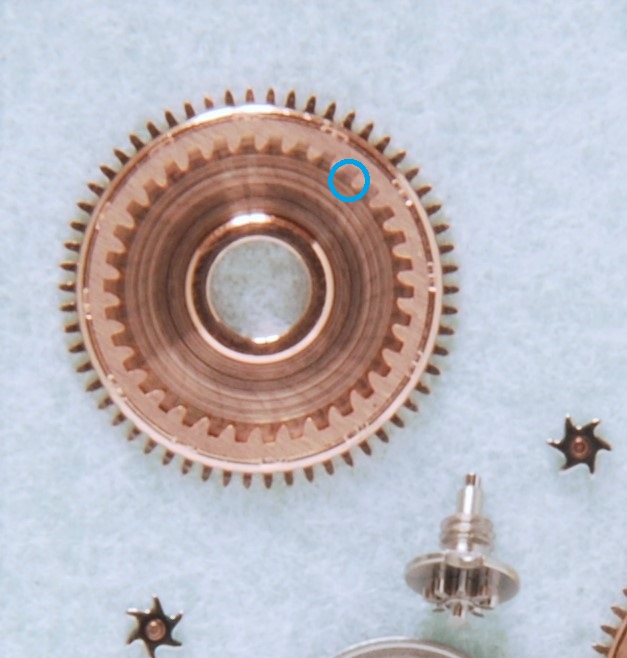
I suppose while we're at it, this is how I oil the automatic ratchet wheel assembly on these as it has a similar style of locking satellite wheel. The HP1300 in the middle is for the bearing surface between this and the steel ratchet wheel shown (not the square, obviously😁). I also put a very small amount of oil on the upper surface of the auto ratchet wheel where it contacts the steel wheel, as I've tried to indicate.


Oh, by the way, if you don't have 9020, I'd see no harm in using HP1300 in all of these locations. I am sure that somewhere I have some sort of guide for these locations and will look it up. It's not Omega but may be BHI or ACW.

Right, so let's see if Al is doing something similar and if anyone else has something to comment - you know watchmakers, oiling methods and oils! Am off to hide now...😁

Cheers, Chris
 
Posts
17,942
Likes
37,521
Thanks for that mate, great pointers.

As for various methods of oiling, I've seen real bitch fights on the webs, but I think that our members here will offer their tips and consider that as adding to the knowledge pool. Not arguing that theirs is the only/correct method.
 
Posts
2,219
Likes
4,952
Agreed Jim, we get some good sharing here.

I don't think I've ever discussed this with Al who does a lot of these so would be very interested in his regime here.

The rest of this calibre is straightforward and you can be guided by an 1120 oiling sheet, it's just these few parts that are out of that spec.

Cheers, Chris
 
Posts
29,674
Likes
76,836
Omega and other makers didn't always produce technical guides that are as detailed as those you see for modern movements. So they often relied on the skill and knowledge of the watchmaker - you were expected to know what type of oil to put where, and where not to oil, etc. The full technical guides you see today that have all kinds of details are a more recent thing. So most of what you will find publicly available for these movements will simply be parts lists, with no lubrication information. As Chris suggested, using a tech guide from another movement is always a good approach when you don't have information on the movement that's currently on your bench.

Now Omega does produce additional documents other than just parts lists, and even the more complete modern tech guides. These are called "General information for calibers" and usually cover a whole family of calibers rather than specific movements. So information that would apply across a number of movements in the same family. There is such a document for the 55X family, and in there they give information on disassembly, cleaning, and lubrication of the winding wheel. In addition this document lists parts that are mandatory replacements during service, how to make specific adjustments (like syncing the day and ate change on the 75X series), and other useful information.

On the winding wheels for the 55X, 56X, and 75X movements, new wheels come lubricated from the factory. If the date code on the package is less than 4 years ago, then the wheel can be removed and used as is. If it's older than 4 years, it must be cleaned and lubricated again. I replace a lot of these as the pivots are often worn, and as Chris suggested they are not cheap, so it's usually the most expensive part I replace on these movements. Unfortunately although Omega does sell some of the individual parts of this assembly, the main pinion is not one of them.

So specifically for the winding wheel, what does Omega suggest? The general information document refers you to yet another document called Work instruction 40, which outlines rules for lubrication for all movements. In modern watches the reversing wheels are assemblies that can't be disassembled for cleaning and lubrication. You have no choice but to clean them in an assembled state, and lubricate them in an assembled state. Omega recommends using what they refer to as the splashing method of lubrication. For modern reversing wheels this means submerging the wheel in Lubeta V105 - a solution specifically designed for lubricating reversing wheels:


This is a lubricant that is suspended in a solvent, so after dipping the wheel in you blow off the excess with a bulb blower, and let it air dry under a cover, and then install it in the watch. The substitute method is mostly intended for markets where V105 is not available, and there they suggest making your own solution of Moebius 9010 diluted in solvent. Ratio of oil to solvent is 3/100, and they recommend benzene.

Hope this helps.

Cheers, Al

 
Posts
2,219
Likes
4,952
Now, that's odd. I'm sure I posted here the other day with the oiling data I had for these reversing wheels but, it seems to have disappeared. In the unlikely event I've put something there I shouldn't have, I won't post it again.

Anyway, after many postal issues, which happens here sometimes, case parts turned up this afternoon.

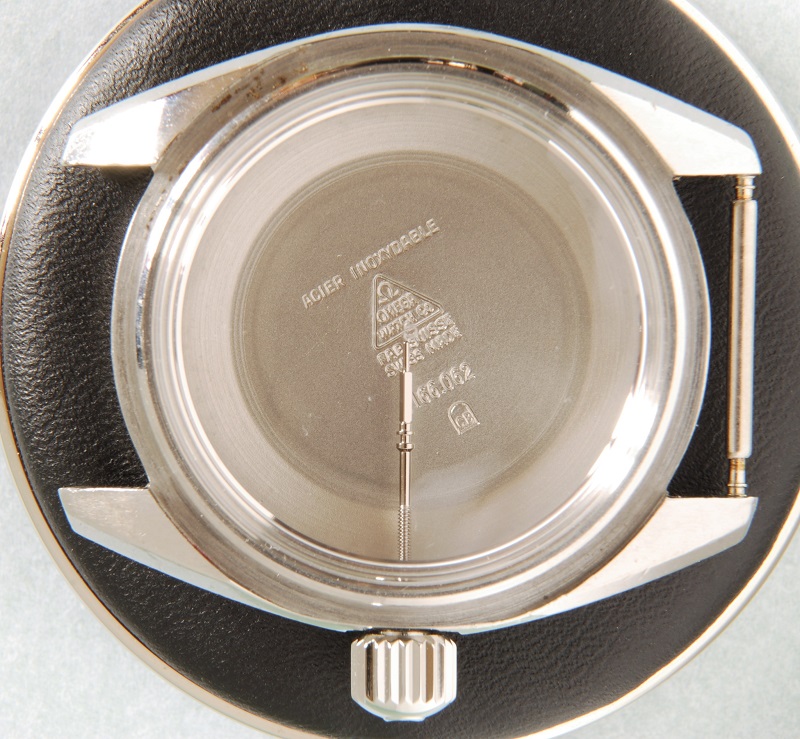
New crystal, crown and stem fitted to the case. I do a water resistance test at this point and all is well. Omega symbol lined up😉


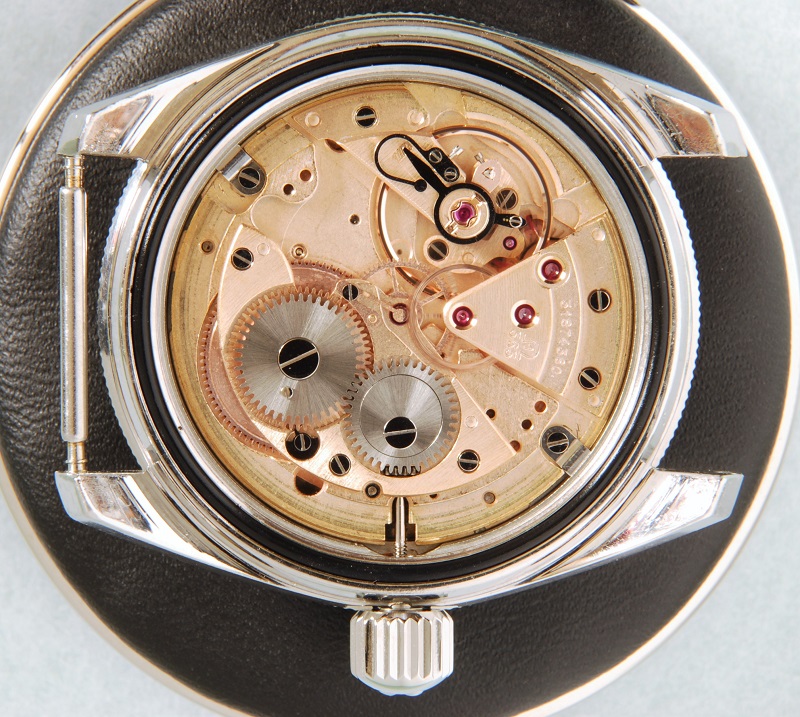
Bezel fitted and movement cased again. Stem trimmed and it's running in the case.

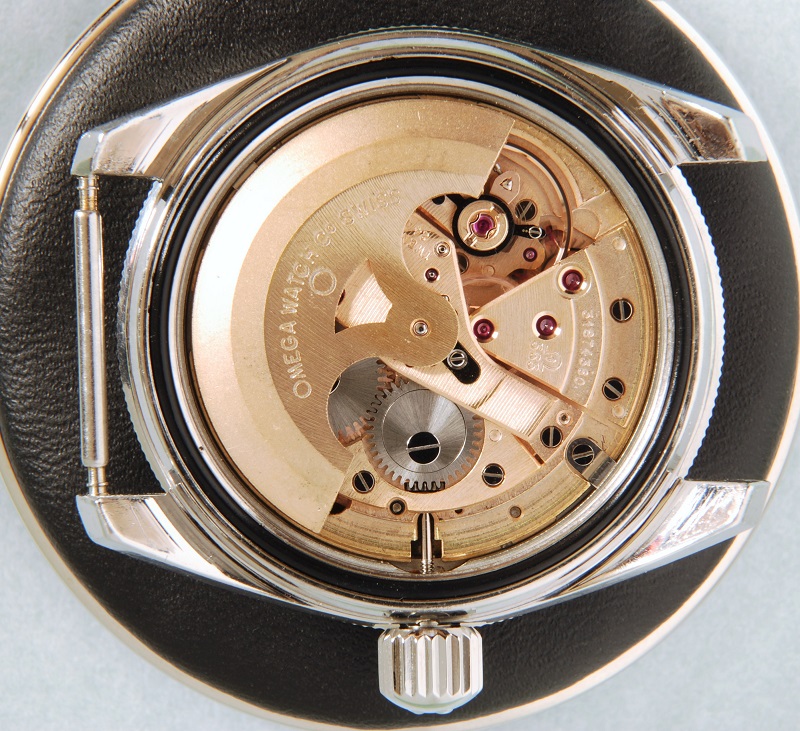
Added the auto mechanism.


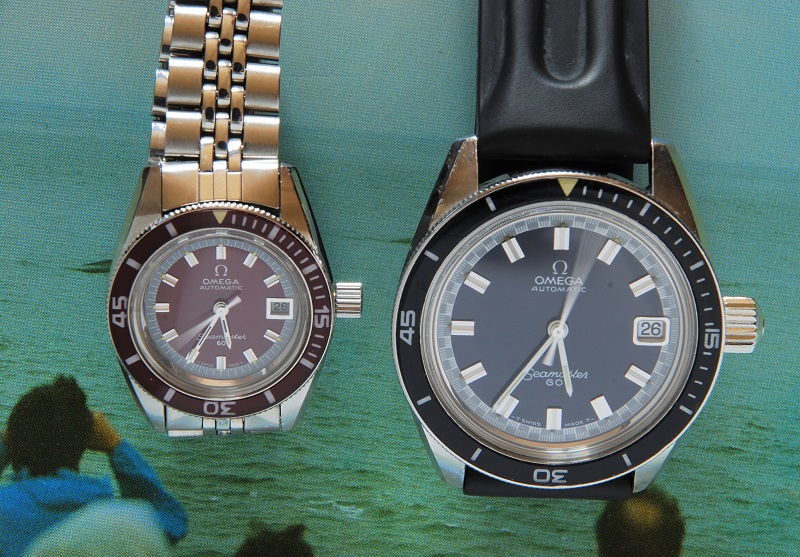
Fitted the case back and the watch is finished for the moment. Putting it into final testing now but fitted my one 19 mm strap to show it with my wife's baby Seamaster. That's a franken as I built it from parts a few years ago but it'sa lovely watch.


Clearly the same range with very similar dials and bezels. Will now keep an eye out for a one in Bordeaux like hers.....

Cheers, Chris
 
Posts
1,531
Likes
1,088
Hi Jim

It'll be nice in the end but the plates were very dirty and scratched around the edges, from the rotor and some heavy handedness at the case clamps.

I think they are from the French but my French is not brilliant….

DU (Dial up) = CH (“Cristal Haute”) or Crystal high in English.

DD (Dial down) = CB (“Cristal en Bas”) or Crystal down in English.

They also use FH which is equal to CB. This is “something haute” but I’m not sure what the “F” stands for. I suspect it’s something to do with “Fermeture” which would be “closing” in English so, it would mean closing piece high? We need Francois!

Cheers, Chris

Hi,

CB stands for Cadran bas (= dial down), CH for cadran haut (dial up), FB for fond bas (back down), etc.

Nice thread Chris - as usual!

Edit: I wrote this post before seeing Al already gave the answer...
 
Posts
25
Likes
3
I am doing a similar restoration on an 1660.062. The Omega AD told me just this week that Omega still has most parts for this model except for the Bakelite bezel.

Is the bezel supposed to click or just slide?
 
Posts
2,219
Likes
4,952
It just slides. You might struggle to get a bezel, dial and case but, what other parts are you looking for? Are you having Omega do it as some people on here would not recommend it.

Cheers, Chris
 
Posts
1,434
Likes
6,513
I'm not refinishing the case and will let the watch wear it's battle scars.

Cheers, Chris

And quite right too!
 
Posts
25
Likes
3
No, I am doing the resto with an independent who specializes in Omegas. I have most parts, the dial is in great shape as is the bezel. I am replacing the crystal with a date magnifier and need some hands and a case back. The last owner put a Constellation case back on it.

I am not polishing the case either......
 
Posts
2,219
Likes
4,952
Sorry, when you said "The Omega AD told me just this week that Omega still has most parts for this model except for the Bakelite bezel.", I assumed you were going to use Omega. Are you saying the AD will sell you the parts? That would be unusual.

Or, are you trying to find the parts yourself? If your watchmaker specializes in vintage watches, then he should have the same contacts I do and if he can't find them, you will struggle I'd have thought so, good luck.

Cheers, Chris
 
Posts
25
Likes
3
Yep, got a quote from the Omega AD before deciding I couldn’t sell a kidney to find a watch addiction.

The independent can find some of these parts used or NOS for me
 
Posts
25
Likes
3
Yep, got a quote from the Omega AD before deciding I couldn’t sell a kidney to find a watch addiction.

The independent can find some of these parts used or NOS for me


So my restoration WAS nearly complete. I sourced a new crystal on eBay along with an NOS big crown and a donor 565 caliber movement which needed only a new balance and 2nd wheel. I also found the appropriate case back on eBay and the hands from Ofrei. Fine, until I went to pick it up today.

Firstly let me say, the watchmaker was really patient with me and did a great job of cleaning and servicing the watch. He did too good a job.

He put the Bakelite bezel insert in the ultrasonic cleaner and it has come out transparent. The blue colouring has all come off and the Bakelite is now cracked and broken.

I have read that these bezel inserts are hard to find. How hard to find will determine the kind of discussion I need to have with the watchmaker.

Does anyone know where I could find a replacement bezel insert (blue) ? Did my watchmaker just ruin my restoration? I am freaking out a bit over this

If I could just find a replacement bezel insert, I am sure he would offer to pay for it. He’s a good watchmaker but I don’t think this is my fault. Mistakes happen
 
Posts
2,520
Likes
17,832
😲

(Btw, a fascinating thread, worthy of resurfacing, even apart from the latest misfortune!)
Edited: