Better/Cheaper/Quicker Money Transfer

Posts
707
Likes
1,041
I’ve been meaning to try Transferwise. Thanks for the reminder.

Also, for anyone concerned about the security of giving a service your IBAN number and/or bank routing numbers - this is not authenticating or identifying info, and it’s not going to get a criminal anywhere, ...not any more than knowing someone’s postal address. In a financial sense, that is all it is. Agencies, freelancers and other vendors often publish this type of info on their websites, at least in the EU.

 
Posts
270
Likes
970
A friend of mine moved temporarily overseas a bit more than a year ago. He used transferwise for moving some funds cut into tranches. He was very satisfied regarding speed, fees and conversion rates.
I would probably use this service up to a certain sum as replacement for bank transfers.
The risk that the service goes belly up, and the deposits on the move from one or two days are gone is existent IMHO. But that even happend to the market leading cash transport provider in my country some time ago 😲.
 
Posts
1,069
Likes
3,135
I've used transferwise loads of times. It's pretty quick and pretty cheap so I'd recommend it.
 
Posts
2,921
Likes
14,963
Why don't more of you folk use either Transferwise or Revolut?

My bank in Singapore uses something very similar to Transferwise for wire transfers; this change happened about 6 mths ago.

The user interface looks almost identical so I wonder if they using Transferwise in the background. Rates are almost identical to Transferwise's, and much better than the old rate before they changed the system.

As an example, previously I used to pay (including fees) about 1.5% above mid-market rates. Now, using the same bank but the new system, I pay only about 0.55-0.6% above mid-market rates. Using transferwise, it would be about 0.3-0.4%, so I suspect the small difference is my bank's markup? Either way, I'm happy to use my bank's new system.
 
Posts
5,071
Likes
15,650
Another idea that popped into my mind regarding using something like Revolut : money can be transferred at the same place/time as the actual goods. I.e. if a buyer and a seller meet up such that the buyer can look at said goods to make up his mind prior to purchasing, he can do the payment immediately to the seller standing in front of him, who will then receive the funds directly, and the exchange can be done.
 
Posts
2,675
Likes
7,487
Transferwise (https://transferwise.com)

They take 0.5% cut (https://transferwise.com/pricing). Money is not internationally transferred...and they use Reuters mid-market rate (they claim).

My limited experience after a few TransferWise transactions has shown a loss of about 0.8% compared to the spot FX rate (ie: mid-market rate).

You say that "money is not internationally transferred", what do you mean by that?

- I have successfully transferred money from my US bank account in USD directly into my Canadian bank account in CAD. Is that not considered "international"?

- I have read that people from the US have struggled sending money to Europe, can anyone confirm? I was hoping TW would become my new means of sending money from my US account to European members for watch purchases...
 
Posts
5,071
Likes
15,650
You say that "money is not internationally transferred", what do you mean by that?

My layman understanding :
- in every country they offer the service, they have a bank account.
- Person A in Canada wants to transfer $X to Person B in USA, they deposit $X in Canada account.
--Meanwhile, Person C in USA wanted to transfer Z yen to person D in Japan, and so they deposit Z-exchange-rate $ into USA account.
- Person B in USA then will get cash that may have been deposited by person D, E, F ... etc in USA.
- And so on and so forth.

As such, the cash doesn't cross borders, hence they can offer a very good exchange rate, and a small fee on top. I hope I understand it correctly, as well as make sense.
 
Posts
5,317
Likes
24,323
My layman understanding :
- in every country they offer the service, they have a bank account.
- Person A in Canada wants to transfer $X to Person B in USA, they deposit $X in Canada account.
--Meanwhile, Person C in USA wanted to transfer Z yen to person D in Japan, and so they deposit Z-exchange-rate $ into USA account.
- Person B in USA then will get cash that may have been deposited by person D, E, F ... etc in USA.
- And so on and so forth.

As such, the cash doesn't cross borders, hence they can offer a very good exchange rate, and a small fee on top. I hope I understand it correctly, as well as make sense.

Isnt that the actual, or interpreted definition of money laundry?
 
Posts
5,071
Likes
15,650
Isnt that the actual, or interpreted definition of money laundry?

I dunno, am a law abiding citizen 😀

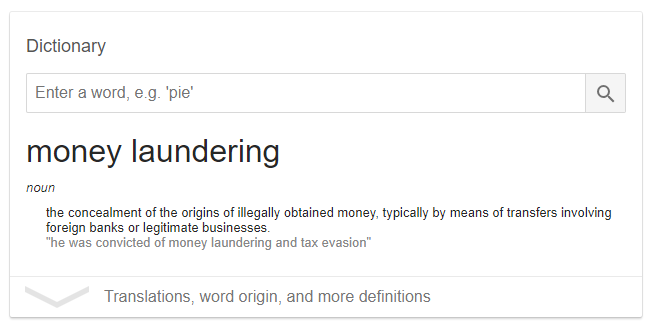
Here is what google says...


From books/movies :

So, some bloke has a legit business (e.g. laundromat) that runs at a loss, but in the books turns a massive profit annually (cash from some illegal activity) ...

My guess :

As long as they do not conceal the source of their cash, and legitimately as a business pass auditing , abide by laws etc , its not laundering...
 
Posts
5,317
Likes
24,323
I use Bitcoin for sending long distances. If you are focused on the fiat value, (as I am currently) then doing the conversions immediately there is little risk - as the transmission is so quick. (Compared to Bank Transfer).

For example sending $20,000 from Europe to china via BT takes 3 or four days, and numerous questions, and cannot be guaranteed.

If instead I convert 20k with Coinbase and less than a few minutes later my recipient is in a position to move it out of crypto the same way.

Now there are are risks, and frictional losses, but there are also frictional gains while the system is so new and volatile.

But for me the immediacy and the certainty, not to mention the discretion, out weigh everything else.

Its early, but once more people use it, the volatility will reduce, and central banks are going to find it tough.

The real leap, is when no one is converting out of crypto. Then the cental banks wont find it tough.

They will not have a role at all.

By the way, as to reversals or removals from your Bank Account. The US government can go into any bank account anywhere in the world and remove US dollars. If you own US dollars, one very wealthy Middle East man told me, they are not really yours.
 
Posts
5,317
Likes
24,323
I dunno, am a law abiding citizen 😀

Here is what google says...


From books/movies :

So, some bloke has a legit business (e.g. laundromat) that runs at a loss, but in the books turns a massive profit annually (cash from some illegal activity) ...

My guess :

As long as they do not conceal the source of their cash, and legitimately as a business pass auditing , abide by laws etc , its not laundering...

Of course you are correct.

What I was looking at is the legal definitions that now pervade our lives, and that we rarely read.
What you described were "Third Party Payments" which I believe now fall under ML legislation.
 
Posts
1,301
Likes
2,575
Isnt that the actual, or interpreted definition of money laundry?
The Australian subsidiary of TW is registered with our federal agency responsible for tracking and identifying illicit international financial transfers so even if the funds don't cross our borders I assume the transactions are reported as long as they are above the reporting threshold. I'm sure it'll be more or less the same for other countries they operate in.
 
Posts
5,071
Likes
15,650
Of course you are correct.

What I was looking at is the legal definitions that now pervade our lives, and that we rarely read.
What you described were "Third Party Payments" which I believe now fall under ML legislation.

I am utterly clueless with respect to such laws ... I know e.g. in CH there is a threshold for which nobody cares (I think its 100k CHF annually), but now know who to bother for enlightenment 😀
 
Posts
2,675
Likes
7,487
I use Bitcoin for sending long distances. If you are focused on the fiat value, (as I am currently) then doing the conversions immediately there is little risk - as the transmission is so quick. (Compared to Bank Transfer).
Isn't there also the perceived benefit that with Bitcoin transactions become somewhat invisible or at least difficult to trace?

If I buy a rare watch today for $20k USD via Bitcoin and sell it for $200k USD via Bitcoin in the future, there is no way for the gov't to track/trace these 2 transactions and in any way prove that I might owe them capital gains on $180k?