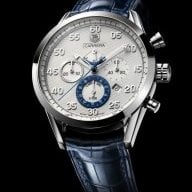
Without stopping the chrono though....
If we do an experiment....
1. Wind watch fully, then check power reserve
2. Wind watch fully, start chrono and leave it running, then check power reserve
The power reserve on 2. will be shorter!
Hence, running the chrono continuously, shortens the power reserve, in other words, the chrono runs down the mainspring faster
Please correct me if I’m wrong :thinking:
Do you teach math or physics?
Anyway, yes, the watch will stop sooner with the chronograph running, but that does not mean that the mainspring unwinds "faster" with the chronograph running. The power reserve of a watch is a fixed thing, based on the number of turns of the mainspring barrel, and the number of turns of the center wheel. The number of turns of the barrel is determined by the length of the mainspring. The formula for this is:
n2/n1 = Z1/Z2
Where:
Z1 - number of teeth in the barrel
Z2 - number of teeth in the center pinion
n1 - number of revolutions of the barrel
n2 - number of revolutions of the center pinion
Yes, the watch will stop sooner with the chronograph running, but it has nothing to do with the mainspring unwinding faster. It stops sooner due to the torque being delivered by the mainspring, no longer exceeding the loads on the movement. The torque delivered by the mainspring drops over time, as shown on this graph:

The watch will stop even without the chronograph running, due to the loads exceeding the torque. So in fact, a watch mainspring never fully unwinds, because the torque will drop lower than is required to keep the watch operating no matter what. So the only thing that changes the point where it stops on that curve in the chart above, is what the loads are.
Loads can come from many different things - chronograph function running, date change, or even the movement just being dirty or worn out. This is why testing how long the watch will run against the designed power reserve can be an indicator of the watch condition.
So if you look at the chart above, under normal conditions without any extra loads from complications, let's say the watch stops on that chart at 6 turns of the mainspring barrel, leaving 1/2 a turn still to unwind. When you add the chronograph to the loads, the torque level required to keep the watch functioning is higher, so it will stop at say 5.5 turns of the barrel. But after it stops, you can turn the chronograph off again, and the watch will run until it reaches 6 turns again. This illustrates clearly that the spring hasn't "run down" faster.
So no, it is physically impossible for the spring to wind down faster, unless the movement speeds up dramatically, and that doesn't happen when the chronograph is running. The mainspring in a watch doesn't operate like a battery, where a higher load will "drain" it faster.
Note that you are not alone in this belief. I have to explain this to someone, somewhere, about once a month. I recently had one very smart individual tell me this explanation defies the laws of thermodynamics, which was interesting to say the least.
🤦
Cheers, Al