A question for Seamaster 300 Heritage owners…

Posts
7,392
Likes
23,861
I recently picked up an example in nice shape, and have a question for owners who have used theirs for a while: has anyone needed to replace their crown/tube due to wear? For those that use theirs frequently, have you noticed any indications of wear starting to happen? Thanks.
 
Posts
2,815
Likes
3,747
no problems with the crown after 4+ years for me. I bought used and it was about 6 months old when I got mine (based on the warranty card), so it is about 5 years old. I wore it almost non-stop until I got my Speedmaster last year, but I still wear it every weekend.

I don’t unscrew the crown a lot, though (I keep it on a winder when not wearing it). Maybe once a month when it gets more than 30 seconds off in time.
 
Posts
7,392
Likes
23,861
Thanks, Donn. Really helpful. So, maybe you have unscrewed/screwed the crown about 40-50 times with no change in status?
 
Posts
1,437
Likes
1,459
Thanks, Donn. Really helpful. So, maybe you have unscrewed/screwed the crown about 40-50 times with no change in status?
What problem are you having?
 
Posts
7,392
Likes
23,861
What problem are you having?
Nothing yet. Trying to get a read on the durability factor regarding the crown and tube. I hear the tube is very difficult to replace.
 
Posts
30,285
Likes
78,160
Nothing yet. Trying to get a read on the durability factor regarding the crown and tube. I hear the tube is very difficult to replace.
Most modern case tubes just screw in, so it shouldn't be an issue.
 
Posts
7,392
Likes
23,861
Most modern case tubes just screw in, so it shouldn't be an issue.
I read that the Heritage Seamaster 300 tube is friction fit, and is near impossible to remove, but that’s just hearsay.
 
Posts
30,285
Likes
78,160
I replace Seamaster friction fitted tubes (which also will have Loctite retaining compound on them). They are more difficult that the threaded tubes, but certainly not "near impossible" for me or for Omega I'm sure.
 
Posts
93
Likes
56
Interesting question. I’d also be curious to hear from owners who have worn theirs regularly over several years. It would be helpful to know how well the crown and tube hold up over time.
 
Posts
30,285
Likes
78,160
Interesting discussion, because although there are brands and models that have a bad reputation for failed threads on screw down crowns, Omega is not one of them.

Is there something specific driving this concern?
 
Posts
1,437
Likes
1,459
I read that the Heritage Seamaster 300 tube is friction fit, and is near impossible to remove, but that’s just hearsay.
Where did you read this? There are millions of friction fit tubes in the world. If it was impossibly difficult to remove them watch companies wouldn't make them this way.
 
Posts
2,671
Likes
2,856
Interesting discussion, because although there are brands and models that have a bad reputation for failed threads on screw down crowns, Omega is not one of them.

Is there something specific driving this concern?
Breitling is the absolute worst. For some reason they machine the tubes as a part of the case, AND it is a material that isn't good for holding threads.
 
Posts
4,136
Likes
8,854
Thanks, Donn. Really helpful. So, maybe you have unscrewed/screwed the crown about 40-50 times with no change in status?

I've had mine for just over 3 years. During the first couple of years I wore it a lot and didn't unscrew the crown much, but now it is part of a regular rotation. No issues here
 
Posts
10,125
Likes
57,950
I never had any problem with the crown/tube. My only complaint is that the crystal really should have AR coating on both the outside and the inside. Given that it has the AR coating only on the inside makes for a lot of reflections that can make it hard to see that beautiful dial. Other than that, it's a great watch -- incredibly accurate, beautiful dial, and probably one of the best bracelets that Omega has made for quite some time.
Edited:
 
Posts
7,392
Likes
23,861
Where did you read this? There are millions of friction fit tubes in the world. If it was impossibly difficult to remove them watch companies wouldn't make them this way.
Probably Reddit. But they were referring to this specific model, not all models and all companies.
 
Posts
774
Likes
1,814
I have a Seamaster from 1998, which I bought used in 2018. I took it in for it's first service in my possession in 2023 and the watchmaker remarked that it still had what looked like its original soldered tube. He had to use some kind of special Omega jig to upgrade it to a screwed version to use the correct service parts. I might be getting the details of that a little wrong, but that's how I remember it anyway.

Point is, that crown tube probably lasted up to a quarter of a century and it was still fine. So I tend to not think too much about this.

That said, I still like to give the crown a little counter clockwise turn until I feel it engage the thread so as not to risk accidentally cross threading it.

 
Posts
30,285
Likes
78,160
I have a Seamaster from 1998, which I bought used in 2018. I took it in for it's first service in my possession in 2023 and the watchmaker remarked that it still had what looked like its original soldered tube. He had to use some kind of special Omega jig to upgrade it to a screwed version to use the correct service parts. I might be getting the details of that a little wrong, but that's how I remember it anyway.

Point is, that crown tube probably lasted up to a quarter of a century and it was still fine. So I tend to not think too much about this.

That said, I still like to give the crown a little counter clockwise turn until I feel it engage the thread so as not to risk accidentally cross threading it.

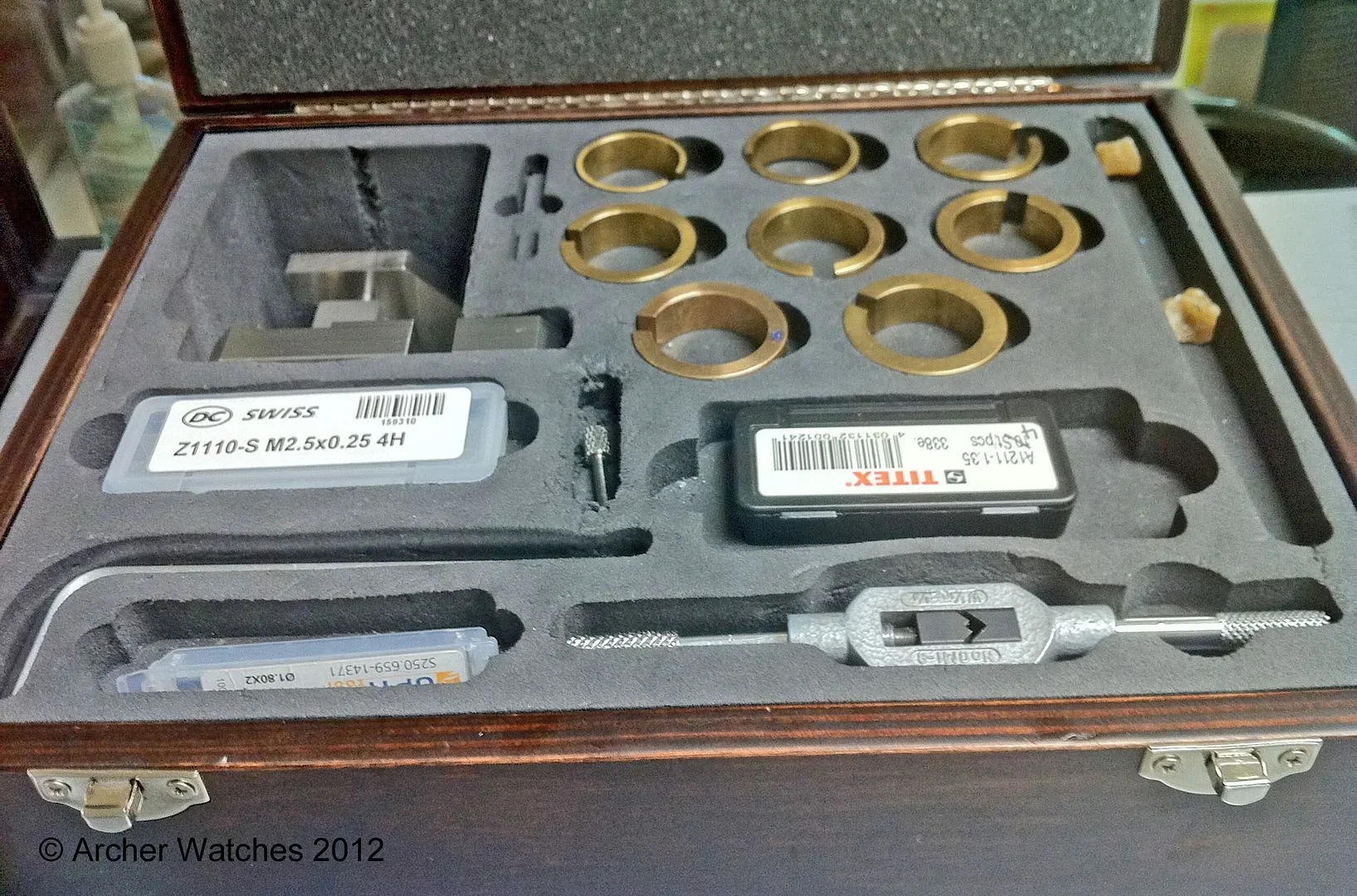
You are remembering it correctly. This is the kit with the jig...


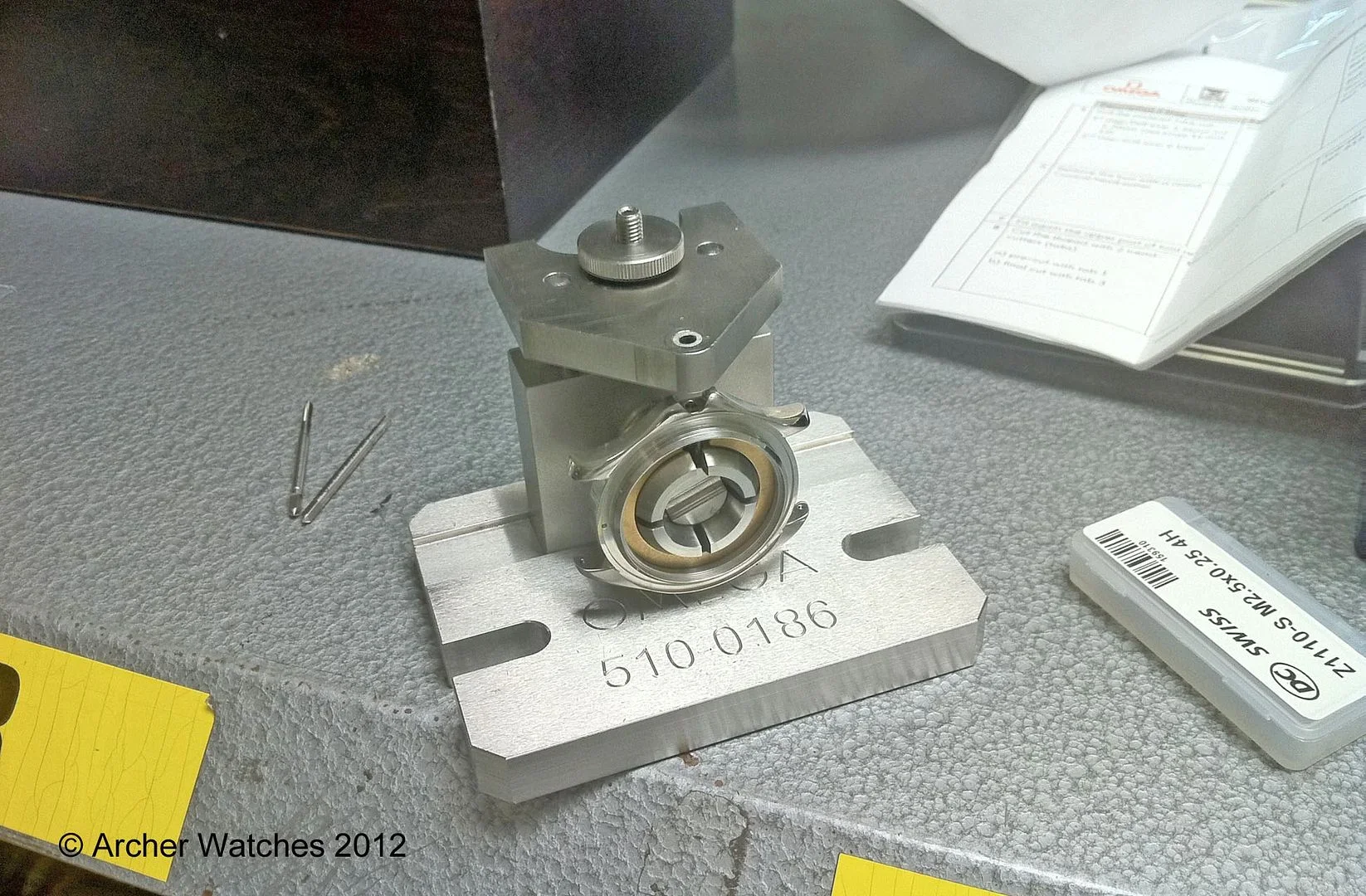
The jig holds the watch in such a way that the case tube hole is perfectly aligned, as the hole that is drilled has to be perfectly set-up both front to back and radially, or it will cause problems. Here is a case I was about to drill out:


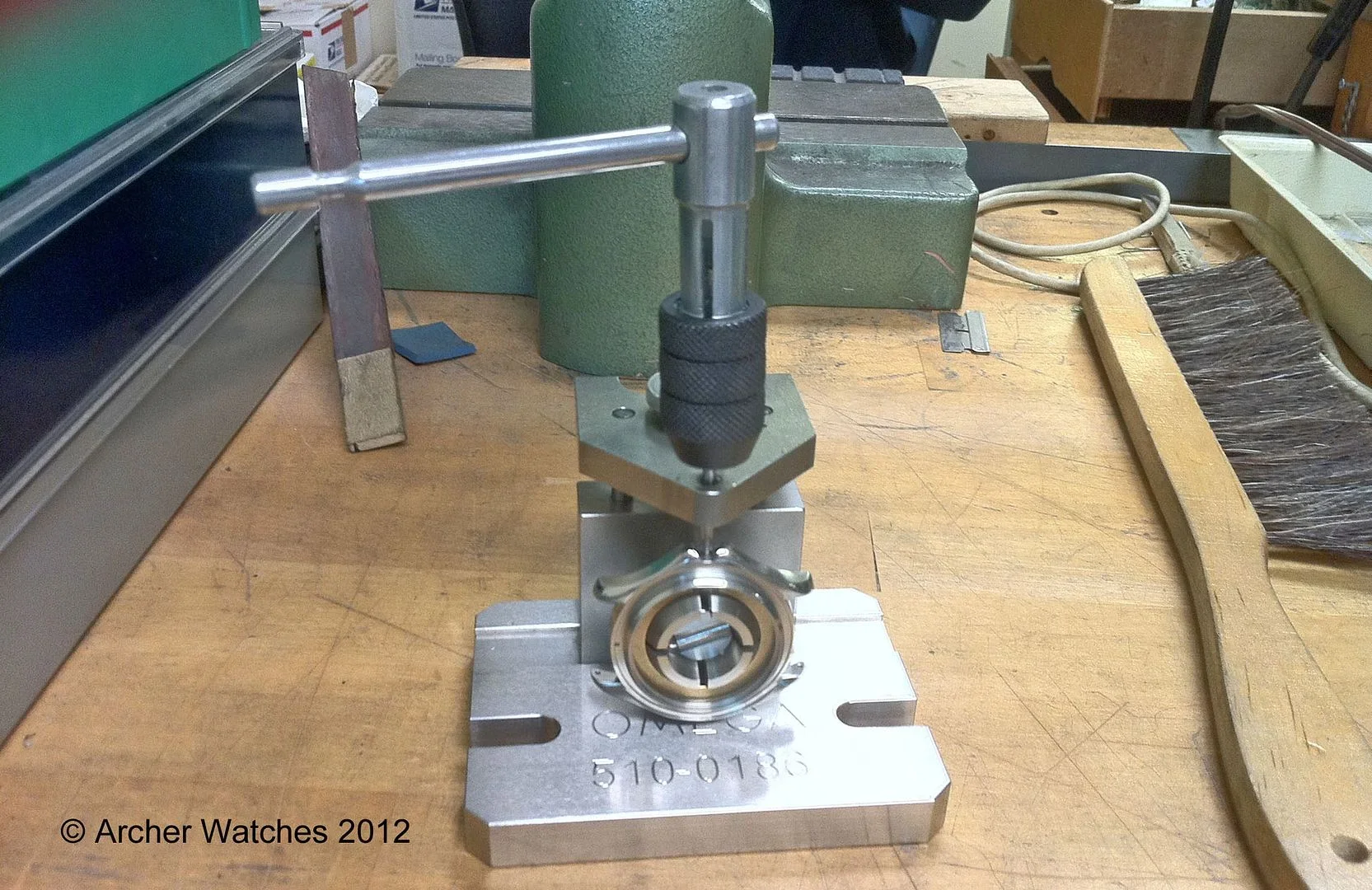
Once drilled, the case has to be tapped - cutting the threads. This is done in two stages first with a tap that partially cuts the threads, then a second tap that finishes the threads. Here is the case being tapped:


Once done the new case tube is screwed in place. Not my jig - I took these photos at Omega when I was there for training. I finished the 5 days of training in 4.5 days so I had Friday afternoon to do what I wanted, and I chose to spend it in the case department where I tried this process. The jig kit is very expensive so I never bought one, but I wanted to go through the process at least.

On the very rare occasion when I run into a soldered tube that needs replacing, I sent the case frame to Omega and they do the swap for $30, so I'm not about to spend $5K on the kit as it would never pay for itself.

This is only needed for soldered tubes, so not for press fitted tubes.
 
Posts
7,392
Likes
23,861
That said, I still like to give the crown a little counter clockwise turn until I feel it engage the thread so as not to risk accidentally cross threading it.

You literally read my mind. This was my next question: of those of you who have screw down crowns, how many use the counter-clockwise technique before screwing the crown down? And, mechanically, does this make the most sense, and potentially limit wear and cross-threading? If you spin the crown clockwise first, aren’t you causing mechanical friction to the same thread surface as when you go counter-clockwise?
 
Posts
7,392
Likes
23,861
I don't find it's necessary on most watches.
This is what our brilliant ai friends have to say. To me, it makes no sense at all, but maybe I’m missing something:

Clockwise immediately:

  • The crown may be slightly misaligned.
  • The first thread can catch against the wrong part of the mating thread.
  • Applying additional pressure can cause cross-threading.
  • You may create localized wear or damage.

Counter-clockwise first:

  • The threads aren't being forced into engagement.
  • The crown can rotate until the thread starts naturally align.
  • You feel the slight drop when the thread starts register.
  • Reversing direction allows the threads to engage correctly.