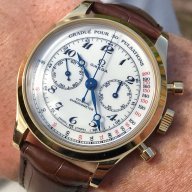
321 SS delivery!

Posts
733
Likes
1,457
Nice, congrats. That is some next level "Big Boy" wrist game right there 😲
 
Posts
622
Likes
2,847
Lovely duo indeed. Congratulations.

On the plat, are the sub dials meteorite ?
 
Posts
2,667
Likes
2,980
Lovely duo indeed. Congratulations.

On the plat, are the sub dials meteorite ?
Yes they are meteorite
 
Posts
29,916
Likes
77,361
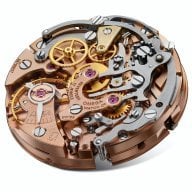
@Archer, can you comment on, from a watchmaking perspective, how big (or not) of an issue it is if the regulator arrow is pointed mostly or completely toward full A or full R? One difference to the new 321 Speedmasters from the classic premoon Speedmasters is the transparent caseback. But when the 321s shipped in the 1960s, for all we know, half could have been full A, the other half full R, and would any buyer then or any of us here today have known, and would it have mattered?

And, other than the regulator, how else can watches be adjusted at the factory or during service by a watchmaker? For example, if you got a 321 in for service that was off by say, five minutes per day after you’ve reassembled it but otherwise is well oiled, and your careful inspection during service showed no wear or damage to bushings, jewels, gears, pivots, etc, how would you adjust the watch to get it back into spec?

Does it make a difference in a practical sense? Not the amount I see in these watches. But given the entire marketing fabrication that Omega has wrapped this watch in, taking of special scans (BS), special teams of watchmakers (more BS), the fact that they seem unable to center the regulator seems particularly sloppy.

I would half expect them to say that because the original watch they "scanned" didn't have a centered regulator, they are being faithful to it by not centering these...🙄

Every watchmaker who is formally trained will tell you that it is the way things are done - you make an effort to leave the regulator centered when the service is done, in order to give the biggest range in each direction for any subsequent corrections. But it is also a point of pride in doing a good job, and why most of the time on a more modern watch with a fine regulator, I never use it. There are times when this is very difficult to do, due to the condition of the movement or hack work done by a previous watchmaker. But on a brand new movement, this should be simple and straightforward to do, in particular with the "special team" that is assigned to these based on everything we hear...

As for how you do this, it's an adjustable mass balance, so you adjust the mass. You add or remove as needed to get to the center.

Cheers, Al
 
Posts
2,667
Likes
2,980
But on a brand new movement, this should be simple and straightforward to do, in particular with the "special team" that is assigned to these based on everything we hear...

As for how you do this, it's an adjustable mass balance, so you adjust the mass. You add or remove as needed to get to the center.

Cheers, Al
So on a brand new movement, would this be like a 5 minute thing to do then before the movement is cased up?
 
Posts
29,916
Likes
77,361
So on a brand new movement, would this be like a 5 minute thing to do then before the movement is cased up?

All of the regulators in this thread have been to the slow side - this means the movement was running fast, and had to be slowed down to be close to running at zero. All it would take to resolve this is to add two timing washers of the appropriate weight to screws opposite each other on the balance. This would slow the watch down, allowing you to push the regulator closer to the middle. If you had a good selection of washers, then it would not take long at all.

For a watch that is running slow, and has had the regulator pushed to the fast side, there you have to remove weight. This is more involved, so more than 5 minutes, but this isn't something that takes hours or anything.

Considering what they are asking for these, it's something I would expect to be done, put it that way.
 
Posts
433
Likes
382
Thanks for sharing your insight and knowledge, Al!!
 
Posts
36
Likes
66
This watch looks fantastic. I don’t normally do that “grail watch” thing but I think this could be mine
 
Posts
261
Likes
179
All of the regulators in this thread have been to the slow side - this means the movement was running fast, and had to be slowed down to be close to running at zero. All it would take to resolve this is to add two timing washers of the appropriate weight to screws opposite each other on the balance. This would slow the watch down, allowing you to push the regulator closer to the middle. If you had a good selection of washers, then it would not take long at all.

For a watch that is running slow, and has had the regulator pushed to the fast side, there you have to remove weight. This is more involved, so more than 5 minutes, but this isn't something that takes hours or anything.
Hey Archer, how do you reconcile the difference in accuracy between a full wind and power reserves of 50% - 25%? I would imagine they would have very different regulation needs?
 
Posts
29,916
Likes
77,361
Hey Archer, how do you reconcile the difference in accuracy between a full wind and power reserves of 50% - 25%? I would imagine they would have very different regulation needs?

There are tolerances for this, but you try to make the movement as isochronous as possible.
 
Posts
261
Likes
179
Hmm, is it a function of the spring? I would imagine that would be the main source of discrepancies?
 
Posts
29,916
Likes
77,361
Lots of factors...not something I can explain in a few sentences...