2 New Essential Tools Coming This Month..........

Posts
5,753
Likes
2,939
I found out collecting watches is not easy task as I expected........
A lot of homework, practicing eyes on those small fonts , discussions in forum and whatsapp, sleepless night waiting for those ebay ending time,....not mentioning significant dent in wallet.

That's why supporting tools are critical.........and I welcome two of my new helper in this quest ..........coming this month

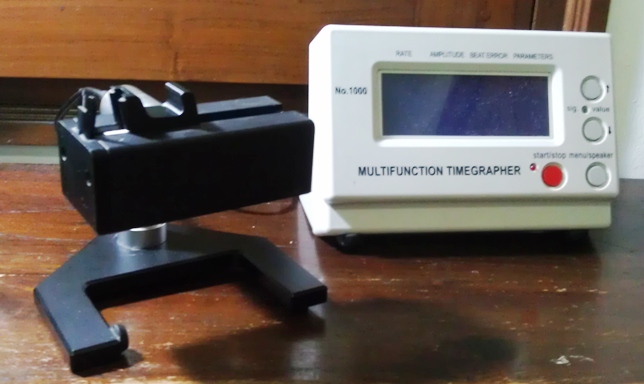
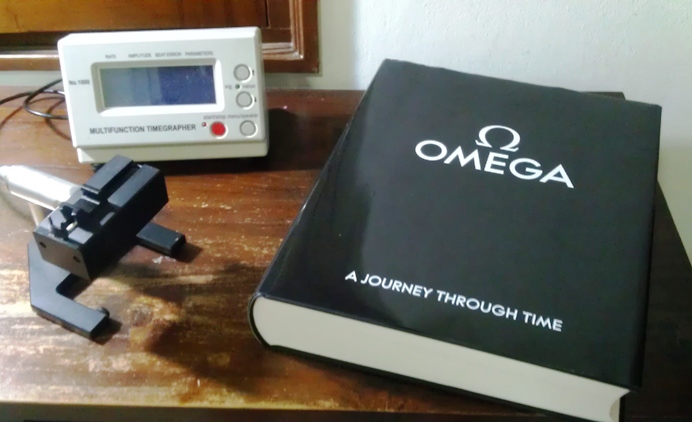
AJTT and a timegrapher


AJTT does not need anymore introduction:


Timegrapher is new to me. My watchmaker advised me to buy one for detecting whether a watch need to be serviced/ repaired. I am lucky to find a nice used one from my fellow local collector who does not need it anymore.


Well, I have new toys to tinker for coming months......馃榾
 
Posts
34,271
Likes
38,891
I found out collecting watches is not easy task as I expected........
A lot of homework, practicing eyes on those small fonts , discussions in forum and whatsapp, sleepless night waiting for those ebay ending time,....not mentioning significant dent in wallet.

That's why supporting tools are critical.........and I welcome two of my new helper in this quest ..........coming this month

AJTT and a timegrapher

12639

AJTT does not need anymore introduction:
12640

Timegrapher is new to me. My watchmaker advised me to buy one for detecting whether a watch need to be serviced/ repaired. I am lucky to find a nice used one from my fellow local collector who does not need it anymore.
12641

Well, I have new toys to tinker for coming months......馃榾

Nice, how much did the timegrapher set you back used?
 
Posts
5,753
Likes
2,939
Nice, how much did the timegrapher set you back used?

I bought for USD 130 used. One of my collector friend has 'retired' because he felt he already got his ultimate grail. I knew he had this timegrapher, contact him and he is willing to let go.

This model is the base bottom model. You can find new in china websites for USD 175 + shipping (I think it is for whole sale) or around USD 250 + shipping in US Ebay.
 
Posts
2,378
Likes
3,105
I found out collecting watches is not easy task as I expected........
A lot of homework, practicing eyes on those small fonts , discussions in forum and whatsapp, sleepless night waiting for those ebay ending time,....not mentioning significant dent in wallet.

That's why supporting tools are critical.........and I welcome two of my new helper in this quest ..........coming this month

AJTT and a timegrapher

12639

AJTT does not need anymore introduction:
12640

Timegrapher is new to me. My watchmaker advised me to buy one for detecting whether a watch need to be serviced/ repaired. I am lucky to find a nice used one from my fellow local collector who does not need it anymore.
12641

Well, I have new toys to tinker for coming months......馃榾
Nice! Following this thread 馃榾
 
Posts
5,753
Likes
2,939
After tinkering with my timegrapher, now I have questions bugging me.

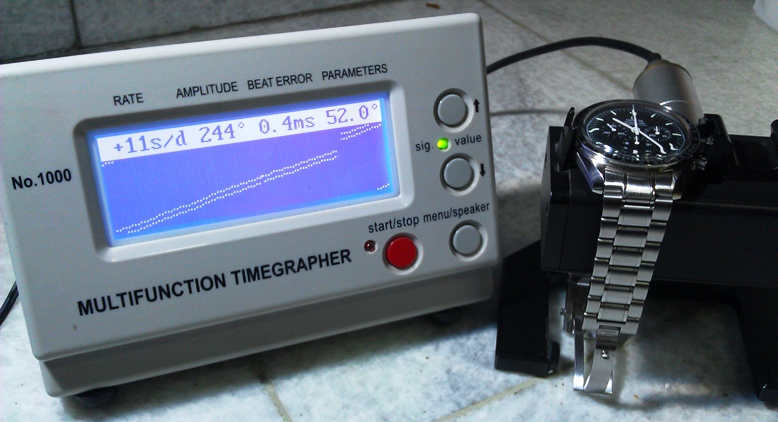
Only 2 of my watches that have COSC limit (below 4 s/day variation) one is my Speedy moonwatch (-2 s/day) and the other one is my 70 C case Constellation (-3s/day)
The other have variation from +11s/day up to -350s/day!!!! Now I need to separate what is acceptable deviation for vintage (below 1980), young timer (1980-2000) and modern (2000 up). So what is considerable normal/ acceptable?
Say for a non chronometer 1950's caliber 5XX, is 30s/day variation acceptable?

What other factor like beat error acceptable limit? 0.5ms? 1.0 ms?

What problem can be detected by this indicators (rate, beat error, amplitude etc)? Oil dry up/ become dirt ? Parts wear down?

Probably our watchmaker expert Archer, Steve and other could enlighten us, the amateurs..........

Thanks
 
Posts
29,674
Likes
76,835
Owning one of these as a collector is like using a 15X loupe to look at your newly purchased watch - you will see things that give you more stress when you should be enjoying your watch....

It would take a long time to explain the proper use of a timing machine. How to use it to diagnose faults is a skill that can take years to perfect, so not something I can teach you in a forum post really.

If you watch the video posted it will show you a bit about how to use the machine, but one key thing with these cheap machines he mentions in passing when timing the Seagull. At one point he said the variation in rate is because he is talking, and the machine is picking it up. These cheap Chinese machines are terrible for picking up sounds from the room, so when taking measurements with them, you really need to have the room very quiet. Professional machines don't have this issue.

Every movement has characteristics that you will need to know to determine if the movement is running to factory specifications. Tolerances for amplitude, beat error, average rates, and positional variation are specified by the factory, and vary from one movement to another in many cases. You will also need to know the lift angle for the movements you are checking in order to determine the correct balance amplitude.

Now above you talk about "variation" on several watches, but what does that mean? Is that one measurement taken in one position, or a variation across a series of measurements? What positions were checked? What was the state of wind on the watch when the checks were done? Measuring the rate in one position is not really a very useful check unless the watch is obviously running very poorly.

I am certainly willing to help, but I can't "tell you everything" in one post, so if you want to answer some of the questions I have posted, we can try to narrow things down a bit. Maybe try starting with one watch, and we can take it from there. The Speedmaster would be a good place, so let me know what movement is in your watch, and I can post some timing specifications for you.

Cheers, Al
 
Posts
5,753
Likes
2,939
Thanks Al,
Very good points. I wouldn't dream to be able become expert instantly. Just a basic understanding on how to utilize this tool for early warning and screening newly bought vintage/ pre-owned watch.
As your suggestion I'll record 3 watches in 3 position (0, 90 and 180 degree) with 30 times crown winding. Is it OK?

Thanks
HP
 
Posts
6,712
Likes
18,581
HP,

May I suggest for simplicity's sake that you start with one watch as Al suggests and let Al walk you though it? I'm speaking purely from my own self interest, as I am following the thread closely for my own "eddication."
 
Posts
29,674
Likes
76,835
Thanks Al,
Very good points. I wouldn't dream to be able become expert instantly. Just a basic understanding on how to utilize this tool for early warning and screening newly bought vintage/ pre-owned watch.
As your suggestion I'll record 3 watches in 3 position (0, 90 and 180 degree) with 30 times crown winding. Is it OK?

Thanks
HP

Please pick one watch, and let me know what the movement is inside - we need to have a starting point so I can tell you what positions to check, what the lift angle is, etc.

Al
 
Posts
29,674
Likes
76,835
OK,
One watch, speedmaster moonwatch.

HP

HP - if you want my help, please read my questions carefully and answer them. I don't really have a lot of time to chase you for answers. Please provide the calibre of the movement in your watch.

Al
 
Posts
5,753
Likes
2,939
HP - if you want my help, please read my questions carefully and answer them. I don't really have a lot of time to chase you for answers. Please provide the calibre of the movement in your watch.

Al
Sorry Al, I 've just come home from work so it's my trip time when you ask question, no intention to delay answer.
 
Posts
29,674
Likes
76,835
Sorry Al, I 've just come home from work so it's my trip time when you ask question, no intention to delay answer.


It's okay, but you have to understand that there are differences in movements - if this was a Cal. 1864 we would be looking at very different requirements than with an 1861.

So with the Cal. 1861, this is a non-chronometer movement, so as with any Omega non-chronometer movement, the timing checks are done in 3 poistions only for Omega specs (note that for every watch I service, I always check 6 positions at full wind regardless of the movement, but that's just me being picky). When looking at the requirements from Omega, the reference is Work Instruction 28, so these numbers come from that document.

So this watch beats at 21,600 vph, the lift angle is 50 degrees, the maximum allowed beat error is 0.6 ms. Note that setting the lift angle correctly is quite important, as the balance amplitiude is a calculated value using the lift angle. Rule of thumb is that for every 1 degree error in lift angle, there is a 6 degree error in balance amplitude readings. Most machines default to 52 degrees as this is what Rolex uses, but Omegas can vary quite a lot from that - some as low as 36 degrees, and some as high as 54 degrees.

The three positions you check for this movement are CH (dial up), 9H (crown down), and 6H (crown left). The first check I do after service is to test the minimum balance amplitude, and this is done at full wind -24 hours. So since you are not able to let the mainspring down, you would need to fully wind the watch, let it run for 24 hours, and then put it on the timing machine. Check it in the three positions above, and the balance amplitude should not be below 190 degrees in any of those three positions. Note that due to frictional losses, the lowest amplitude should always be in a vertical position, so either the crown down or crown left positions.

So for each position, note down the balance amplitude, average rate, and beat error. So when you are done, you would have 3 readings like this:

Dial up - 220 degrees, +5 s/d, 0.3 ms
Crown down - 190 degrees, +1 s/d, 0.2 ms
Crown left - 195 degrees, +6 s/d, 0.3 ms

Note that your numbers may be significantly different from these, and these are just examples.

So how to perform these checks - place the watch on the microphone stand, and Omega states the stabilization time for this movement at 30 seconds, and the measurement time at 20 seconds. This means after you place the watch on the stand, or move the watch from one position to another, you need to leave it for at least 30 seconds to stabilize the readings. I typically use 1 minute for this to be safe. Then you need to take the measurements over a period of 20 seconds, and again I usually use a minute to be safe. So place the watch on the machine dial up to start, let it sit for at least 30 seconds, and when that time is up, start counting off 20 seconds. At the end of 20 seconds look at all the numbers and write them down. Switch to the next position, and then repeat, making sure to let the watch stabilize after each change of position. Please post your results here in this thread.

When you have completed this check, we can move on to the next series of checks. In the context of a service, if the watch fails to meet this minmum balance amplitude specification, it would have to be disassembled and repaired so it did meet this, or there is not much point in moving on.

A quick word on balance amplitude, and how most timing machines measure it. As most of you likely know, the balance amplitude is the measure of how far the balance wheel swings. What many people (even some watchmakers) don't fully undestand is how the machine displays this information. As noted this is a calculated value using sounds from the escapement and the lift angle. The bit that eludes most people is that the number displayed on the machine is actually an average. The balance wheels swings in one direction, then reverses and swings in the other direction, and the number displayed is an average of those two readings. So for example the wheel may swing say 270 degrees in one direction, then 280 the other, and the machine will display an average of 275. It's important to understand this when we talk about maximum balance amplitudes later on.

Cheers, Al

 
Posts
5,753
Likes
2,939
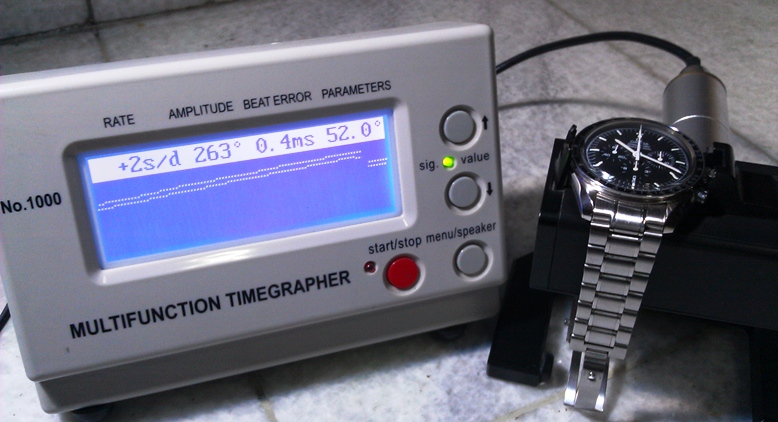
Al, while waiting for your further instruction, I did this test:

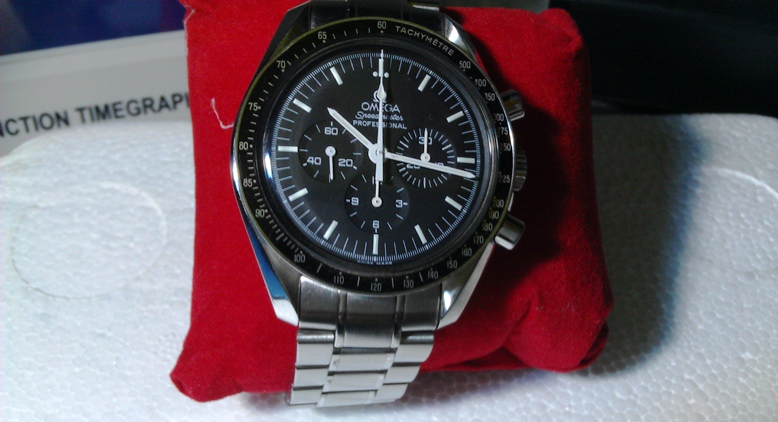
Object: 2001 Speedmaster moonwatch caliber 1861. I wound it 50 times which is around 50% of full power reserve.


The test conducted with the default lift angle of 52 degree. The room condition is quiet.

First position is horizontal with the dial face up. This is the result:


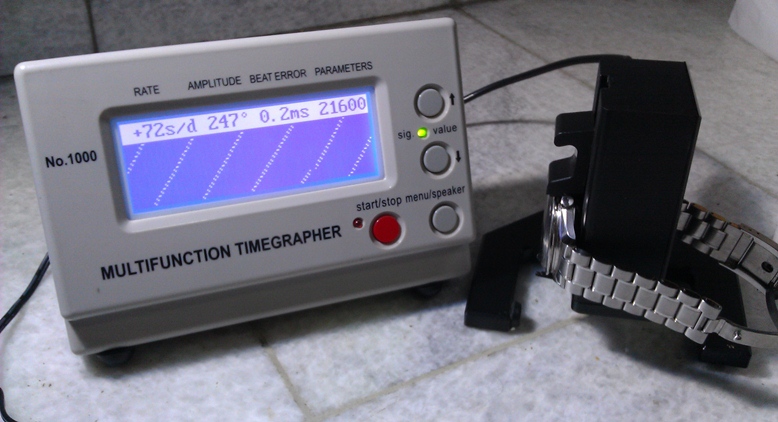
The second position is vertical, with this result:


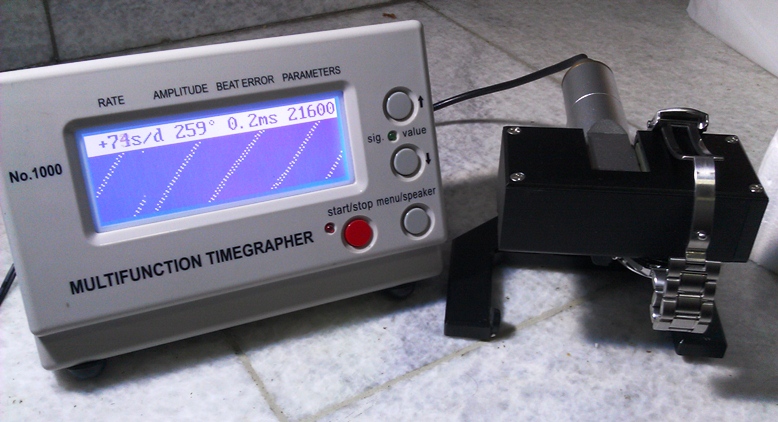
and third position is horizontal with the dial face down. This is the result:


Last, I tested back at horizontal dial face up position. Interestingly now the result is different than the first test position:


Hope this is sufficient for first session. If you want test with different condition (e.g lift angle or position) I will repeat it again.

Many thanks.

HP
 
Posts
5,753
Likes
2,939
It's okay, but you have to understand that there are differences in movements - if this was a Cal. 1864 we would be looking at very different requirements than with an 1861.

So with the Cal. 1861, this is a non-chronometer movement, so as with any Omega non-chronometer movement, the timing checks are done in 3 poistions only for Omega specs (note that for every watch I service, I always check 6 positions at full wind regardless of the movement, but that's just me being picky). When looking at the requirements from Omega, the reference is Work Instruction 28, so these numbers come from that document.

So this watch beats at 21,600 vph, the lift angle is 50 degrees, the maximum allowed beat error is 0.6 ms. Note that setting the lift angle correctly is quite important, as the balance amplitiude is a calculated value using the lift angle. Rule of thumb is that for every 1 degree error in lift angle, there is a 6 degree error in balance amplitude readings. Most machines default to 52 degrees as this is what Rolex uses, but Omegas can vary quite a lot from that - some as low as 36 degrees, and some as high as 54 degrees.

The three positions you check for this movement are CH (dial up), 9H (crown down), and 6H (crown left). The first check I do after service is to test the minimum balance amplitude, and this is done at full wind -24 hours. So since you are not able to let the mainspring down, you would need to fully wind the watch, let it run for 24 hours, and then put it on the timing machine. Check it in the three positions above, and the balance amplitude should not be below 190 degrees in any of those three positions. Note that due to frictional losses, the lowest amplitude should always be in a vertical position, so either the crown down or crown left positions.

So for each position, note down the balance amplitude, average rate, and beat error. So when you are done, you would have 3 readings like this:

Dial up - 220 degrees, +5 s/d, 0.3 ms
Crown down - 190 degrees, +1 s/d, 0.2 ms
Crown left - 195 degrees, +6 s/d, 0.3 ms

Note that your numbers may be significantly different from these, and these are just examples.

So how to perform these checks - place the watch on the microphone stand, and Omega states the stabilization time for this movement at 30 seconds, and the measurement time at 20 seconds. This means after you place the watch on the stand, or move the watch from one position to another, you need to leave it for at least 30 seconds to stabilize the readings. I typically use 1 minute for this to be safe. Then you need to take the measurements over a period of 20 seconds, and again I usually use a minute to be safe. So place the watch on the machine dial up to start, let it sit for at least 30 seconds, and when that time is up, start counting off 20 seconds. At the end of 20 seconds look at all the numbers and write them down. Switch to the next position, and then repeat, making sure to let the watch stabilize after each change of position. Please post your results here in this thread.

When you have completed this check, we can move on to the next series of checks. In the context of a service, if the watch fails to meet this minmum balance amplitude specification, it would have to be disassembled and repaired so it did meet this, or there is not much point in moving on.

A quick word on balance amplitude, and how most timing machines measure it. As most of you likely know, the balance amplitude is the measure of how far the balance wheel swings. What many people (even some watchmakers) don't fully undestand is how the machine displays this information. As noted this is a calculated value using sounds from the escapement and the lift angle. The bit that eludes most people is that the number displayed on the machine is actually an average. The balance wheels swings in one direction, then reverses and swings in the other direction, and the number displayed is an average of those two readings. So for example the wheel may swing say 270 degrees in one direction, then 280 the other, and the machine will display an average of 275. It's important to understand this when we talk about maximum balance amplitudes later on.

Cheers, Al
OK, now my tests above does not use correct procedure. I'll wound my watch full now and conduct the test tomorrow after 24 hour using 50 degree lift angle and the method you describe above.

Many thanks Al.
 
Posts
29,674
Likes
76,835
No, not really. I've just given you instructions on how to perform the test. When you have completed them and posted the results I will comment further. Again I'm going to ask that you read my posts carefully, and follow my instructions or we are not going to get very far mate.

Cheers, Al

edit - looks like we were typing at the same time - I know you are anxious to learn all this, but one thing you need for watchmaking is patience. Thanks for doing the test again.

Al