The very low serial made me think of 'outliers' and my statistics classes, long (maybe too long...) ago. Bear with me for a moment.
Let's assume, for fun, that the production of different calibers happens at a single production line and is spread out over the production process according to some simple rule: "first we make nine 861's, then one 1040, then nine 861s again" and so on, repeating the same sequence over and over. Also assume all movements receive a serial number at the end of said hypothetical production line.
Now let's say those serial numbers range from 0,000,001 to 1,000,000. If we take a large enough sample of 1040 calibers, we would find that the smallest difference in serial numbers is 10 (e.g. 2 watches with serial numbers 300,920 and 300,930). Assuming the above is true, we would know that 100,000 1040s were produced (total serial numbers divided by smallest difference).
Of course, the above isn't true. Let's take a second case, where the production of different calibers is spread out over the production process completely randomly (but are still assigned consecutive serial numbers based on moment of completion). This could look like two production lines (one for 861s and one for 1040s): whenever any movement is completed, it is added to a third 'serial number etching' line.
Assuming the same zero-to-million serial range, we could now start randomly sampling 1040 calibers from the population and noting the serial numbers. Given that the 1040s are randomly distributed over the population, the differences between consecutive serial numbers in our sample would follow, I think, a normal distribution. In fact, if we noted the serial numbers of ALL of the 1040s, calculated the difference between consecutive ones, and plotted the occurence of all the values, we would see a bell curve around the average difference, the area under which equals the total number of 1040s produced.
But it seems to me that to construct this curve, you don't need to sample all the 1040s. You would just need a large enough sample to see the outline of such a curve ("connecting the dots"). The area under such a curve could be recalculated into an estimate of the total number of 1040s produced, given that we have some idea of what the serial number range for 1040 calibers is (i.e. the total number of Omega watches produced during the 1040 production timeframe).
I wonder if that's correct, and if
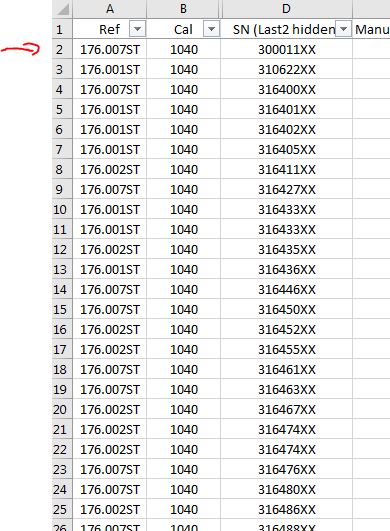
@Andy K 's sample is large enough to do something like that.
Of course, it only works if serial numbers are indeed assigned randomly. In fact, I don't know how the watches recieve serial numbers at all - if it's in batches ("we make two hundred 1040 movements, give them consecutive serial numbers, and then we make 600 861s and do the same") then probably none of what I say here makes sense.