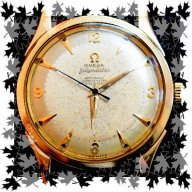
176.007 & cal. 1040 Production Totals and the Speedmaster 125 Conspiracy Theory

Posts
3,184
Likes
3,855
There's so much in this thread that reminds me why the forum can be such a great place 👍😁
 
Posts
872
Likes
9,890
Thank you very much for the comprehensive analysis! Great work and extremely commendable effort!

My 125 cal. 1041 has the serial in the 382373XX range.

I am somewhat familiar with sampling and data analysis (although not a statistician, just involved in medical research); your conclusions seem valid from where I'm standing.
However, for the sake of argument alone, I would like to bring into discussion a few elements:

1) - Occurrence of sales vs number of units - what we're actually dealing with here is, in my view, the rate of occurrence of an event - in our case, a watch being sold.
Most watches come from people who don't wear them, then sell to dealers/shops that post them on the Internet, or try and sell them directly. If for either aesthetic reason or financial gain this watch "gets the short straw" more often when a selling decision is made, then it will be found much more often on the open market.

2) Possible sampling errors - your study includes watches from international forums; however, many countries have dedicated selling services on and off the Internet, on which watches are sold and bought in large numbers. It may be possible that other case numbers get sold/traded internally and therefore never make it to your list, hence skewing the results in favor of the more collectible Speedmaster 125.

These are, again, possible biases and are in no way meant to discredit your work; they are more or less the equivalent of "possible limitations of the study", part of the Discussion section of medical papers that peer reviewers tend to ask for the most 😀
Edited:
 
Posts
1,854
Likes
5,412
Thank you very much for the comprehensive analysis! Great work and extremely commendable effort!

My 125 cal. 1041 has the serial in the 332373XX range.

I am somewhat familiar with sampling and data analysis (although not a statistician, just involved in medical research); your conclusions seem valid from where I'm standing.
However, for the sake of argument alone, I would like to bring into discussion a few elements:

1) - Occurrence of sales vs number of units - what we're actually dealing with here is, in my view, the rate of occurrence of an event - in our case, a watch being sold.
Most watches come from people who don't wear them, then sell to dealers/shops that post them on the Internet, or try and sell them directly. If for either aesthetic reason or financial gain this watch "gets the short straw" more often when a selling decision is made, then it will be found much more often on the open market.

2) Possible sampling errors - your study includes watches from international forums; however, many countries have dedicated selling services on and off the Internet, on which watches are sold and bought in large numbers. It may be possible that other case numbers get sold/traded internally and therefore never make it to your list, hence skewing the results in favor of the more collectible Speedmaster 125.

These are, again, possible biases and are in no way meant to discredit your work; they are more or less the equivalent of "possible limitations of the study", part of the Discussion section of medical papers that peer reviewers tend to ask for the most 😀

The serial number you are giving is impossible according to the laws of statistics
 
Posts
1,854
Likes
5,412
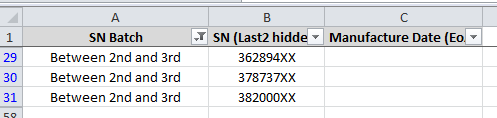
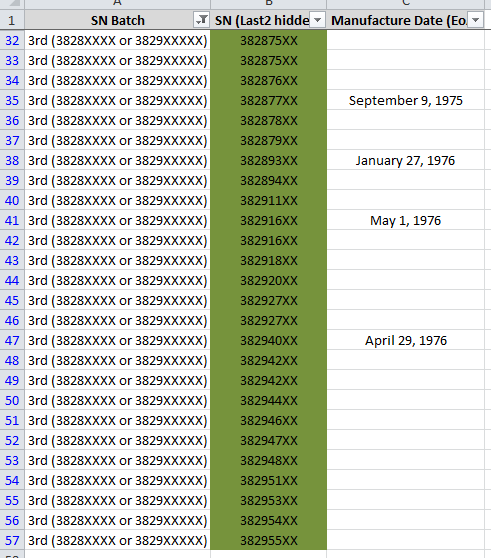
I think there were three tight batches and some produced in between:

Batch 1 includes serials 3507XXX. Here shown with dates from EoA when available:
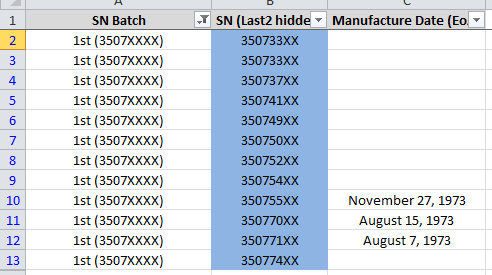
This batch is from 73. Mine is that 8/7/73 one, and it does not have an alphanumeric code on the caseback. So maybe by then the first 2,000 had been alotted? Or maybe it was polished out or replaced along the way. Is there an upper limit to the serials you've observed with the caseback number? That would be interesting to know.

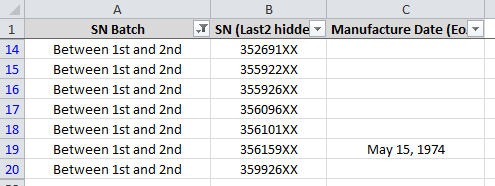
Then there's this looser grouping higher in the 35 million range, only one known production date in mid 1974:


Batch 2 - the 3625 and 3626XXXX - through early 1975:
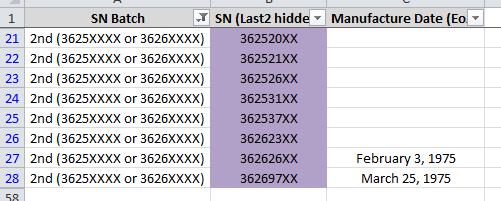

Another loose grouping. This one includes the ONLY 37 million SN I've seen on either cal. 1040 or 1041. (I didn't see the actual movement- it is from a 2007 Antiquorum listing so it could be a typo): [EDIT- I have since been made aware of another 37million SN - on a cal. 1040]


Batch 3 is the biggest, including 3828 and 3829XXXX. This batch is very late in the game, including late 75 and through mid 76. The Swiss watch crisis was fully going on, so it is understandable that Omega was a) phasing out the higher cost 1040 in favor of the 1045 and b) producing whatever buyers wanted to maintain revenue.

I'm totally with you - it is REALLY suspect that they would make exactly 2,000 pieces, and not one spare. 👍

I have only seen 35 million serial 125 bearing the marking, but not many and I can't explain what happened to the others or didn't happen. But out of 2.000 original units how many should still exist according to statistics?
 
Posts
872
Likes
9,890
Corrected, it was 38*****. In my defense, I've wrote that post at 3AM
 
Posts
1,819
Likes
5,923
1) - Occurrence of sales vs number of units - what we're actually dealing with here is, in my view, the rate of occurrence of an event - in our case, a watch being sold.
Most watches come from people who don't wear them, then sell to dealers/shops that post them on the Internet, or try and sell them directly. If for either aesthetic reason or financial gain this watch "gets the short straw" more often when a selling decision is made, then it will be found much more often on the open market.
Agreed, we have to take a few leaps to accept sales (mostly sales, some people just show off or share their movements online but I admit that's very few of my samples) as a proxy for production. But I think we do it all the time. Rolex Subs are seen commonly for sale because they are made by the boatload every year. They are more common than say a Habring2. But we don't make the assumption that people sell their Sub because it's design lends it to "quick flipping", which is the traditional assumption made about the 125. Rather, we just assume that numbers seen online and/or for sale reflect the overall production and popularity of that watch.

You say the "short straw" watch is found "Much more often" on the open market. I'm open to that, but how do you define "much more often"? 2x, 3x, 5x more often? Maybe. But almost 10x more often doesn't seem likely. Both from a math standpoint (again, I find factors of exactly ten almost always are typos and are rarely coincidence) and from just an aesthetic standpoint. I'm biased for sure, but I don't think the 125 is 10x less attractive or wearable than similar cal. 1040s. I think people have similar reactions to the 176.002 Mark III.


2) Possible sampling errors - your study includes watches from international forums; however, many countries have dedicated selling services on and off the Internet, on which watches are sold and bought in large numbers. It may be possible that other case numbers get sold/traded internally and therefore never make it to your list, hence skewing the results in favor of the more collectible Speedmaster 125.

This is a definite possibility. One market I think about often is Iran, a known country where Omega was historically popular but doesn't have a big western web presence. And there could be several other countries. I just imagine there being pockets of the world that are lousy with 176.001s and gold plated 176.010s that we are unaware of.

Both great points! I enjoy the discussion. 👍

But out of 2.000 original units how many should still exist according to statistics?
Great question! I have no idea. I remember a thread about 2998 and 2915 Speedmasters where people speculated on how many have been tossed out, destroyed beyond repair, and simply no longer exist. I think that might be more like the German Tank Problem @TNTwatch mentioned.

But it reminds me there's another way to frame this question. If we believe Richon/AJTT's figure of 82,200 for cal. 1040 AND we believe that cal. 1040 is a decent comparable for 1041, how many out of 2,000 cal. 1041s should I have observed in the same observation period? The answer is about 5 or 6.

It's just crazy to me. The 125 is nearly as common on the market as the 176.007 in steel. If it had cal. 1040, it would easily be the second most common reference in the family.
Corrected, it was 38*****. In my defense, I've wrote that post at 3AM

Thanks! 33 million would have been quite an anomaly! 😀
 
Posts
1,819
Likes
5,923
There's so much in this thread that reminds me why the forum can be such a great place 👍😁
I appreciate hearing that.. Thank you!😀
 
Posts
924
Likes
1,778
I work with data all the time

It shows 👍

Excellent work on my favorite calibre once again, and very clear write up. While not conclusive (as you yourself state several times) it certainly has plausibility going for it. It convinced me that something is going on, at least. I am equally suspicious of factor 10 'coincidences'. The following remark is not to discredit anything you said but rather as possibility to strengthen it further.

Your assessment that the 2,000 number must be incorrect, rests strongly on 232 being a ‘reasonable’ (or even 'typical') amount of observations of a population of 82,200 over a 6 month period using your method. Although intuitively it indeed feels more reasonable than observing 2.75% of all 125’s over the same period, we really don’t know one way or another. One (rather laborious) solution would be to do the same for other watches. Ideally, we would need a watch produced in the same time period, and one of which a production run is solidly documented.

Although I have little knowledge of the Moonwatch, it does come to mind as an option. It seems to be the best-document Omega watch in existence, and is certainly comparable to the 1040/1’s in terms of (contemporary) price, style etc. Does ‘Moonwatch Only’ not list production runs for specific references (the 145.022-74 for example)?

The enormous popularity of this watch might actually help in establishing an ‘upper bound’ for your observations. With the recent (and current) value increases, I would say that the incentive to buy and sell a vintage Moonwatch has never been higher, so we might expect a relatively large share of the population to appear on the market. If, in a six-month period, one would observe, say, 1% of the population, then I would say there’s no way the 2.75% for the 125 could be accurate. If you would find a percentage that’s closer to the 0.282% number, why, that would be fantastic 😉
 
Posts
924
Likes
1,778
Oh, and I just checked the earliest of my 007s: it has a serial number of 3164XXXX. PM sent!

[EDIT] and now the second one, also 3164XXXX.
Edited:
 
Posts
1,060
Likes
1,631
Here are some 176.004 serial numbers that were readable on ebay pictures (and others): 34243323 35605868 34254198 36259132 35598835 35603818 35603812 34681912 35606874 34254045 35605351
I've a 176.007 from 13/8/1973 34251986
And I've an interesting 176.004 with a 38287671 cal 1041 !!

I noticed that many Seamaster dive watches got their movement swapped during service (30%). That was a common practice in Switzerland where "Gameo" was servicing Omega watches. I was told that they had a stock of serviced movements ready to fit any incoming watches with same movement, but not always: I even got a 166.091 with a 1001 instead of a 1002 and that 176.004 with a 1041 fitted instead of a 1040.
I hope it helps.
 
Posts
1,819
Likes
5,923
It shows 👍

Excellent work on my favorite calibre once again, and very clear write up. While not conclusive (as you yourself state several times) it certainly has plausibility going for it. It convinced me that something is going on, at least. I am equally suspicious of factor 10 'coincidences'. The following remark is not to discredit anything you said but rather as possibility to strengthen it further.

Your assessment that the 2,000 number must be incorrect, rests strongly on 232 being a ‘reasonable’ (or even 'typical') amount of observations of a population of 82,200 over a 6 month period using your method. Although intuitively it indeed feels more reasonable than observing 2.75% of all 125’s over the same period, we really don’t know one way or another. One (rather laborious) solution would be to do the same for other watches. Ideally, we would need a watch produced in the same time period, and one of which a production run is solidly documented.

Although I have little knowledge of the Moonwatch, it does come to mind as an option. It seems to be the best-document Omega watch in existence, and is certainly comparable to the 1040/1’s in terms of (contemporary) price, style etc. Does ‘Moonwatch Only’ not list production runs for specific references (the 145.022-74 for example)?

The enormous popularity of this watch might actually help in establishing an ‘upper bound’ for your observations. With the recent (and current) value increases, I would say that the incentive to buy and sell a vintage Moonwatch has never been higher, so we might expect a relatively large share of the population to appear on the market. If, in a six-month period, one would observe, say, 1% of the population, then I would say there’s no way the 2.75% for the 125 could be accurate. If you would find a percentage that’s closer to the 0.282% number, why, that would be fantastic 😉

Thanks for the kind words. My conclusions also rely heavily on trusting that 82,200 is correct, although that number comes from from the same source (Richon/AJTT) as the 2,000. So even a mediocre defense attorney would tear my evidence to shreds! 😉 The numbers just seem to make more sense when trusting 82,200 and not 2,000 or both.

Back to your point about the moonwatch, that's a great idea as a test of what's observable. Now I just have to decide if I have the energy to undertake that project...😲
 
Posts
1,819
Likes
5,923
Here are some 176.004 serial numbers that were readable on ebay pictures (and others): 34243323 35605868 34254198 36259132 35598835 35603818 35603812 34681912 35606874 34254045 35605351
I've a 176.007 from 13/8/1973 34251986
And I've an interesting 176.004 with a 38287671 cal 1041 !!

I noticed that many Seamaster dive watches got their movement swapped during service (30%). That was a common practice in Switzerland where "Gameo" was servicing Omega watches. I was told that they had a stock of serviced movements ready to fit any incoming watches with same movement, but not always: I even got a 166.091 with a 1001 instead of a 1002 and that 176.004 with a 1041 fitted instead of a 1040.
I hope it helps.

Wow, thanks, that is a big help. 😀 And I wasn't aware that diver movements were regularly swapped out. Coincidentally, I received archive extracts last week for 4 of my watches. And I was completely bummed out when the extract came back on my Big Blue listing it as a 176.007. However, it does refer to it being delivered to Switzerland. So perhaps mine is also a victim of a movement swap at Gameo. It makes me feel better that this was a common practice back in the day and not necessarily a complete parts watch.

Any way, these numbers will possibly inflate the 004 estimates for a while, but I'm sure everything will normalize over time. 👍
 
Posts
1,060
Likes
1,631
Not only diver's movements were swapped by Gameo, all movements were swapped. My father in law worked there (1970-87) and he told me that it was more efficient as they had work all year long (no more low points) and customers didn't have to wait too long.
As diver's waterproofness was not very effficient at that time, divers were serviced more often than dress watches or even speedmasters. I noticed that about 30% (or probably closer to 50%) of my swiss-origin seamasters got their movement swapped. I got very disappointed too at first, but it doesn't bother me now, it's part of history of the watch.
 
Posts
1,819
Likes
5,923
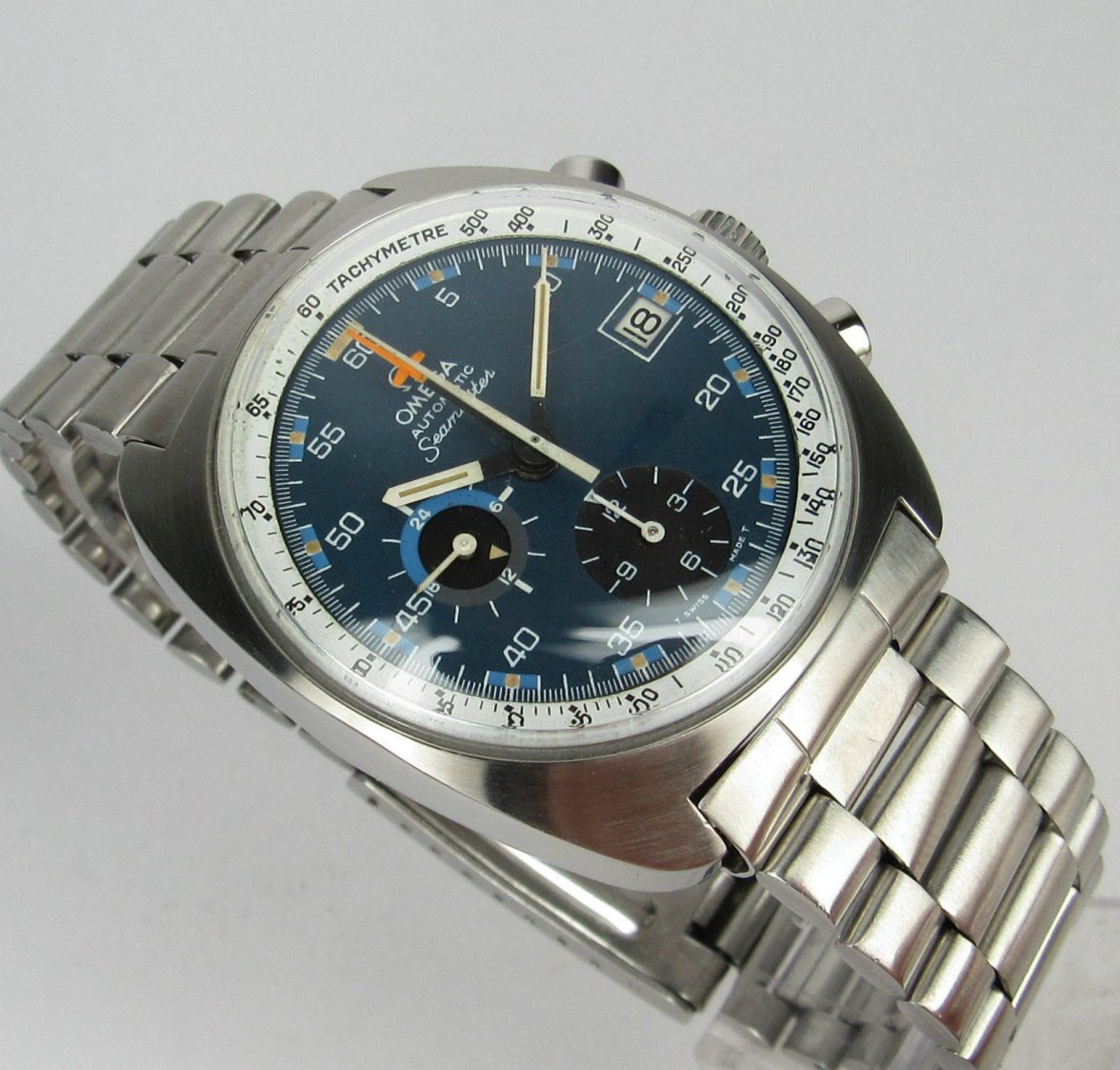
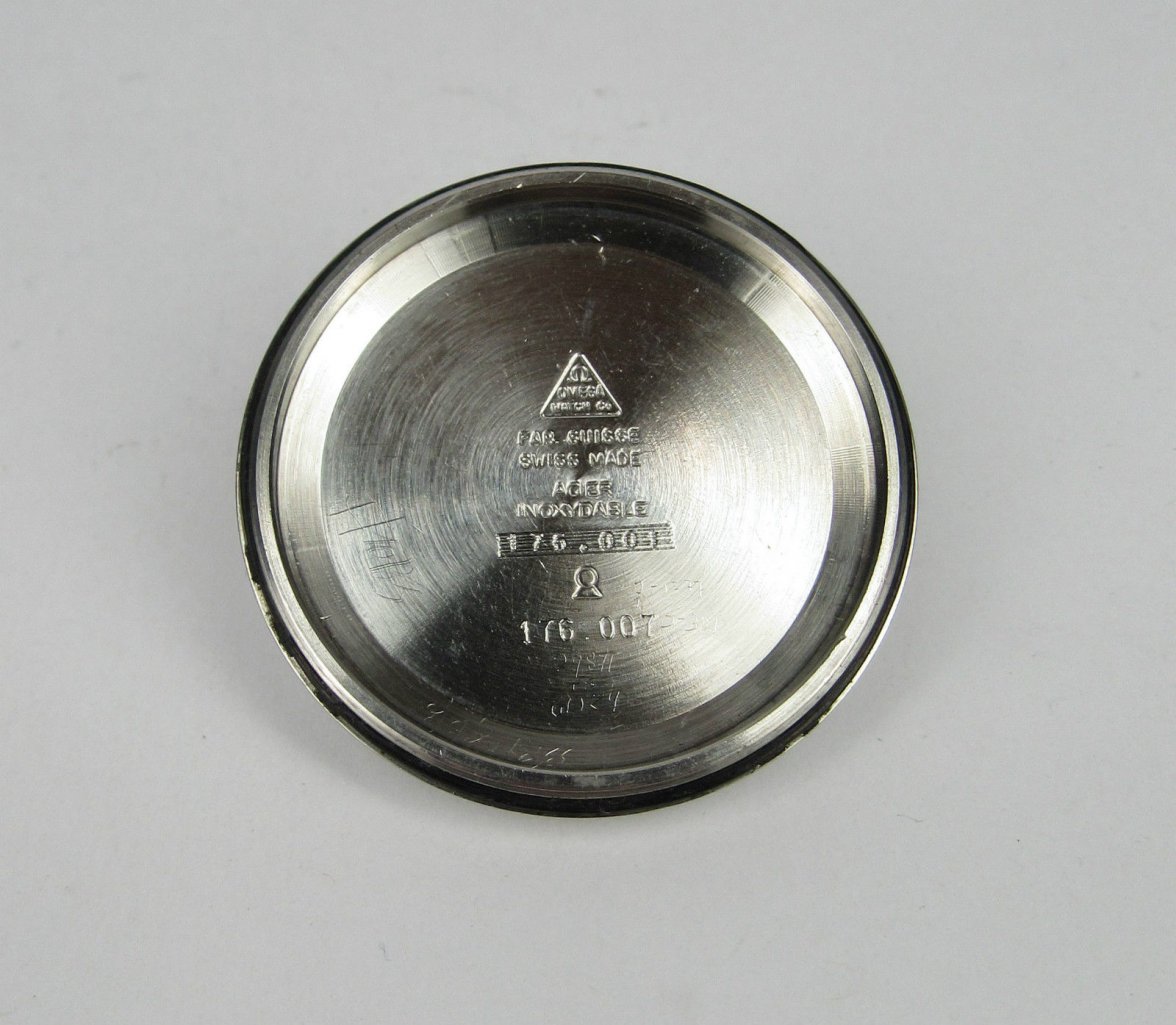
Interesting 176.007 on eBay: http://www.ebay.com/itm/231948022927?_trksid=p2055119.m1438.l2649&ssPageName=STRK:MEBIDX:IT

If someone here buys this and orders an extract, I'll buy you a beer and throw in some NATOs for your trouble. 😁

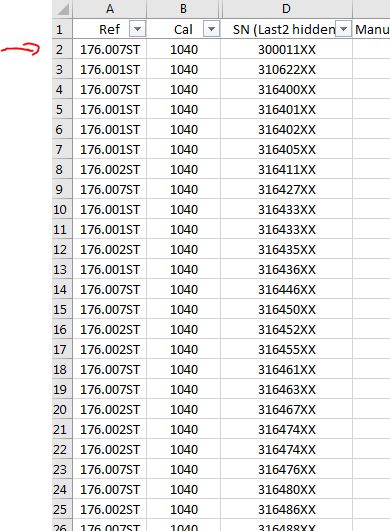
SN is the lowest I've seen on a 1040 by over a million.


Slightly surprising too that it is a 176.007 and not a 176.001 (though it is a transitional with the dual ref. caseback). I say slightly because as you can see, the low serials are a mix of -001, -002, and -007.


I'd be VERY interested to know the production date of this one. The correlation between production date and serial numbers can be loose, but I'd wager this is among the earliest.
 
This website may earn commission from Ebay sales.
Posts
1,060
Likes
1,631
Who would put $2500 for an over polished (and wrong, should be sunburst), with a wrong bracelet (should be 1170/653) and a swapped movement. I'd sell mine with original sunburst, correct bracelet and omega extract for less than that !!
 
Posts
2,876
Likes
1,962
with a wrong bracelet (should be 1170/653)
It is a 1170/653 but has the clasp replaced with one from the 1155/146. Not strange considering the watch's condition.
 
Posts
924
Likes
1,778
This is really early, given how close together the consecutive numbers 3 to 25 (cells D4 to D26) in your list are.

How about just ordering an extract? You have the serial number and photographs. Maybe we could all pitch in!

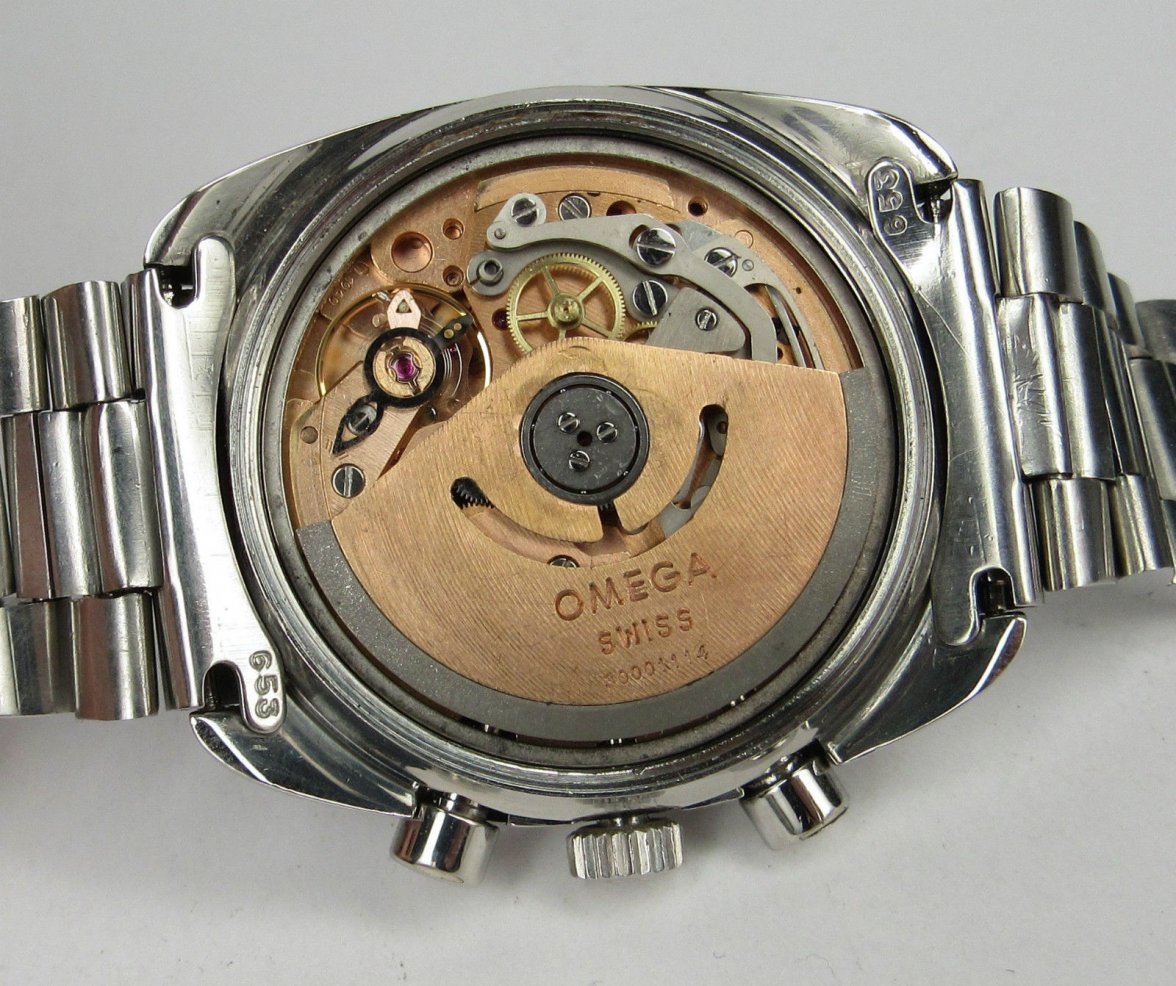
PS I just sourced an actual NOS 1170 bracelet for one of my 176.007s - old style, with screws. I'm over the moon and wanted to share it 😉
Edited: