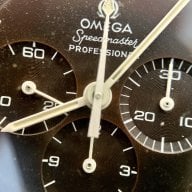
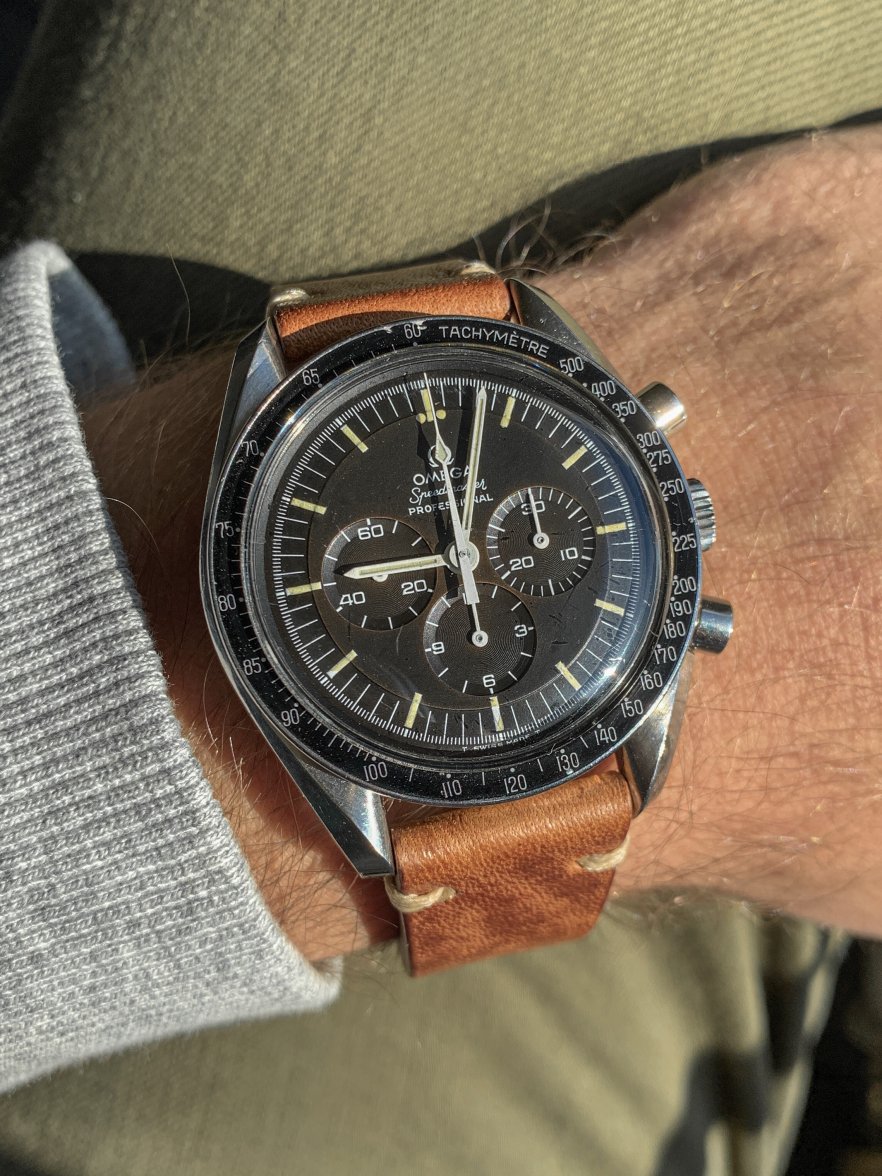
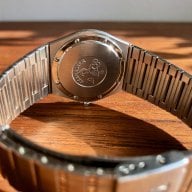
105.003 and 105.012 born the same day

Posts
405
Likes
2,020
Today I decided to classify my extracts, and I realized that two of my watches had been produced at the same time !
50503262201_910227f941_b.jpg

Here are the dates of all my extracts, it could be funny to see if we can find other twin sisters on the forum ?

23 January 1959
8 July 1963
23 September 1963
11 November 1964
26 February 1965
13 April 1966
22 April 1966
15 November 1966
23 March 1967
23 March 1967
19 April 1967
6 June 1967
15 September 1967
11 October 1967
6 May 1968
20 May 1968
6 June 1968
10 June 1968
14 June 1968
8 November 1968
27 January 1969
9 March 1970
24 June 1970
2 July 1970
12 November 1970
30 April 1971
12 October 1971
20 November 1985
3 March 1989
20 July 1989
8 January 2001
 
Posts
1,430
Likes
2,955
Impressive list...

It's the Birthday Paradox..."In a room of just 23 people there’s a 50-50 chance of at least two people having the same birthday. In a room of 75 there’s a 99.9% chance of at least two people matching."

You have more than 23 watches so your odds were better then 50-50 that you'd find two watches that share a production date. Just saying... What I find more incredible is the amazing collection you have accumulated over the years.

Source: https://betterexplained.com/article...:text=23 people.,at least two people matching.
 
Posts
2,671
Likes
3,555
Impressive list...

It's the Birthday Paradox..."In a room of just 23 people there’s a 50-50 chance of at least two people having the same birthday. In a room of 75 there’s a 99.9% chance of at least two people matching."

You have more than 23 watches so your odds were better then 50-50 that you'd find two watches that share a production date. Just saying... What I find more incredible is the amazing collection you have accumulated over the years.

Source: https://betterexplained.com/articles/understanding-the-birthday-paradox/#:~:text=23 people.,at least two people matching.

the odds are less than 50-50 for having the same month, day, AND year. The birthday “paradox” only deals with the month and day. When one adds the year, the calculation is not based on 365 days a year, but 365 days for each year - in this case the years of production of those watches. Say it was 5 years (the run of the 105.012), then that is 355x5 possibilities to consider, not just 365. Don’t have the time to do the actual odds.

So, pretty impressive, IMO.
 
Posts
317
Likes
278
I have a 145.022-69 born on July 2, 1970. Delivered to Sweden.

30 582 1XX

Edited:
 
Posts
1,430
Likes
2,955
the odds are less than 50-50 for having the same month, day, AND year. The birthday “paradox” only deals with the month and day. When one adds the year, the calculation is not based on 365 days a year, but 365 days for each year - in this case the years of production of those watches. Say it was 5 years (the run of the 105.012), then that is 355x5 possibilities to consider, not just 365. Don’t have the time to do the actual odds.

So, pretty impressive, IMO.
You are absolutely correct. The birthday paradox does only deal with month and day. Still, I'm more impressed by the sheer number of Speedmasters accumulated.
 
Posts
405
Likes
2,020
You are absolutely correct. The birthday paradox does only deal with month and day. Still, I'm more impressed by the sheer number of Speedmasters accumulated.

Thanks 😀 more than 10 years of collecting (and I don't have extracts for all my watches)
 
Posts
1,430
Likes
2,955
the odds are less than 50-50 for having the same month, day, AND year. The birthday “paradox” only deals with the month and day. When one adds the year, the calculation is not based on 365 days a year, but 365 days for each year - in this case the years of production of those watches. Say it was 5 years (the run of the 105.012), then that is 355x5 possibilities to consider, not just 365. Don’t have the time to do the actual odds.

So, pretty impressive, IMO.

I thought I'd ask my eldest son who is a graduate student in mathematics...

So, here's how it works. Let's consider a trait and we are examining collections of n objects to see if any two objects in the collection both have the same version of that trait.

In the Birthday Problem, the trait is "day of birth", of which there are 365. So, letting our trait come in T possible versions, let's write f(T,n) to denote the probability that a collection of n objects possessing various versions of a given trait (which comes in T total possible number of version) contains a pair of objects with the same version of the trait.

For the Birthday Problem, the probability of there being a pair of people among n people possessing the same birth day is given by f(365,n). This is because there are n people in consideration, and because the trait we are measuring (day of birth) comes in 365 possible varieties.


For the situation under consideration here, the probability is applying to following three pieces of information:

A day of the month
A month
A year.

In particular, note that the production date identifier can be thought of as:

One number between 1 and 31 (the day of the month), followed by one name out of twelve (the name of one of the twelve months), followed by a year.

The watches in question were only capable of being produced during the same year for a period of 5 years ('64-'68). Thus, to measure the probability of any two watches out of n watches having the same year among those 5, we use f(5,n).

In those 5 years, all 12 months are present, so, the probability of n watches having the same "month of production" is given by f(12,n)

Finally, we have to deal with the days of the month. Here, the calendar causes us some grief because not all months have the same number of days. However, given that I don't want to have to spend TOO much time on this, let's simplify the problem and assume that all 12 months have the same number of days: 31.

Thus, in examining whether there is a pair of watches in a collection of n watches that have the same day number on their production date, the probability of this is given by f(31,n).

To find the probability of all three of these events happening simultaneously, we multiply them:

P(n) = f(31,n) * f(12,n) * f(5,n)
Thus, P(n) is the probability that a collection of n watches (in an ideal world where every month has 31 days) share the same production date
If you're curious, f(T,n) = T! * T^(-n) / (T-n)!

This then gives
P(7) ≈ 47%
P(8) ≈ 61%

So, if you have 7 watches (all of which were made within a single 5-year period), there's about a 47% that there will be a pair of watches among those 7 with the same production date. The question is how you define the events. If you want to treat each individual combination of day, month, and year as an independent entity, P(n) = f(5*365,n), then you'd need approximately 50 watches to have a 50% chance of finding two watches that share same production date. If you treat the production date as a composite of three deterministic quantities; "day of month", "month", "year'... you will get the first answer, however, if you treat each production date as a single entity you get the second answer which is 50 watches. So, he says...
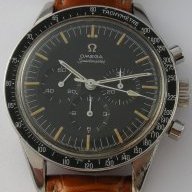
 
Posts
4,991
Likes
18,535
I thought I'd ask my eldest son who is a graduate student in mathematics...

So, here's how it works. Let's consider a trait and we are examining collections of n objects to see if any two objects in the collection both have the same version of that trait.

In the Birthday Problem, the trait is "day of birth", of which there are 365. So, letting our trait come in T possible versions, let's write f(T,n) to denote the probability that a collection of n objects possessing various versions of a given trait (which comes in T total possible number of version) contains a pair of objects with the same version of the trait.

For the Birthday Problem, the probability of there being a pair of people among n people possessing the same birth day is given by f(365,n). This is because there are n people in consideration, and because the trait we are measuring (day of birth) comes in 365 possible varieties.


For the situation under consideration here, the probability is applying to following three pieces of information:

A day of the month
A month
A year.

In particular, note that the production date identifier can be thought of as:

One number between 1 and 31 (the day of the month), followed by one name out of twelve (the name of one of the twelve months), followed by a year.

The watches in question were only capable of being produced during the same year for a period of 5 years ('64-'68). Thus, to measure the probability of any two watches out of n watches having the same year among those 5, we use f(5,n).

In those 5 years, all 12 months are present, so, the probability of n watches having the same "month of production" is given by f(12,n)

Finally, we have to deal with the days of the month. Here, the calendar causes us some grief because not all months have the same number of days. However, given that I don't want to have to spend TOO much time on this, let's simplify the problem and assume that all 12 months have the same number of days: 31.

Thus, in examining whether there is a pair of watches in a collection of n watches that have the same day number on their production date, the probability of this is given by f(31,n).

To find the probability of all three of these events happening simultaneously, we multiply them:

P(n) = f(31,n) * f(12,n) * f(5,n)
Thus, P(n) is the probability that a collection of n watches (in an ideal world where every month has 31 days) share the same production date
If you're curious, f(T,n) = T! * T^(-n) / (T-n)!

This then gives
P(7) ≈ 47%
P(8) ≈ 61%

So, if you have 7 watches (all of which were made within a single 5-year period), there's about a 47% that there will be a pair of watches among those 7 with the same production date. The question is how you define the events. If you want to treat each individual combination of day, month, and year as an independent entity, P(n) = f(5*365,n), then you'd need approximately 50 watches to have a 50% chance of finding two watches that share same production date. If you treat the production date as a composite of three deterministic quantities; "day of month", "month", "year'... you will get the first answer, however, if you treat each production date as a single entity you get the second answer which is 50 watches. So, he says...
Now I remember why I became a lawyer. I suck in math.
 
Posts
1,430
Likes
2,955
Now I remember why I became a lawyer. I suck in math.
My youngest is considering applying to law school or a pHd, he sucks at math too. He's doesn't like the logic reasoning and logic game sections of the LSAT as it is too much like math. So, I know your math skills can't be that bad unless in Amsterdam, I believe that is where you live, you don't need to take an exam such as the LSAT to get into law school.
 
Posts
377
Likes
470
I thought I'd ask my eldest son who is a graduate student in mathematics...

So, here's how it works. Let's consider a trait and we are examining collections of n objects to see if any two objects in the collection both have the same version of that trait.

In the Birthday Problem, the trait is "day of birth", of which there are 365. So, letting our trait come in T possible versions, let's write f(T,n) to denote the probability that a collection of n objects possessing various versions of a given trait (which comes in T total possible number of version) contains a pair of objects with the same version of the trait.

For the Birthday Problem, the probability of there being a pair of people among n people possessing the same birth day is given by f(365,n). This is because there are n people in consideration, and because the trait we are measuring (day of birth) comes in 365 possible varieties.


For the situation under consideration here, the probability is applying to following three pieces of information:

A day of the month
A month
A year.

In particular, note that the production date identifier can be thought of as:

One number between 1 and 31 (the day of the month), followed by one name out of twelve (the name of one of the twelve months), followed by a year.

The watches in question were only capable of being produced during the same year for a period of 5 years ('64-'68). Thus, to measure the probability of any two watches out of n watches having the same year among those 5, we use f(5,n).

In those 5 years, all 12 months are present, so, the probability of n watches having the same "month of production" is given by f(12,n)

Finally, we have to deal with the days of the month. Here, the calendar causes us some grief because not all months have the same number of days. However, given that I don't want to have to spend TOO much time on this, let's simplify the problem and assume that all 12 months have the same number of days: 31.

Thus, in examining whether there is a pair of watches in a collection of n watches that have the same day number on their production date, the probability of this is given by f(31,n).

To find the probability of all three of these events happening simultaneously, we multiply them:

P(n) = f(31,n) * f(12,n) * f(5,n)
Thus, P(n) is the probability that a collection of n watches (in an ideal world where every month has 31 days) share the same production date
If you're curious, f(T,n) = T! * T^(-n) / (T-n)!

This then gives
P(7) ≈ 47%
P(8) ≈ 61%

So, if you have 7 watches (all of which were made within a single 5-year period), there's about a 47% that there will be a pair of watches among those 7 with the same production date. The question is how you define the events. If you want to treat each individual combination of day, month, and year as an independent entity, P(n) = f(5*365,n), then you'd need approximately 50 watches to have a 50% chance of finding two watches that share same production date. If you treat the production date as a composite of three deterministic quantities; "day of month", "month", "year'... you will get the first answer, however, if you treat each production date as a single entity you get the second answer which is 50 watches. So, he says...

This of course assumes that production takes place on all 31 days of the month in all months regardless of weekends and holidays. 😉

On the flip side, fun calculation and also great collection by OP!