Will chocolate dials stop altering?

Posts
231
Likes
339
Hi OF,

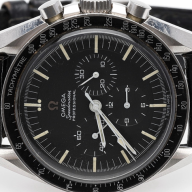
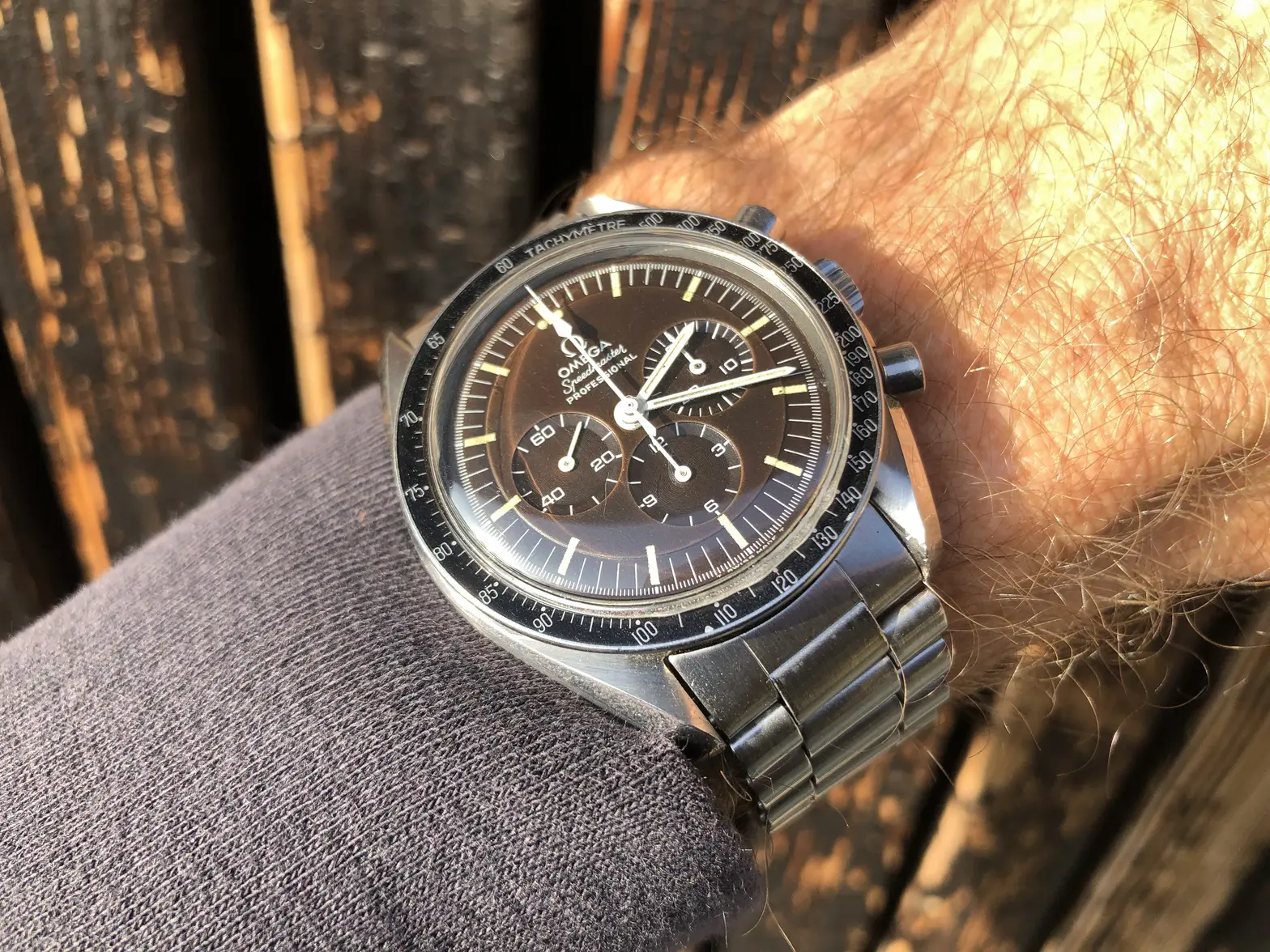
as the new owner of this nicely aged chocolate dialed Speedmaster, I wonder if the process of alteration will finally stop or will it go on and we end up with a destroyed dial with the surface flaking off and the surface is finally coming to dust? I barely remember from my college days that every chemical reaction ( I suppose this is the case here ) will end when one of the involved substances has completely reacted with another substance. So maybe these chocolate dials are a bit like Bansky's self destroying work of art?

Sorry for this silly question, but I hope those with more insight have arguments that could ease my mind.

Meanwhile I am happy with the situation as is:
 
Posts
24,245
Likes
53,989
Predictions are hard, especially about the future.
 
Posts
288
Likes
685
What a good question. I have thought the same thing. I would think the decay would take a very long time. Or at least long enough that we will not be worried about it!

Beautiful watch!
 
Posts
461
Likes
385
The chocolate dial is caused by one of the pigments in the original mixture being fugitive/light sensitive and fading on exposure to light. In that sense when all the black has faded it will reach an endpoint and the change of the remaining brown will be slow. This has nothing to do with the medium or its adherence to the dial metal or the layering of the paint. The mechanical strength of the paint is subject to all the usual problems any dial faces, not just tropical dials. That's my 2 cents of worthless prediction.
 
Posts
288
Likes
685
If light exposure is the reason for fading then how do we explain watches that are stored in a box or safe with no light exposure?
 
Posts
966
Likes
3,956
In my experience, however, maintaining them in the same condition can influence variations in dial color.
 
Posts
461
Likes
385
If light exposure is the reason for fading then how do we explain watches that are stored in a box or safe with no light exposure?
There has to be an energy source for the degradation reaction to take place... If not light then thermal energy...and if it is in a dark safe then it has to be a very unstable compound e.g. black Sharpie ink fades completely in 1-2 years-worth of indoor sunshine, that is pretty unstable but I have not noticed significant fading when it is stored out of light over many years. This suggests that the Omega dials have something even more unstable in their formulation. It would be nice to know exactly which black dye/pigment fades on the dials, but I don't think that anyone has done that analysis and published the results.
Edited:
 
Posts
7,176
Likes
23,251
I would think if the cause were exposure to excess humidity, and the watch was permanently moved to a drier climate, I would expect, at the very least, that whatever process is in play will slow down.
 
Posts
3,017
Likes
6,434
Are there members who have had black dial watches turn brown during their ownership, or brown dial watches turn a further shade of brown? And if yes, over what period of time?
 
Posts
231
Likes
339
What a good question. I have thought the same thing. I would think the decay would take a very long time. Or at least long enough that we will not be worried about it!

Beautiful watch!
If you put it on a linear timeline the alteration in this case took 55 years and the change is still subtle, only visible when light hits the dial in an angle. So maybe you are right, I have to wait another 55 years to see what happens .... but I will decay before that!
 
Posts
231
Likes
339
The chocolate dial is caused by one of the pigments in the original mixture being fugitive/light sensitive and fading on exposure to light. In that sense when all the black has faded it will reach an endpoint and the change of the remaining brown will be slow. This has nothing to do with the medium or its adherence to the dial metal or the layering of the paint. The mechanical strength of the paint is subject to all the usual problems any dial faces, not just tropical dials. That's my 2 cents of worthless prediction.
Ok, with that in mind it should be recommended to keep it in the drawer to prevent further detoriation. I think of the red cars of the past that sit on parking lots with the paint literally coming of in flakes that worries me....
Edited:
 
Posts
231
Likes
339
I would think if the cause were exposure to excess humidity, and the watch was permanently moved to a drier climate, I would expect, at the very least, that whatever process is in play will slow down.
Aside from the UV-exposure the humidity is widely considered a possible reason for the decay. It was reported that samples from e.g. South America more often show chocolate dials. But to my experience they also show more oxidation on the case and movement parts....
 
Posts
231
Likes
339
..... I forgot where I read about it but of course: all described in our beloved MO page 115. So definetely oxidation of the nickel zinc plating of the dial. But no conclusion there as whether it will stop. So best is probably: stored vacumized in a freezer for future generations....
 
Posts
13,309
Likes
18,419
If light exposure is the reason for fading then how do we explain watches that are stored in a box or safe with no light exposure?
Radioactivity has something to do with paint decay, especially in humid climates.
gatorcpa
 
Posts
6,868
Likes
12,619
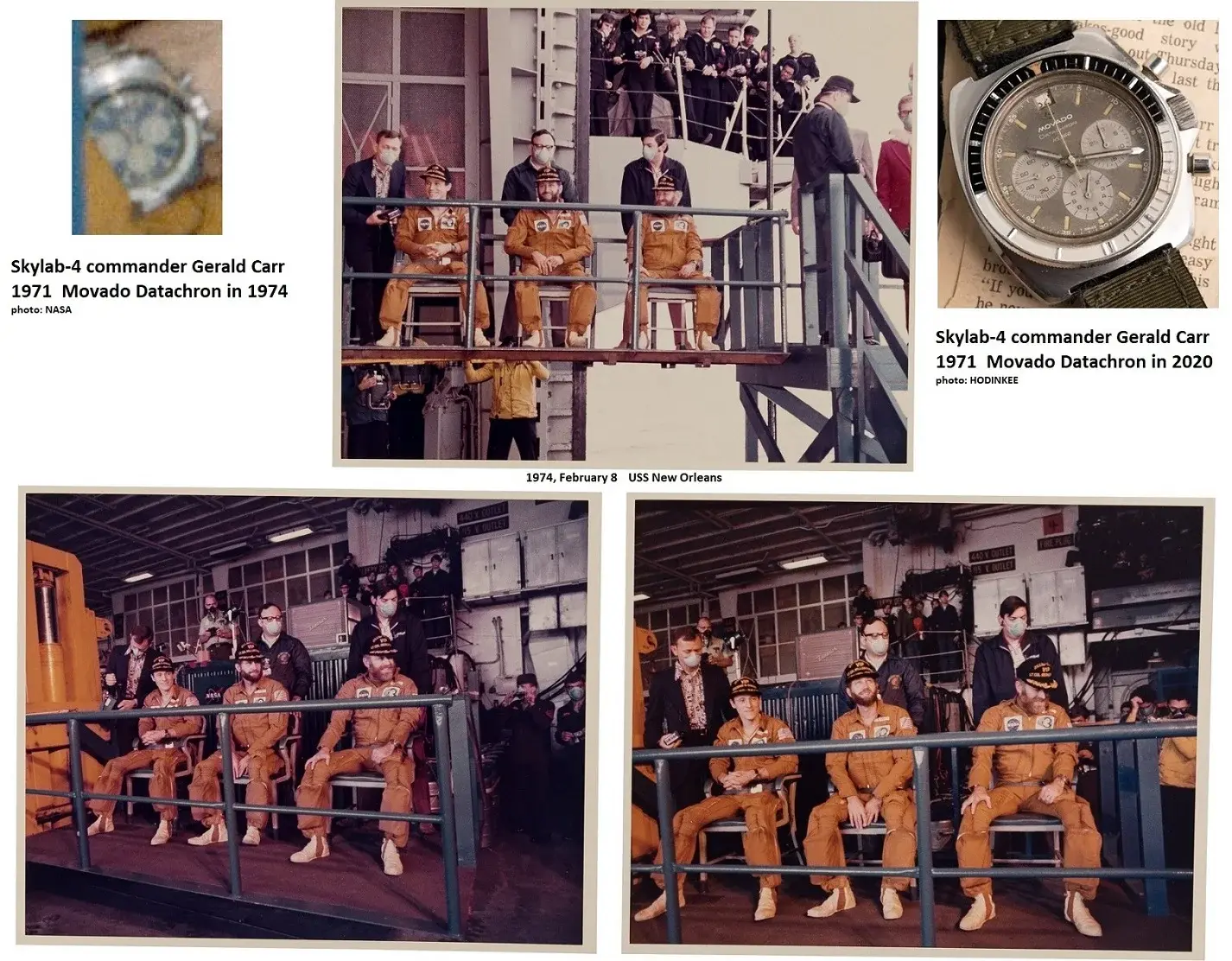
Let's once-and-for-all point out the very best documented case of a real "chocolate" dial !
February 8, 1974... after 84 days in space the Skylab SL-4 crew returned home, recovery by USS New Orleans.
US Marine Corps Colonel aviator & Skylab-4 astronaut Gerald Carr's Movado Datachron HS360 automatic chronograph remains the best documented case of a wrist watch dial turning "chocolate" !
Just compare the striking blue dial in the 1974 photos with the same watch with brown patinated dial photographed in 2020. #Movado #NASA
(Photos: NASA/USN - collage MoonwatchUniverse)
.
 
Posts
231
Likes
339
From blue to brown! Astonishing! It took 46 years for this discoloration...so we just wait!