I'm trying to get a sense of how meaningful the specification is. Mr Jones watch might well be in specification, but is it typical that the 321 (for example) cannot be adjusted to beat the specification soundly, for example to COSC standards?
At its last service my 1861 Speedmaster seems to be beating the spec soundly.
Tom
Hi Tom,
The answer I give would depends entirely on what you mean by COSC standards? Do you mean the commonly quoted -4 to +6 per day average rates? If so, then yes it would be very unusual for me not to get an 1861 to fall within those standards (let's leave 321's out as wear and parts availability cloud the issues with those). Or do you mean what Omega requires for tolerances for positional variation and isochronism? Or do you mean full blown COSC testing with all tolerances met over all the temperatures they test to? The last 2 definitions are certainly more problematic to assert that every watch could meet these standards.
So in fact with Jones in LA's watch he is meeting those basic "-4 to +6 standards" with the average rate being +0.2, but still you say the variation is "too much for that movement" but what do you base that judgment on? It seems you are basing it on the one example of this movement that you own, and I guess my point here is that applying what you see on one watch, across all watches, is not really a good idea in terms of having reasonable expectations. And again it certainly does not indicate the need for service.
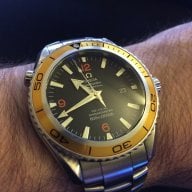
Let's look at the last watch I serviced yesterday as an example - it's a Marathon GSAR, so very much a tool watch, with a very basic ETA 2824-2 elabore grade movement. So it does not have the better mainspring, pallet fork jewels, balance wheel and balance springs that the Top or COSC versions would have. Photos of the watch and movement:


Again basic finishing and nothing special at all. ETA allows the Delta to be as much as 20 seconds (3 positions only) with another 15 added for isochronism, and the average rate can be anywhere from 0 to 14 seconds and still be within spec., so not great performance.
When it arrived it was not running well:

Low amplitude at full wind dial down (even though I didn't set the lift angle correctly), losing 30 seconds a day, and large beat error. There were a few worn out parts I replaced, new mainspring, clean, oil, and basic adjustments only. The watch was horribly adjusted when it came in, so the balance spring was not centered at all in the regulating pins for example, and I simply performed the normal adjustments I do on every watch. Here are the results:


Now by anyone's standards, these are good numbers. Delta is just 3.2 seconds over 6 positions at full wind, and average rate is +1. Note that over 1/2 of that Delta figure comes in just the last position (crown right) that is not included in COSC calculations, so if I just use the first 5 the Delta is 1.5 seconds over 5 positions. I can tell you they don't get much better than this, even in COSC guise.
So does this mean I should expect every 2824-2 of at least this grade to perform this well? Hell no! I didn't even have to do any dynamic poising to get this, so just basic adjusting and all the stars aligned and the sum of the parts fell into place to give very good results. This watch would be at the far right of the bell curve. Assuming that because one example is this good that all should be is just not reasonable, because there will be variation across all movement types where some will be average, some better than average, and some worse than average.
Cheers, Al