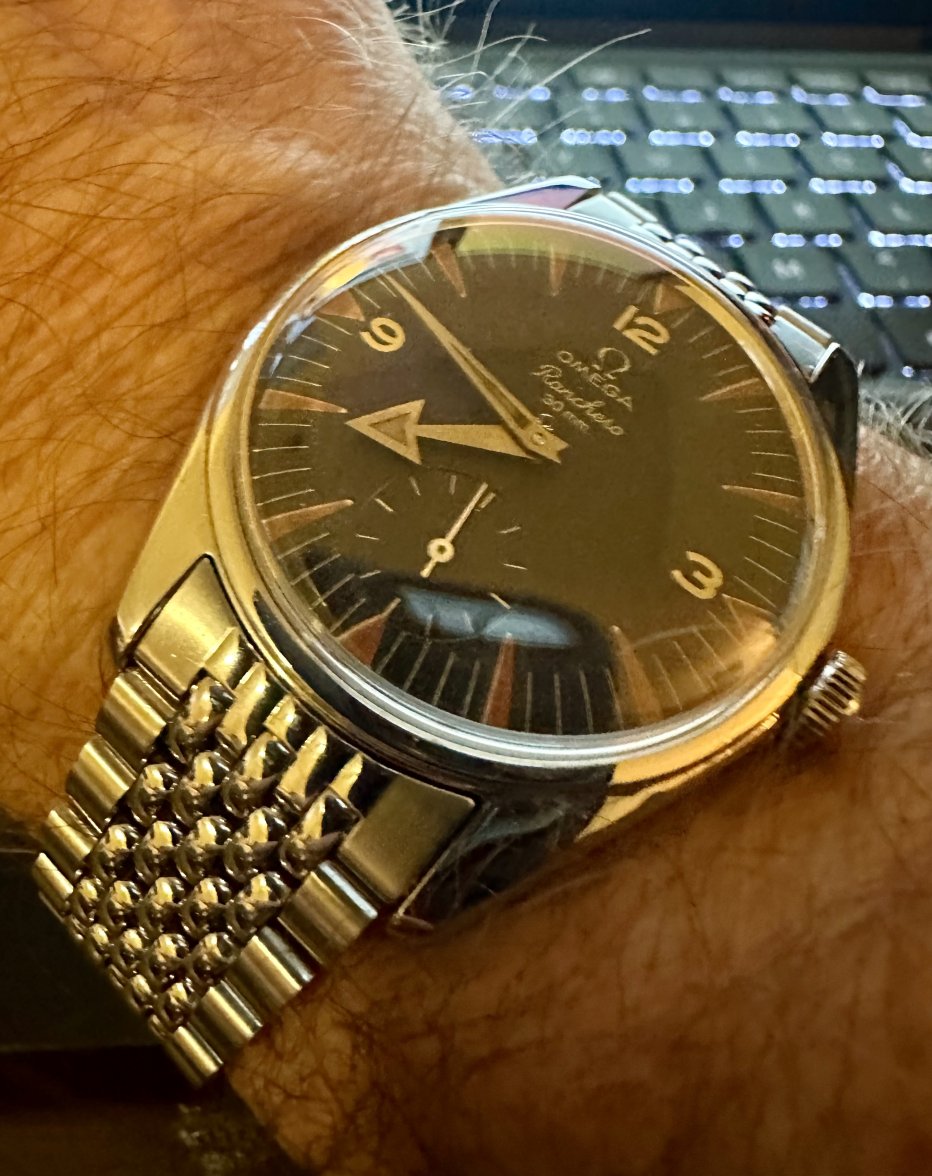
To my knowledge, that information is not available, although we know that radiation emissions from tritium are far lower than from radium. Since tritium has a half life of only 12 years (as opposed to 1,600 years for radium), and we know that the last 3590.50 was produced in the 1996-1997 timeframe, there would be very little in the way of radioactive emission from a 3590.50 purchased today.
As @gbesq noted, any radiation from a 90s watch will be greatly reduced. Also, in my experience, in practice it's difficult to measure anything above background levels from a watch with a tritium dial.
Perhaps you can explain the context/purpose of this question, you might get more engagement with your thread.
An interesting side note: I work at a facility with radiation portal monitors that every worker must pass through at the end of their day... one worker was wearing a vintage radium dialed watch a few weeks ago and alarmed the monitor. Apparently ~1.5mrem/hr on contact. A non-negligible amount of dose!
As @gbesq noted, any radiation from a 90s watch will be greatly reduced. Also, in my experience, in practice it's difficult to measure anything above background levels from a watch with a tritium dial.
Perhaps you can explain the context/purpose of this question, you might get more engagement with your thread.
I acquired this model recently. It is the first tritium watch in my collection and am taking this opportunity to do some research. I am not worried about the risks and am actually wearing it but the tritium beta emission (too low to be detectable by common monitors/devices) then led me to Bremsstrahlung, another fascinating topic, and here I am reading about the deceleration of these particles in acrylic vs. glass (i.e. Hesalite vs. crystal; again, nothing that worries me but since I am taking this as an opportunity to learn and play with formulas, I wanted to know if we knew the amount of tritium mixed into the these 1990s watches). The one I own has about 25% left.
I acquired this model recently. It is the first tritium watch in my collection and am taking this opportunity to do some research. I am not worried about the risks and am actually wearing it but the tritium beta emission (too low to be detectable by common monitors/devices) then led me to Bremsstrahlung, another fascinating topic, and here I am reading about the deceleration of these particles in acrylic vs. glass (i.e. Hesalite vs. crystal; again, nothing that worries me but since I am taking this as an opportunity to learn and play with formulas, I wanted to know if we knew the amount of tritium mixed into the these 1990s watches). The one I own has about 25% left.
The good news with beta radiation, is that it’s easily stopped by a layer of clothing, a watch case etc. You would have to ingest the tritium for it to be of any concern.
I acquired this model recently. It is the first tritium watch in my collection and am taking this opportunity to do some research. I am not worried about the risks and am actually wearing it but the tritium beta emission (too low to be detectable by common monitors/devices) then led me to Bremsstrahlung, another fascinating topic, and here I am reading about the deceleration of these particles in acrylic vs. glass (i.e. Hesalite vs. crystal; again, nothing that worries me but since I am taking this as an opportunity to learn and play with formulas, I wanted to know if we knew the amount of tritium mixed into the these 1990s watches). The one I own has about 25% left.
Great choice for both a Speedmaster reference and a watch with tritium lume. For reasons unknown, the tritium markers and hands on the 3590.50 model seem to patinate more attractively and more consistently than any other Speedmaster reference IMO. The markers and the hands almost always fade to a very attractive shade that ranges from pale yellow to a vivid orange.
The good news with beta radiation, is that it’s easily stopped by a layer of clothing, a watch case etc. You would have to ingest the tritium for it to be of any concern.
You can attenuate the beta from a watch dial with a single piece of paper. I've tried it!
Great choice for both a Speedmaster reference and a watch with tritium lume. For reasons unknown, the tritium markers and hands on the 3590.50 model seem to patinate more attractively and more consistently than any other Speedmaster reference IMO. The markers and the hands almost always fade to a very attractive shade that ranges from pale yellow to a vivid orange.
thank you. Indeed, I researched a lot before choosing this particular reference (“neo-vintage”); mine is from 1991/1992 and I absolutely love it. Can’t get my eyes off it. I’ve seen two that are truly of “pumpkin” colour.
To my knowledge, that information is not available, although we know that radiation emissions from tritium are far lower than from radium. Since tritium has a half life of only 12 years (as opposed to 1,600 years for radium), and we know that the last 3590.50 was produced in the 1996-1997 timeframe, there would be very little in the way of radioactive emission from a 3590.50 purchased today.
There might be some information here, although it is not specific to Omega: 7,5 mCI for "T Swiss T":