The best watch repair book..

Posts
771
Likes
3,081
I would like to know, what you guys think or have use as a reference to repair watches. I have some, but I will get more a bit nerdy but I like to read them. Different perspectives are always good to have, that comes from training and experience.
 
Posts
15,644
Likes
46,689
Anything I have seen tend to be very basic, and mostly covering watches from 50 years ago, or older. And the processes involved would now be considered mostly obsolete. For example: the Bulova Watch Repair Manual, Henry Fried’s watch repair manual. Describe the type and vintage of watches you are wanting to learn about. You might be better off taking an on line course of study through the British Horological Institute (BHI), or the American Watchmakers-Clockmaker’s Institute (AWCI). Maybe suggestions from others?
 
Posts
15,644
Likes
46,689
A lot of watch repair manuals from 75 years ago recommend benzene and cyanide for cleaning, and boxwood sawdust for drying. I wouldn't recommend any book that recommends these procedures. Watches have changed so much since many repair manuals were written, that they would be useless dealing with modern watches. If a person were interested in the repair of watches made when these books were written, they might be helpful. As long as one didn’t follow some of the procedures they recommend.
 
Posts
15,644
Likes
46,689
Epilame wasn't a thing back then either, was it?

No. Nor many other products and machinery used in watch repair. Ultrasonics, timing machines, water resist testers, etc. etc.
 
Posts
771
Likes
3,081
A lot of watch repair manuals from 75 years ago recommend benzene and cyanide for cleaning, and boxwood sawdust for drying. I wouldn't recommend any book that recommends these procedures. Watches have changed so much since many repair manuals were written, that they would be useless dealing with modern watches. If a person were interested in the repair of watches made when these books were written, they might be helpful. As long as one didn’t follow some of the procedures they recommend.
I guess the ideas or products have changed a lot, but the machine still very much the same. A spring does the magic, but what I seen is the detail of the explanation for a repair or a particular system is great. I just got the Fried, second edition to check out.
 
Posts
15,644
Likes
46,689
I guess the ideas or products have changed a lot, but the machine still very much the same. A spring does the magic, but what I seen is the detail of the explanation for a repair or a particular system is great. I just got the Fried, second edition to check out.

“The machine still very much the same”? Compare many modern watches with automatic wind, quick change day/date features etc. with the watches in these books, and you will see that the mainspring powering the watch remains the same, but almost everything else is different.

In my earlier post, I asked you to describe the vintage and features of the watches you want to learn about. You haven’t done that yet.
 
Posts
29,916
Likes
77,361

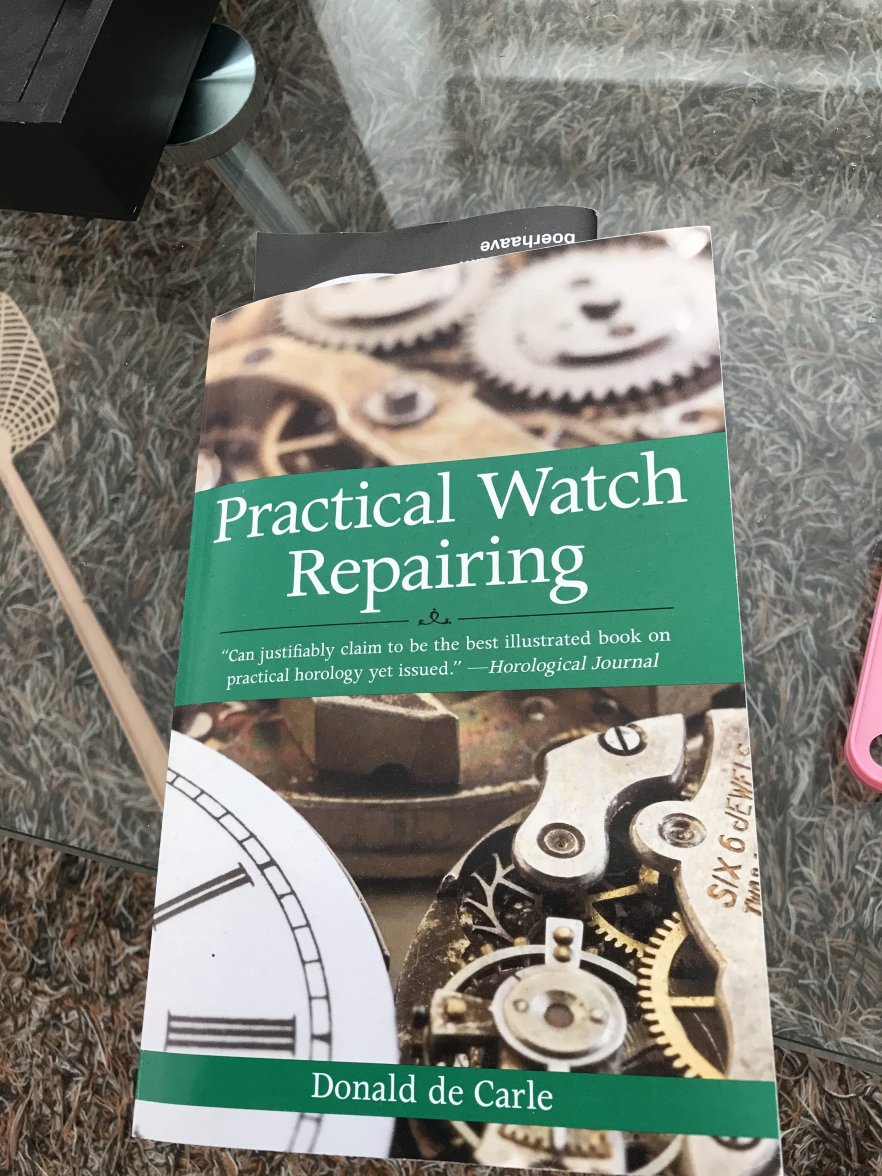
DeCarle...an often cited book for beginners, but it's mostly useless.

"Dissolve a piece of cyanide the size of a walnut in a tea cup of warm water..."

I can tell you no school teaches that anymore...
 
Posts
771
Likes
3,081
DeCarle...an often cited book for beginners, but it's mostly useless.

"Dissolve a piece of cyanide the size of a walnut in a tea cup of warm water..."

I can tell you no school teaches that anymore...
I hope not, haha well I'll just keep reading books I like the technical ones as well. I got I few more coming because I like analog. Putting a new shelve up for all my training books and watch ones.
 
Posts
5,631
Likes
5,812
A related question for @Archer and @Canuck...

These old books spend a lot of paper and ink on balance work, truing, timing, and so forth. You guys do much of that any more?
 
Posts
29,916
Likes
77,361
A related question for @Archer and @Canuck...

These old books spend a lot of paper and ink on balance work, truing, timing, and so forth. You guys do much of that any more?

Depends on the watch. With the ETACHRON system found on many modern watches (invented long after these books were written), the basic adjustments can be much quicker than in the past. Also watches equipped with a moveable stud carrier are much quicker, even if they don't have ETACHRON. The further back you go, the less "user friendly" these adjustments are.

Some watches don't need much work at all (basic balance spring adjustments, spacing and centering of balance spring in the regulating pins), where others I'll spend significant time working through issues related to the balance, so changing staff, extensive balance spring work, fixing loose collets, dynamic poising, etc.

It's rare that the balance doesn't need something tweaked though...