- Posts
- 6,463
- Likes
- 10,103
Mark020
··not the sharpest pencil in the ΩF drawerFollowing a discussion on an Italian forum I made a table which gives some insight in the production numbers of UG in +/- 1944. I have a number of UG databases. My main interest is chrono's with a serial <1 mio but I also register movement numbers. I used the latter to make some calculations. I will share the numbers I have below.
To come to the table I used the following method/assumptions:
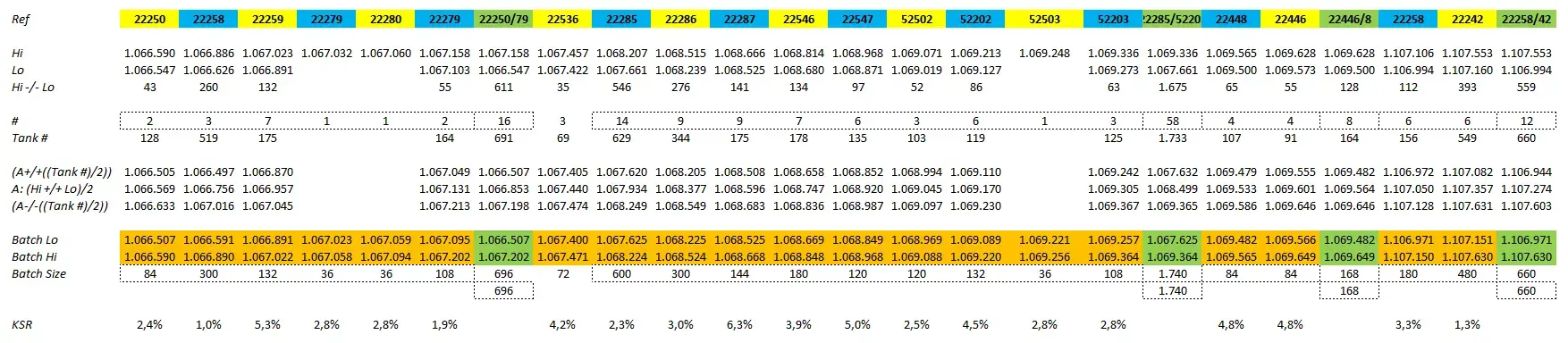
The table:
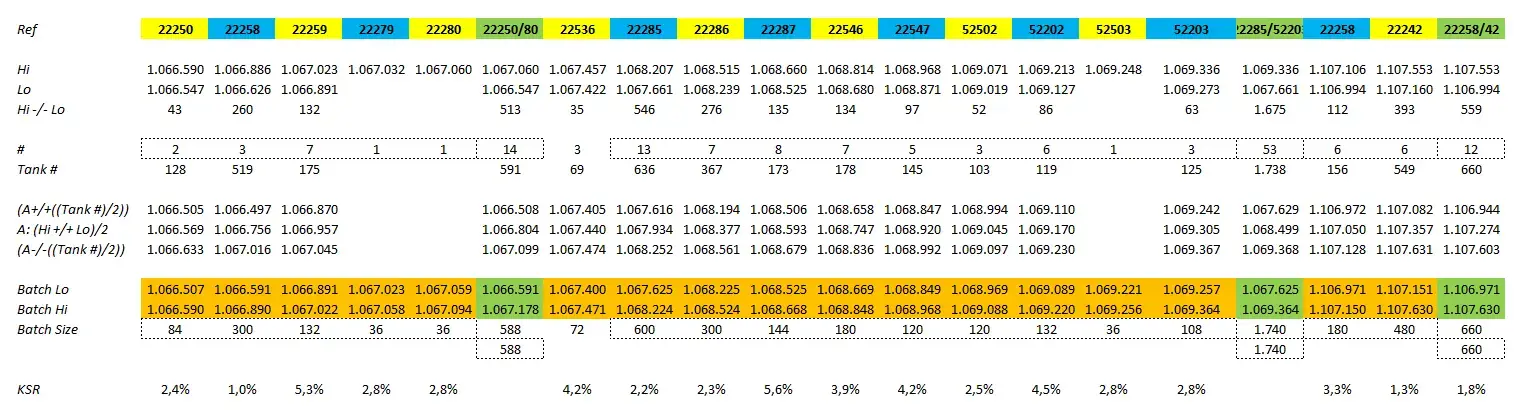
Some further explantion:
As you can see there are some interesting observations:
I am 99% convinced that the production between serials 1.066.500 to 1.067.100, 1.067.400 to 1.069.400 and 1.106.700 to 1.107. 650 must have been along these lines.
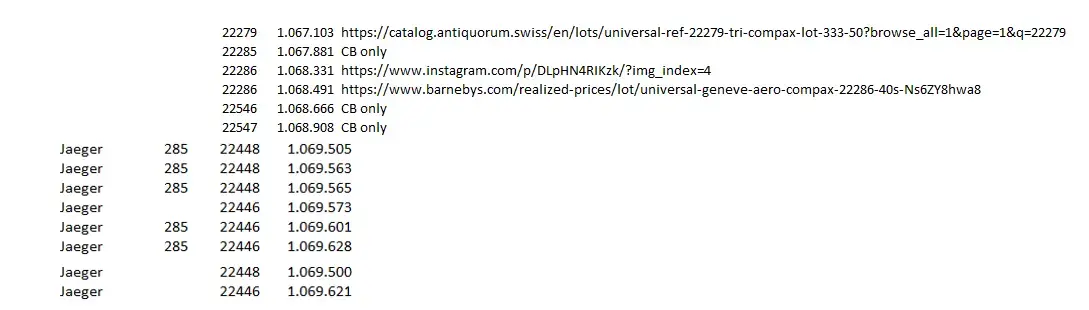
Hopefully somebody has serials which I don't have. Please share them and I will update the table.
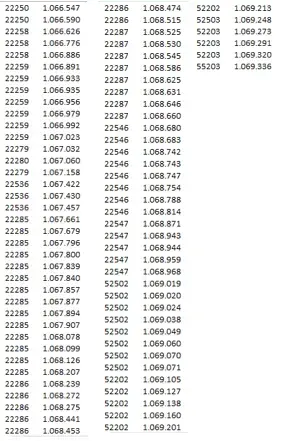
The numbers I used:
To come to the table I used the following method/assumptions:
- UG produced in batches. Within this batch consecutive numbers were used (this is a very important assumption)
- Batchsize is in multiples of 12. IWC used a similar system and Movado most likely as well
- To predict the batch size of a certain reference I use (what I call) the 'Tank Formula'). More about the background and the math here: https://en.wikipedia.org/wiki/German_tank_problem. This formula was introduced to me by a member here but I can't find the thread anymore unfortunately. Initially I only used the tank formula to predict individual batches/references. Later on I realised that it can be used to 'predict' the total size of multiple references as well. The mathematics behind the tank formula are a bit above my pay grade but my conclusions are that: 1) if a new example is found which fits into the current 'interval' the batch size drops but 2) if the new example falls out of the interval the batch size rises. Furthermore the number does not really change that much anymore if the number of examples becomes larger.
The table:
Some further explantion:
- Blue/yellow: reference
- Hi/Lo: highest and lowest number I know
- Hi -/- Lo: this is basically the hard floor of the batch size
- #: number of records I have
- Tank #: batch size based on the Tank Formula
- The next 3 rows are some basic calculations based on the (average of Hi & Lo) +/- (50% of the Tank #)
- The orange rows are the lowest and highest serial numbers within the batch
- Green: this is - what I call - Tank Number Combined so different references combined
- The exact batch size is then determined by combining the Tank Number, Tank Number Combined and the data itself. This is (sometimes) a question of interpretation but if more examples are found lesser options are possible.
- KSR: known survivor rate
As you can see there are some interesting observations:
- Consecutive references were often produced in consecutive batches (but sometimes certain references were produced in more batches)
- UG produced most batches in numbers which are nowadays more associated with microbrands
I am 99% convinced that the production between serials 1.066.500 to 1.067.100, 1.067.400 to 1.069.400 and 1.106.700 to 1.107. 650 must have been along these lines.
Hopefully somebody has serials which I don't have. Please share them and I will update the table.
The numbers I used:
Edited: