I'm going to try to keep this pretty generalised as I don't know the details and I'm too tired (lazy?) to look them up, assuming they're even available.
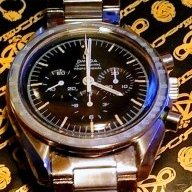
The basic rule when it comes to selling goods in the UK is that "no-one gives what he doesn't have". So, let's assume that the watch was stolen: the person who stole the watch has flawed (or no) title - he doesn't own the watch. Anyone who subsequently buys that watch inherits the same flawed title and that buyer will be the loser in any subsequent claim. The fact that the watch is very identifiable because of the engraving would probably mean that any claim would be easily proven and the watch goes back to the original owner. What does it mean here? There is no way on this earth or the next that the auction house would dare sell the watch.
Now, there are always exceptions in English Law. The one that's relevant here is "estoppel by negligence". Estoppel is a principle of equity (fairness) that was introduced into law. The question that has to be asked is "has the original owner done anything that will preclude him from exercising his legal rights?". When it comes to estoppel by negligence, the question changes to "has the owner FAILED to do something which would then preclude him from exercising his rights of ownership. We actually have precedent on this very question: does the failure to report a theft to the police constitute estoppel by negligence? And the answer is a definite "no". So failure to report a theft doesn't damage your claim to the goods.
Does the owner have to prove theft? Well, yes. He could go with res (ipsa loquitur) - the thing speaks for itself - moving the onus on to the seller to prove that he didn't steal the watch or that he didn't buy it from someone who stole the watch. This could get messy and we'll just leave it at that for now with the exception of this: if the seller can show that the watch was found while diving, for instance, then salvage rights might well come in to play.
What's the bottom line here? The original owner retains good title under English law. The current holder of the property is the one with flawed title and will bear the loss. If the current holder has proof of purchase and/or a contract, he has an action against the seller for the value but this does nothing to give good title.
Source: nine years of law school and practice before I saw the light and did something honest for a change.