- Posts
- 19
- Likes
- 6
ChrisInRedlands
·I recently serviced (clean, oil, regulate) an Omega with a 490 movement which, when I bought it, had moisture damage, including corrosion on the canon pinion that seized the hour wheel. Someone had tried hard to set the watch in this condition, munching a number of teeth on the minute wheel, but other than that and a little staining, the watch was in pretty good shape.
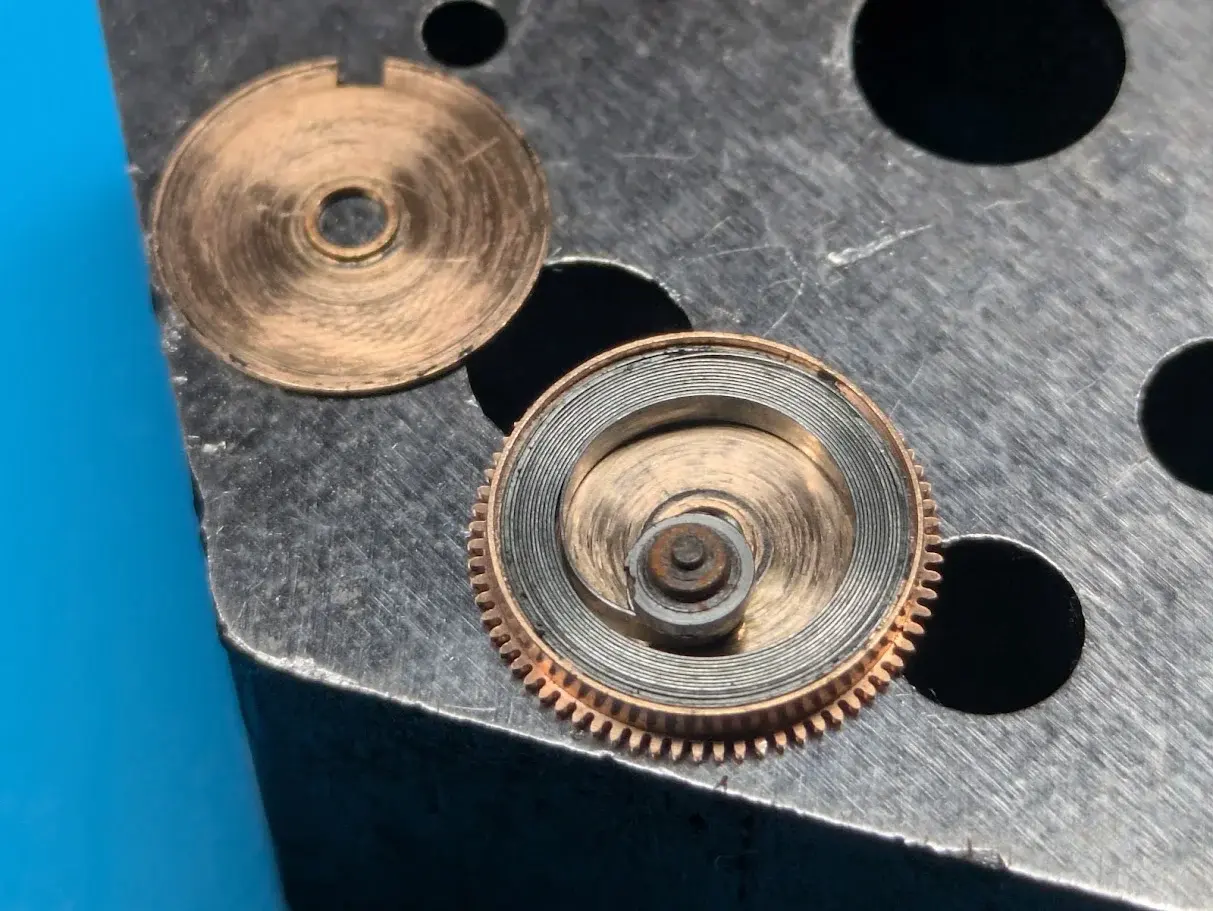
I replaced the mainspring as a matter of course, even though the spring in the watch seemed pretty healthy. When installing the new spring, I lubricated the inside of the barrel wall with four tiny dots of 8217 and touched a little HP1300 on the dry coils of the new spring before reassembling the barrel. There was some corrosion on the arbor, which cleaned up nicely. Here's a picture of the barrel when I first opened it. The arbor cleaned up nicely, and seems to have nice end shake and no play once assembled.
I don't have a picture that shows it, but I was surprised to find that, unlike most automatic barrels I've serviced (just a dozen or so, I'm pretty new), this one had a smooth inner wall with a slightly raised ring about midway down the barrel wall that the bridle rides on instead of the notches or serrations I'm used to seeing. I wish I'd taken a photo of it.
The watch keeps amazing time, losing a couple of seconds a day, the automatic works does its job well (tested with two weeks of wearing), and it has a power reserve of about 40 hours (tested), but the amplitude is poor (around 210 in most positions) and the beat error is around 3ms, which I will probably end up addressing once I have more amplitude. My question: My first thought in terms of the low amplitude was that I may have improperly lubricated the mainspring, causing it to slip prematurely and preventing it from fully winding. It "feels" like it never really winds very tightly, but it's the only Omega 490 I've ever handled. But...is that possible, with a 40 hour power reserve?
Sorry for the long post. I figured I'd try to include all the relevant info. I just want to eliminate the mainspring and barrel from the equation as I start chasing down the cause of low amplitude.
Thanks!
I replaced the mainspring as a matter of course, even though the spring in the watch seemed pretty healthy. When installing the new spring, I lubricated the inside of the barrel wall with four tiny dots of 8217 and touched a little HP1300 on the dry coils of the new spring before reassembling the barrel. There was some corrosion on the arbor, which cleaned up nicely. Here's a picture of the barrel when I first opened it. The arbor cleaned up nicely, and seems to have nice end shake and no play once assembled.
I don't have a picture that shows it, but I was surprised to find that, unlike most automatic barrels I've serviced (just a dozen or so, I'm pretty new), this one had a smooth inner wall with a slightly raised ring about midway down the barrel wall that the bridle rides on instead of the notches or serrations I'm used to seeing. I wish I'd taken a photo of it.
The watch keeps amazing time, losing a couple of seconds a day, the automatic works does its job well (tested with two weeks of wearing), and it has a power reserve of about 40 hours (tested), but the amplitude is poor (around 210 in most positions) and the beat error is around 3ms, which I will probably end up addressing once I have more amplitude. My question: My first thought in terms of the low amplitude was that I may have improperly lubricated the mainspring, causing it to slip prematurely and preventing it from fully winding. It "feels" like it never really winds very tightly, but it's the only Omega 490 I've ever handled. But...is that possible, with a 40 hour power reserve?
Sorry for the long post. I figured I'd try to include all the relevant info. I just want to eliminate the mainspring and barrel from the equation as I start chasing down the cause of low amplitude.
Thanks!


