Let’s imagine it’s 1960

Posts
13,145
Likes
18,053
So a $195 Speedmaster back then is now about $1,704 due to inflation, but the outgoing model was $5,350, about 3x over inflation.
Take a look at the exchange rate of the US dollar to the Swiss Franc. In 1960, $1 bought 4 francs. Today, it takes $1.12 to buy a single franc.

Does it make more sense now?
gatorcpa
 
Posts
4,763
Likes
12,041
The story is based in London.

I can give you the perspective Western U.S., but I don't think it will add to what you have seen already. I suggest you seek archived newspapers from the area, and search for adverts. It would be clear what the dream watches are from the ads and the prices.
 
Posts
1,816
Likes
3,688
I suggest you seek archived newspapers from the area, and search for adverts.
That's a really great suggestion. I try to get into these scenarios by looking at the movies. I'm thinking of your guy as Laurence Harvey, Tom Courtenay, maybe even Dirk Bogarde, Michael Caine or Richard Burton. I know I might be off a few years with some of those (sorry, I know even less about Brit film actors than I do about watches), but IIRC the pushy outsider trying to bust the British establishment was quite a strong theme of the 50s/60s, and they were the sort of people doing that on screen I think.
 
Posts
16,307
Likes
44,983
Take a look at the exchange rate of the US dollar to the Swiss Franc. In 1960, $1 bought 4 francs. Today, it takes $1.12 to buy a single franc.

Does it make more sense now?
gatorcpa
As far as exchange, I’m with you- but when you look at purchasing power for the US dollar as an example- we see a much different picture. I’m not an economist nor accountant- I suck at math- just trying to compare apples to apples in my pea-brain.
To use my mentor as an example, he made $5.6k/yr which is dead on for the median income in 1960. After-say- 30% taxes, he was taking home $327/mo. His $150 GMT was just less than 1/2 one months salary.

The median US income for 2020 was $78,500. Less the same 30% for taxes and the take home is $4,579. By that calculation- if the purchasing power of the US dollar were equal, then the current model of the same watch should be around $2,300....it’s $9,250 MSRP.
 
Posts
7,591
Likes
14,008
Take a look at the exchange rate of the US dollar to the Swiss Franc. In 1960, $1 bought 4 francs. Today, it takes $1.12 to buy a single franc.

Does it make more sense now?
gatorcpa
Fair point, but I would wager that if we knew the Swiss Franc price of a Speedmaster in 1960 and compare it to today's Swiss Franc price you'll still find the price has gone up several times over the cost of Swiss inflation over the last 60 years. Exchange rates have an effect, of course, but not directly in proportion. I remember seeing a Swiss Franc price list for Patek Philippe from the mid- to late 50's and a minute repeater was 5,500 Swiss Francs!
 
Posts
5,636
Likes
5,804
My US inflation calculator says a dollar in 1960 is now $8.74 in 2021. So a $195 Speedmaster back then is now about $1,704 due to inflation, but the outgoing model was $5,350, about 3x over inflation. Granted it might be a little better in construction terms (case/bracelet) but it shows how the watch business has been pushed due to marketing and resultant demand as people around the world have the disposable income to buy such items. The fruits of capitalism on display.
It's actually much more than that. In 1960, "all" watches were mechanical and they were all made pretty much the same way. Today, an analog watch has a Chinese-made electromechanical movement made entirely by machine, and so are the cases and bracelets. Those watches vary in price but ten bucks ain't far off for many and $195 will get you a decent electromechanical watch.

So the comparison isn't strictly even.
 
Posts
13,145
Likes
18,053
You are all overthinking this. The Speedmaster is a very good example, as it has changed very little since the 1960’s. Movements are similar (not the same, I know).

If you converted the $195 into 1960 francs, you’d have about 800 francs. Then apply the CPI computation of 8.74 and you are at $6,992. A little bit over today’s price of a Speedmaster, but there has been about a 10% dip in the dollar over the last few months.

Not exact, but pretty close.
gatorcpa
 
Posts
3,807
Likes
10,436
Disregarding what the prices were and saying I was buying a nice dress watch in 1960 I'd either go for an Omega Constellation or a Longines Conquest. If we open it up to more utilitarian watches I'd consider an Accutron Astronaut, a Rolex Explorer, an Eterna Kon Tiki, or a Nivada Grenchen Antarctic.
 
Posts
13,516
Likes
53,080
I’m four years old. I want a bike.
 
Posts
372
Likes
343
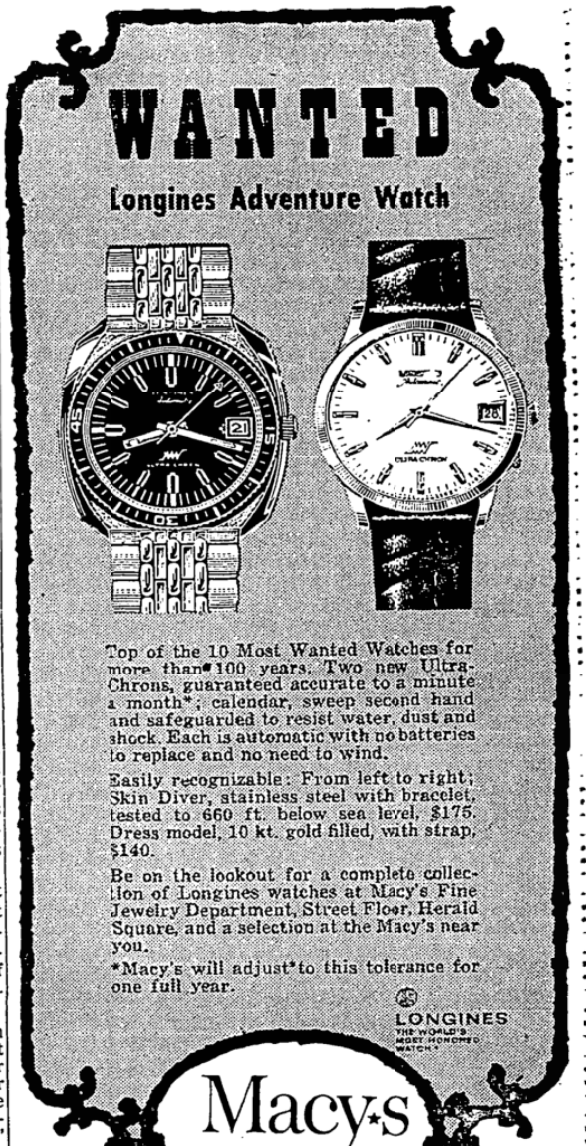
I just searched the New York Times Timesmachine for Longines. It searches articles but not advertisements. I thought I would see what was in the paper on the day that the first moon landing was reported.
 
Posts
8,742
Likes
69,438
With no hindsight? Would buy whatever I liked best for the money. Same as today. 👍
 
Posts
372
Likes
343
I just searched the New York Times Timesmachine for Longines. It searches articles but not advertisements. I thought I would see what was in the paper on the day that the first moon landing was reported.

I just noticed that the seconds hand on the diver has a little arrow at the end. I don't recall seeing the arrow in the pictures that I have seen of that watch (perhaps I am not recalling correctly).
 
Posts
870
Likes
1,573
I write as well, and recently had a similar debate about what a gift to a hero GI might've been in 1945 - I settled on an ornate "gold and black Omega wristwatch, so different from the one he'd worn in Europe and at the same time, an old friend..." because he would be familiar with the tech (in the story) and ornate because it's meant to be congratulatory.

Anyway I just mean to me this would be very dependent on your personal interpretation of who the character really is, how he gets it, etc. For example, a Jay Gatsby type might swan around in the most heavily golden Rolex he could get, hoping it's uncommonness (for the era) would give credence to his false fortune, whereas a Henry Chinaski might be embarrassed his Hamilton CLD even is gold to begin with.

For what you describe...hrm...actually, here's a consideration you may not have considered: a solid gold Smith's DeLuxe!

If he's self-made whether by hook, crook, or honest work, he'd be familiar with Smiths in England in that era, might dislike the 'mainstream' like Omega, Longines, etc, know that Smiths went to the summit of Everest along with Rolex (Smiths used it heavily in ads in the 50s) and by the time you describe, those ads would have been just a few years earlier, when perhaps he couldn't achieve such and mayhaps have worn a steel model when younger - a LOT of nouveau riche in both fiction and real life cling to what they know even if it gets 'blingier', to use the current term.

An of example of what I mean, aprox 1955 production (not my pic):

Untitled_Catalog0792_1024x1024@2x.JPG
 
Posts
1,541
Likes
3,352
If he's self-made whether by hook, crook, or honest work, he'd be familiar with Smiths in England in that era, might dislike the 'mainstream' like Omega, Longines, etc, know that Smiths went to the summit of Everest along with Rolex (Smiths used it heavily in ads in the 50s) and by the time you describe, those ads would have been just a few years earlier, when perhaps he couldn't achieve such and mayhaps have worn a steel model when younger - a LOT of nouveau riche in both fiction and real life cling to what they know even if it gets 'blingier', to use the current term.

So this raises a really interesting question for writers - I'm actually writing a play, and therefore I think the brand name needs to be immediately meaningful to the audience as well as being authentically accurate. They need to know what I'm trying to convey without any further explanation and they can't go and look it up. So, while Smiths may be a suitable brand name, I think its may be a little obscure or even be misunderstood, and so Longines will probably work better for my purposes.
 
Posts
1,816
Likes
3,688
So this raises a really interesting question for writers - I'm actually writing a play, and therefore I think the brand name needs to be immediately meaningful to the audience as well as being authentically accurate. They need to know what I'm trying to convey without any further explanation and they can't go and look it up. So, while Smiths may be a suitable brand name, I think its may be a little obscure or even be misunderstood, and so Longines will probably work better for my purposes.
Spot on - the useful anachronism question is faced by dramatists all the time - and teachers of history as well for that matter. It's not ignorance, or even a crowd-pleasing quest for "relevance", but an important tool in helping today's people to understand the significance that past people, things, or events would have had to their own contemporaries. OK, maybe Downton Abbey overdoes it a bit, and some Pride and Prejudice dramatisations can be a little too raunchy...