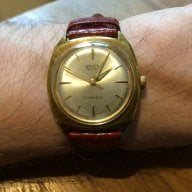
How did my watchmaker know what year my watch was serviced?

Posts
31
Likes
13
I brought a vintage watch I recently bought to a reputable watchmaker in my city for a service. He was swamped with customers so I left the watch with him and he gave me a call later to discuss pricing.

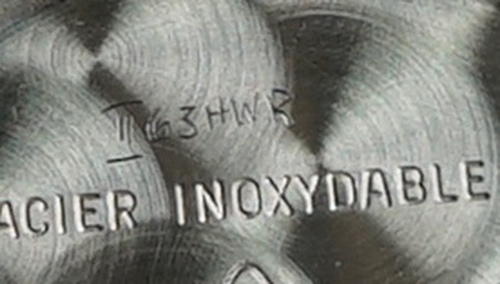
He told me that the last time this watch was serviced was in 1993. Not surprised because the person I bought it from told me that it was his grandfather's watch that's been sitting in the drawer for a long time. But I was surprised that he knew the year of the service... How is it possible? I don't think the caseback or dial had any information written..

here is a pic:

attachment.php
 
Posts
614
Likes
836
I brought a vintage watch I recently bought to a reputable watchmaker in my city for a service. He was swamped with customers so I left the watch with him and he gave me a call later to discuss pricing.

He told me that the last time this watch was serviced was in 1993. Not surprised because the person I bought it from told me that it was his grandfather's watch that's been sitting in the drawer for a long time. But I was surprised that he knew the year of the service... How is it possible? I don't think the caseback or dial had any information written..

here is a pic:

The stuff scratched at the top of the caseback didn't come from Omega.
OTOH, it seems that almost every watchmaker has their own personal code for notating,
so it's largely indecipherable unless you happen to personally know the guy who wrote it.

If he didn't write them himself, your watchmaker may well recognize the marks from his predecessor in your city.
 
Posts
13,483
Likes
31,777
Fortunately scratching service and repair notes inside case backs is now generally frowned upon by watchmakers.
 
Posts
5,636
Likes
5,810
Fortunately scratching service and repair notes inside case backs is now generally frowned upon by watchmakers.

Oh, I wish. 🙁
 
Posts
15,461
Likes
45,793
When I service a watch which has been serviced before by a repair shop that used a sharpie to mark his repair information in the case back, that sharpie marking invariably washes out when I clean the case back. I feel no compunction when I scribe my repair number inside the case back. Tough for the sharpie guy!
 
Posts
5,636
Likes
5,810
When I service a watch which has been serviced before by a repair shop that used a sharpie to mark his repair information in the case back, that sharpie marking invariably washes out when I clean the case back. I feel no compunction when I scribe my repair number inside the case back. Tough for the sharpie guy!

Is it important to have history of the last 2 or 3 or 5 servicings?
 
Posts
15,461
Likes
45,793
Is it important to have history of the last 2 or 3 or 5 servicings?

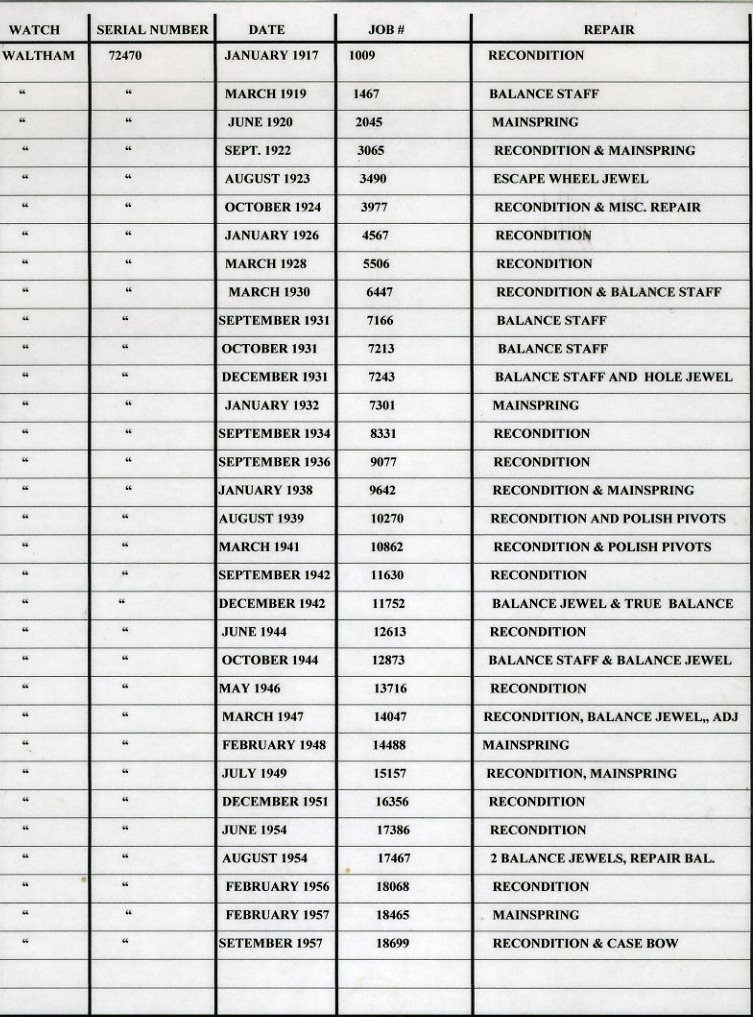
It most certainly would be if the watch ever went back to Mr. Sharpie! One of my pocket watches has 35 repair numbers neatly scribed in tiny numbers inside the case back. It was used by a railroader over his 48 year career with C P Rail. I can tell you what was done, when it was done, and what was charged with each of 32 of those numbers! I didn’t put any of those numbers in the case back, myself. A friend has that watch inspector’s entire watch repair record on his computer data base. Is a record of past repairs important? In the case of this watch it most certainly is!
 
Posts
614
Likes
836
e.g. it's important if your focus is collecting watch servicings, more than it is collecting watches.
 
Posts
15,461
Likes
45,793
e.g. it's important if your focus is collecting watch servicings, more than it is collecting watches.

It is an important part of the history of this particular watch, and I have accumulated a lot of archival material about this watch. It is clearly not my intention to change the opinions of you hard liners who think a sharpie is the way to go.

Again, I asked if the watch repair records should be important to me. Perhaps I’m wrong, but having the information IS important to me, regardless of what you think.
 
Posts
5,636
Likes
5,810
e.g. it's important if your focus is collecting watch servicings, more than it is collecting watches.

Remember a lot of you think this is a "collector site" but many people actually wear the watches they ask about. I am not "collecting" my Railmaster LE, I am wearing it.
 
Posts
15,461
Likes
45,793
Remember a lot of you think this is a "collector site" but many people actually wear the watches they ask about. I am not "collecting" my Railmaster LE, I am wearing it.

My collection comprises pocket watches from 1857, to circa 1955. My wrist watches comprise watches from 1915, to 2000. There are not too many watches in my collection about which I know the back story. But the watches in my collection that are the most special to me are the ones about which I know the back story. This “sharpie” method of recording a watch repair was not done back when 75% of the watches in my collection were in regular use. But you are all absolutely correct. Sharpies are the way to go! Happy now? But I’ll never do it that way.

A lot of shops that use sharpies actually scribe the repair number on top of the sharpie mark.
 
Posts
5,636
Likes
5,810
Not sure how your statements are a reply to mine but you are respected.
 
Posts
15,461
Likes
45,793
Not sure how your statements are a reply to mine but you are respected.

My reply was a general statement on my collection. I tossed in a comment in reply to an earlier post which advocated the use of a sharpie to record a repair inside a watch case back.
 
Posts
1,372
Likes
2,000
It is an important part of the history of this particular watch, and I have accumulated a lot of archival material about this watch. It is clearly not my intention to change the opinions of you hard liners who think a sharpie is the way to go.

Again, I asked if the watch repair records should be important to me. Perhaps I’m wrong, but having the information IS important to me, regardless of what you think.

Next time I'm at my parents' house, I'll take some pictures of the B&O RR watch inspector's log my dad snagged off of eBay about 6 months ago.
 
Posts
3,819
Likes
16,164
It most certainly would be if the watch ever went back to Mr. Sharpie! One of my pocket watches has 35 repair numbers neatly scribed in tiny numbers inside the case back. It was used by a railroader over his 48 year career with C P Rail. I can tell you what was done, when it was done, and what was charged with each of 32 of those numbers! I didn’t put any of those numbers in the case back, myself. A friend has that watch inspector’s entire watch repair record on his computer data base. Is a record of past repairs important? In the case of this watch it most certainly is!
I have a number of railroad watches and clocks, i like seeing the service history contained within these items, its an important part of the history of that piece of important railway equipment. I recently popped the dial of a 1915 Seth Thomas station clock, there were about 60 years of service dates written in the case. I took quite a bit of pleasure in adding to that list when I was done cleaning and oiling the movement.

Dad worked for the CNR for over 40 years, starting firing steam engines and ending up in an office tower. Seeing the history recorded in these cases somehow makes me feel the history he must have seen.

i love those markings.
 
Posts
15,461
Likes
45,793
In my earlier post, I mentioned my Waltham Crescent Street pocket watch that served a C P Railway employee during his 48 year career on the railroad. There are 35 repair numbers carefully scribed inside the case back, detailing the repairs the watch had over those years. 33 of the numbers were placed there by the same railroad watch inspector, and the attached list details 32 of those 33 repairs. These 32 repair numbers span the years between January 1917, and September, 1957. This sort of historic record is not important to every collector, but I think it adds interest in the eyes of some.

Edited:
 
Posts
29,659
Likes
76,811
Fortunately scratching service and repair notes inside case backs is now generally frowned upon by watchmakers.

Yes, intentionally damaging a customer's watch essentially for your own record keeping, is most certainly not accepted generally these days.

There really is no reason to do this.

As for using a Sharpie or any other maker, until I see some analysis that shows that the off gassing from the chemicals in the marker isn't going to cause a problem, I'll do what I've always done - no marks on the watch at all. There are lots of ways to track a repair that you have done that don't involve making any marks on your customer's property.
 
Posts
572
Likes
754
Yes, intentionally damaging a customer's watch essentially for your own record keeping, is most certainly not accepted generally these days.

There really is no reason to do this.

As for using a Sharpie or any other maker, until I see some analysis that shows that the off gassing from the chemicals in the marker isn't going to cause a problem, I'll do what I've always done - no marks on the watch at all. There are lots of ways to track a repair that you have done that don't involve making any marks on your customer's property.
I am very glad you said this.
 
Posts
15,461
Likes
45,793
Well, in regard to my Waltham Crescent Street discussed above, I am ever so thankful that the dastardly railroad watch inspector who scratched 33 repair numbers inside the watch case over the 40 years he serviced it, could have been guilty of such an indiscretion! Indeed! Imagine!