
- Posts
- 1,503
- Likes
- 2,431
asrnj77
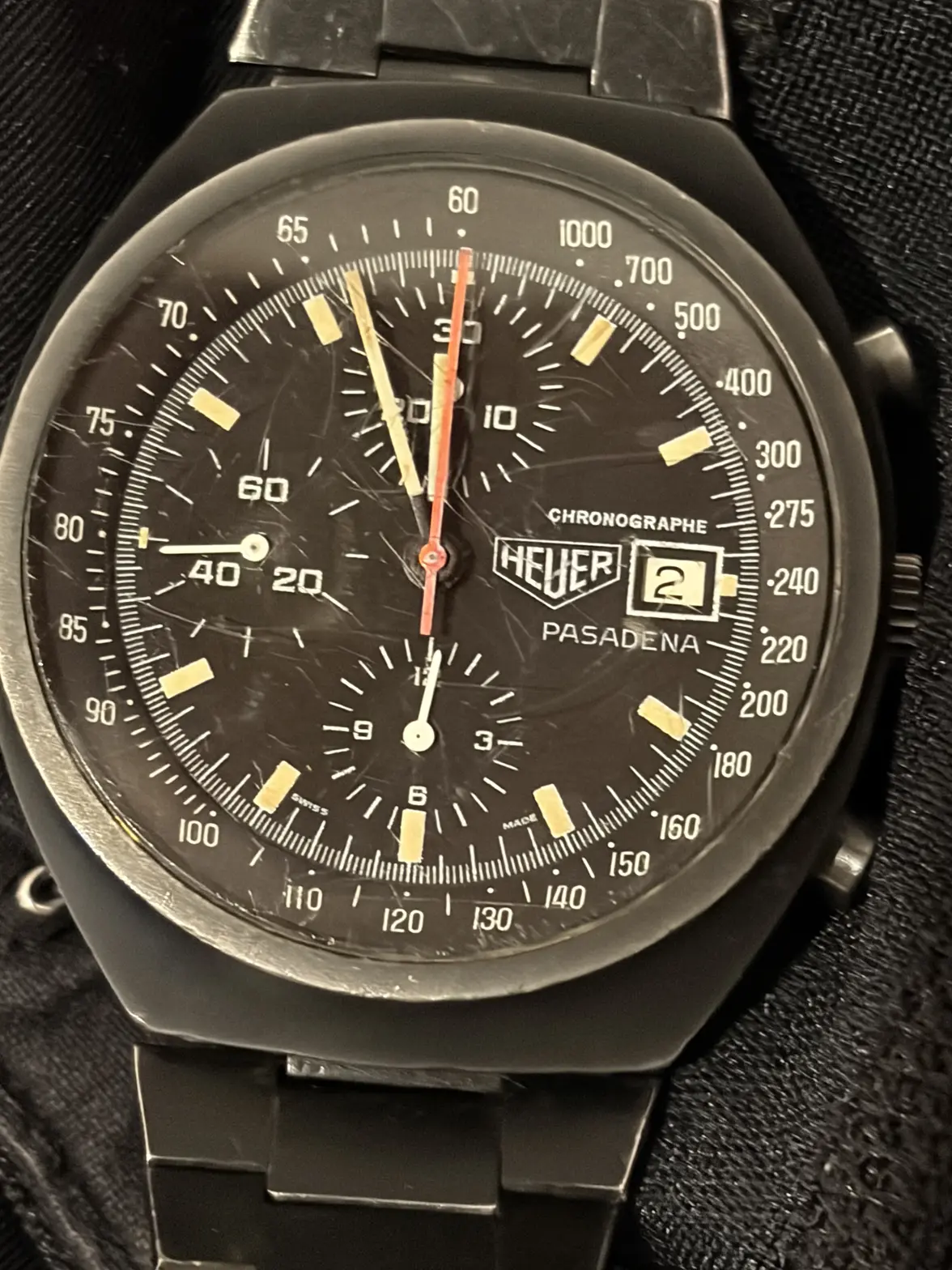
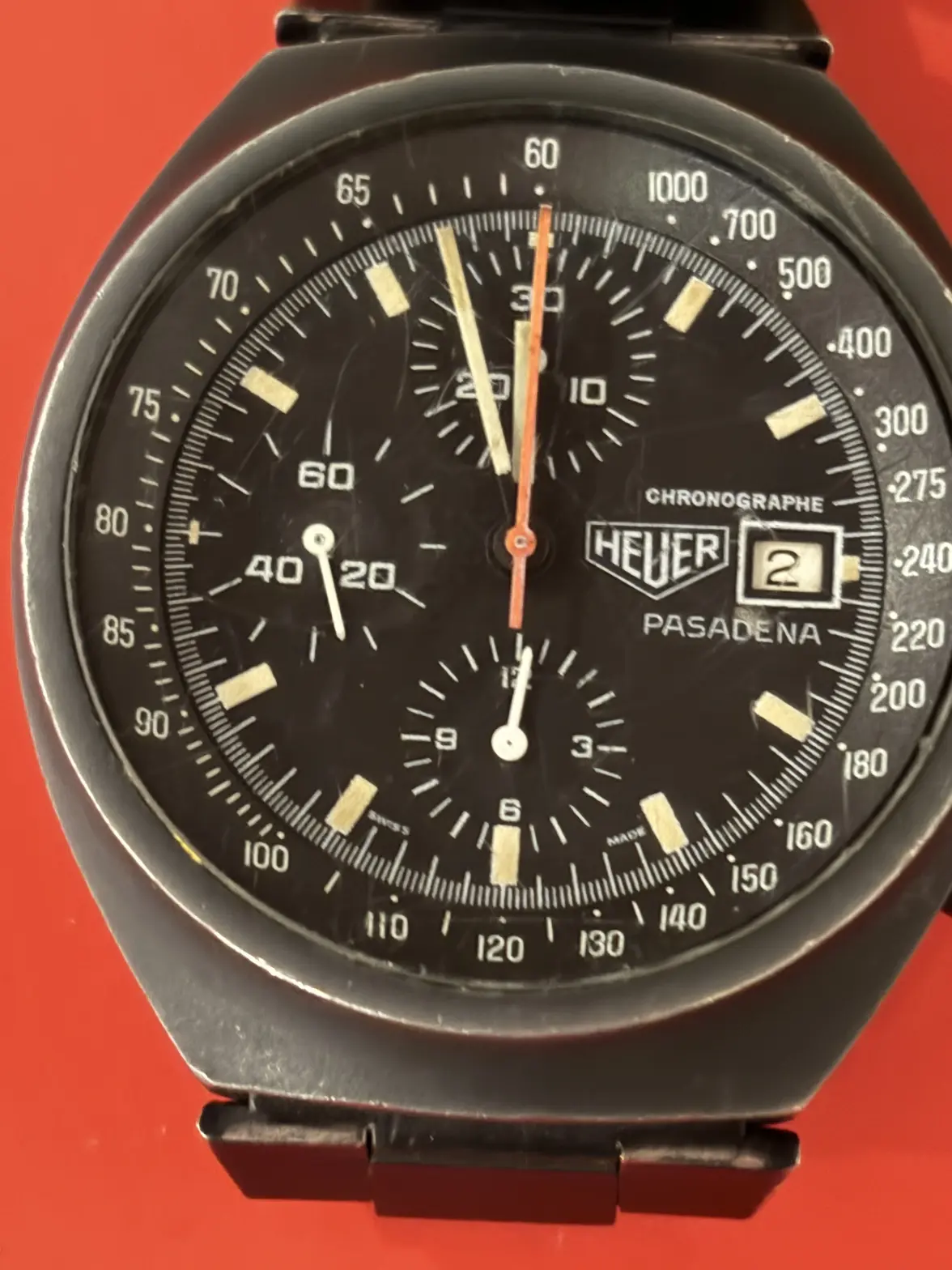
·I picked up this Pasadena from Japan. As many Heuer fans know, date-only dials do not have “Pasadena” on the dial. But, this one does. Not only that, it also has “chronographe” printed above the date. As much as I’ve searched the web, I’ve been unable to find another dial like this one. It’s in pretty good shape except for the scratched mineral crystal which I’ll soon replace.
From TagHeuer.com :
This changed in 1981 when we start seeing Day-Date models with a light grey circle outlining the registers, [such as this example below].
This second-generation “Day-Date” version of the Pasadena, with grey “Daytona rings” around the registers is perhaps the image that most comes to mind when one thinks of the Pasadena.
The lume markers at 3 o’clock, 6 o’clock and 9 o’clock are no longer rectangular, but instead have been changed to small dots.
We also begin to see more subtle changes on the registers, with the sub-dials now indented rather than being a flat surface.
In the early 1980s Heuer began marketing several of its chronographs with no model names, but instead only a simple reference number. The Pasadena followed this approach, with there being versions of the Pasadena that had only the “Heuer” shield and the word “Automatic” on the dial, but not the name Pasadena. Other models that moved to this “no name” approach in the early 1980s included the Silverstone and Cortina.
From TagHeuer.com :
HEUER PASADENA DAY-DATE 750.501- VERSION 1
The first versions of the Pasadena featured a flat back dial, with the registers having no different finish or outline, but simply being created by the use of white hash-marks painted on the dial. Note the square/ rectangular lume markers at 3, 6 and 9, which differ from later Pasadenas.This changed in 1981 when we start seeing Day-Date models with a light grey circle outlining the registers, [such as this example below].
This second-generation “Day-Date” version of the Pasadena, with grey “Daytona rings” around the registers is perhaps the image that most comes to mind when one thinks of the Pasadena.
HEUER PASADENA DATE 750.501- VERSION 2
The second version of the Pasadena arrives in 1982, but this time without the Pasadena name on the dial. We also see another variant of the model, this time with only a date function, rather than the Day-Date of the early models. But despite this change, the two models share the same reference number.The lume markers at 3 o’clock, 6 o’clock and 9 o’clock are no longer rectangular, but instead have been changed to small dots.
We also begin to see more subtle changes on the registers, with the sub-dials now indented rather than being a flat surface.
In the early 1980s Heuer began marketing several of its chronographs with no model names, but instead only a simple reference number. The Pasadena followed this approach, with there being versions of the Pasadena that had only the “Heuer” shield and the word “Automatic” on the dial, but not the name Pasadena. Other models that moved to this “no name” approach in the early 1980s included the Silverstone and Cortina.
HEUER PASADENA DAY-DATE 750.501- VERSION 3
The third version of the Pasadena is a Day-Date model without the Pasadena name, again introduced in 1982 and produced for a relatively short time.HEUER PASADENA DATE 750.501-3 STEEL- VERSION 4
In 1982 we see for the first time a stainless steel version of the date Pasadena, with these chronographs not having the “Pasadena” name on the dial. The steel model usually, but not always, has the “-3” suffix on the reference number.HEUER PASADENA DAY-DATE 750.501-3 STEEL- VERSION 5
The last model in the Pasadena collection is the Day-Date version housed in the stainless steel case, with these models having been produced for only 12 to 18 months.


