Help Identifying Omega Automatic

Posts
11
Likes
3
Not in the common use of the term in the US jewelry industry.

Plaque is sort of "applied"
Or is "gold"
L is mechanically bonded (G is electroplated)
60 micron thickness, which is better than 20 but not by much.

Thanks. Is this what omega forum members refer to as "gold filled"?
 
Posts
11
Likes
3
Thanks, this is great info. I actually haven't come across the term "laminated gold plated" in the research I've done so far.

I found this great document in another thread
http://users.tpg.com.au/mondodec//GoldCap.pdf

From this doc, I found the different terms below. Is "laminated gold plated" equivalent to any of these terms?
"Electoplated" : 5-20 (sometimes 40) microns
"Rolled Gold Plate"/"Gold Plaque" : thicker than gold plated, thinner than gold filled
"Gold Filled" : 50-140 microns
"Gold Capped" : >= 200 microns
 
Posts
5,636
Likes
5,811
This document implies that Australia considers 60 micros "gold filled".

Each country might have its own definition. All you know is that the Swiss considered that you have 60 microns gold mechanically bonded.
 
Posts
11
Likes
3
This. Plaque / Plaqué.

Ok, got it. Sorry for so many questions, but I'm a bit obsessed with being able to precisely describe my dad's watch. 😀

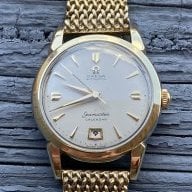
Now another question. I was wondering if it's possible to glean from the markings on the watch where it was purchased. The movement serial number places it in 1958. My Dad lived in England, Germany, Israel, and the US from 1958-60. From what I've researched, imported Omegas (for US and UK at least, not sure about other countries) had cases made by local suppliers. Since this is a Swiss Huguenin Freres case, what can I conclude about where it was purchased?
Edited: