- Posts
- 498
- Likes
- 410
norb1967
·Hello all
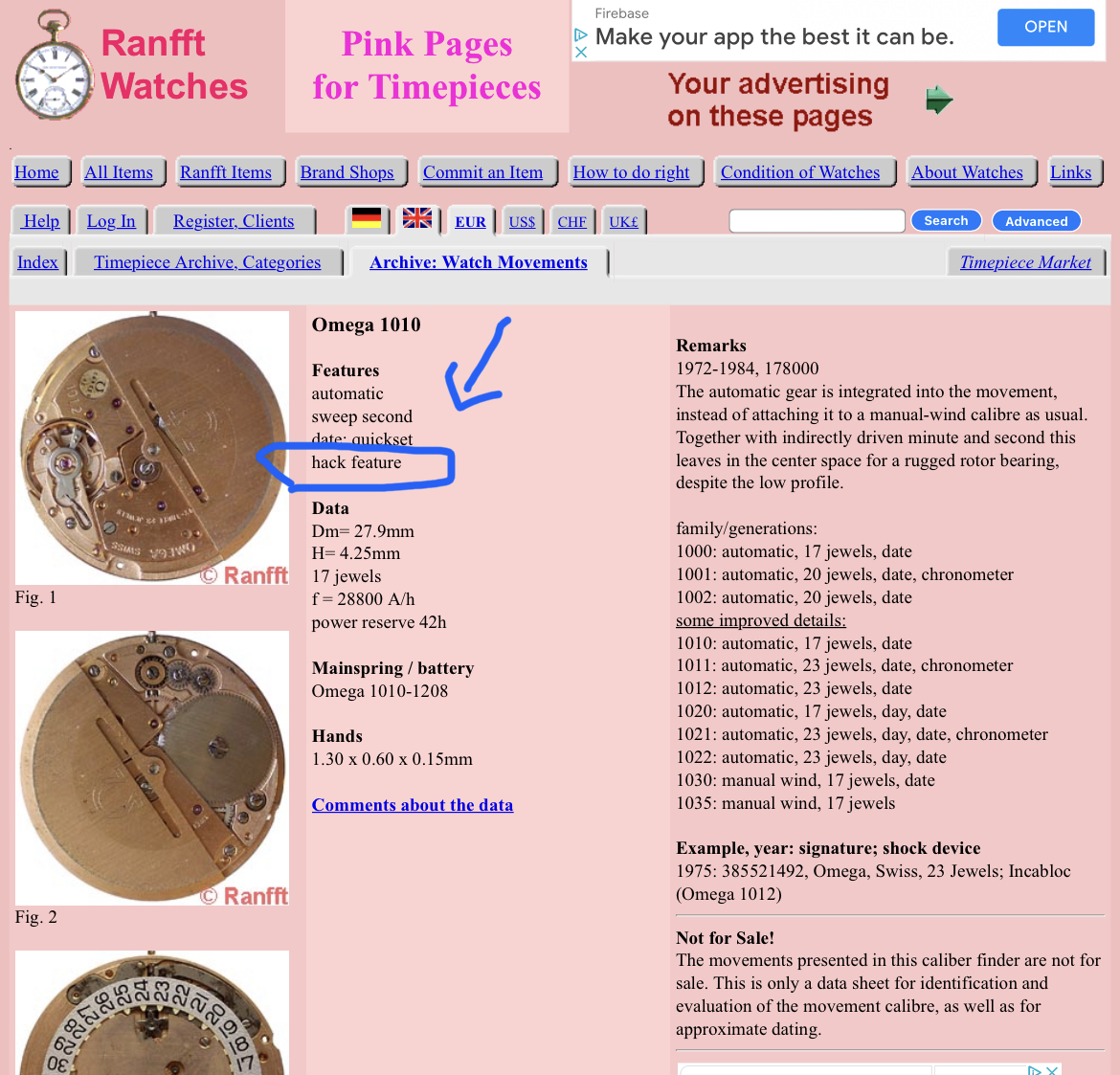
A question about when Omega started to make hacking movements (when the second hand stops when adjusting the time). When I first handled a vintage Omega (an early 50s Seamaster) I noticed the seconds hand didn’t stop when adjusting the time. I have a modern Speedy date (based on the Valjoux 7750 movement) where the seconds hand stops whenever adjusting the time.
At first I thought this was due to an issue with the cannon pinion, but after a little research I realised many vintage watches simply don’t have this functionality. Now I have a lovely 2849 Seamaster from 1959 (503 cal) running like a charm and just serviced, and it too doesn’t ‘hack’ when setting the time.
So, for curiosity’s sake, when did they start adding this feature, and how can one differentiate between a worn movement and one which simply doesn’t have that feature?
A question about when Omega started to make hacking movements (when the second hand stops when adjusting the time). When I first handled a vintage Omega (an early 50s Seamaster) I noticed the seconds hand didn’t stop when adjusting the time. I have a modern Speedy date (based on the Valjoux 7750 movement) where the seconds hand stops whenever adjusting the time.
At first I thought this was due to an issue with the cannon pinion, but after a little research I realised many vintage watches simply don’t have this functionality. Now I have a lovely 2849 Seamaster from 1959 (503 cal) running like a charm and just serviced, and it too doesn’t ‘hack’ when setting the time.
So, for curiosity’s sake, when did they start adding this feature, and how can one differentiate between a worn movement and one which simply doesn’t have that feature?