ETA 2892A2 Automatic Wind Issue - Request for Help Please

Posts
49
Likes
53
I recently serviced an ETA 2892A2 movement and the amplitude at full wind is 300deg and after 24h is 225deg. The reserve is a little low at 38hours but I’m not overly worried about that just now.

My main problem is that the automatic wind mechanism will not work efficiently and the watch stops after 2days of wearing from full wind (it’s taken off at night). I confess that the reverser was not exchanged but cleaned and relubricated with V105. I can’t see and fault with its operation when revolving the weight in either direction the movement is being wound.

The oscillating weight is quite sluggish when the watch is moved. It’s not binding anywhere but there is a definite reluctance for it to spin freely as expected and will easily get hung up at the top (opposing gravity)

I removed the weight, mounted it on a tapered mandrel and although not stiff it seems very damped. I cleaned the bearing through and repeated this experiment with no oil, small oil (9010) and finally oil on all the balls in the race. The difference was negligible.

I compared the freedom of spin to a known good 7750. Chalk and cheese!

Thanks for sticking with me this far! I wanted to give as much detail as possible that might help you help me.

My question is, are such winding issues in the eta 2892A2 automatic winding usually attributed to the bearing and reverser wheel, or can it also be at the ratchet driving wheel etc under the barrel bridge?

The movement feels normal and smooth when wound at the crown, no unexpected resistance.

I’d be grateful for any help that can be offered please

Kind regards
Darren
 
Posts
15,197
Likes
44,654
I’d suggest you remove the auto-wind system, strip it, check each and every component, re-clean it, and re-lube as you re-assemble it. It will be easier for you to trouble shoot the problem than it would be for anyone else since you have the watch.

You say it quits after two days on the wrist, after a full manual wind. Sounds to me as though the automatic winding system isn’t winding at all.

There is no need to open a new thread each time you follow up your post. Simply return to a post you have made and hit the REPLY button.
 
Posts
29,141
Likes
75,305
In my experience the #1 culprit with your problem description is the rotor bearing.

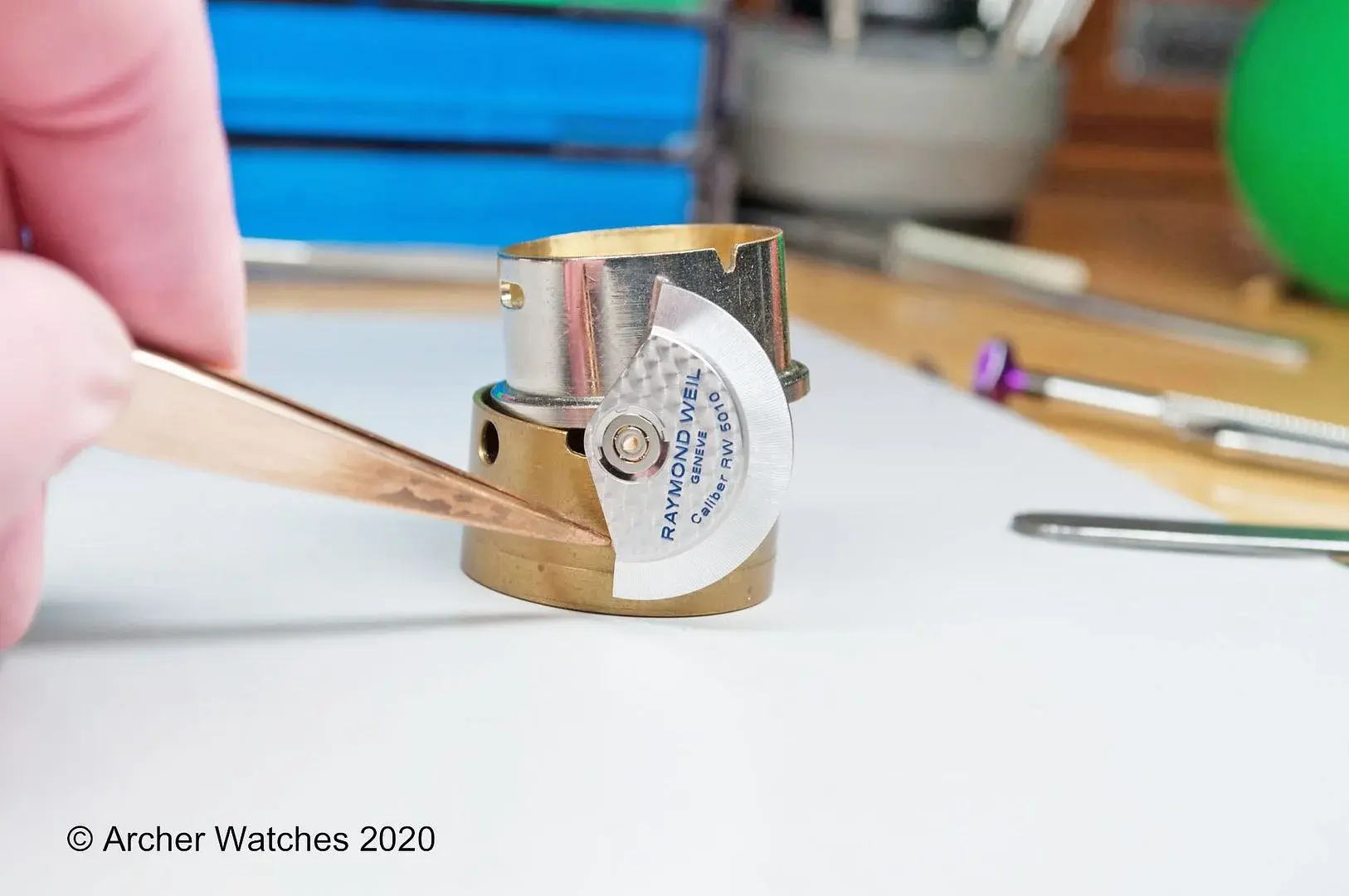
You need to check the condition of the bearing - this is done by using a damping test. As you have already done, you mount the rotor on something (I typically use peg wood) and place that peg wood between two movement holders to support it. This is with a 7750 but it gives you an idea - the rotor must be able to swing and hang freely:


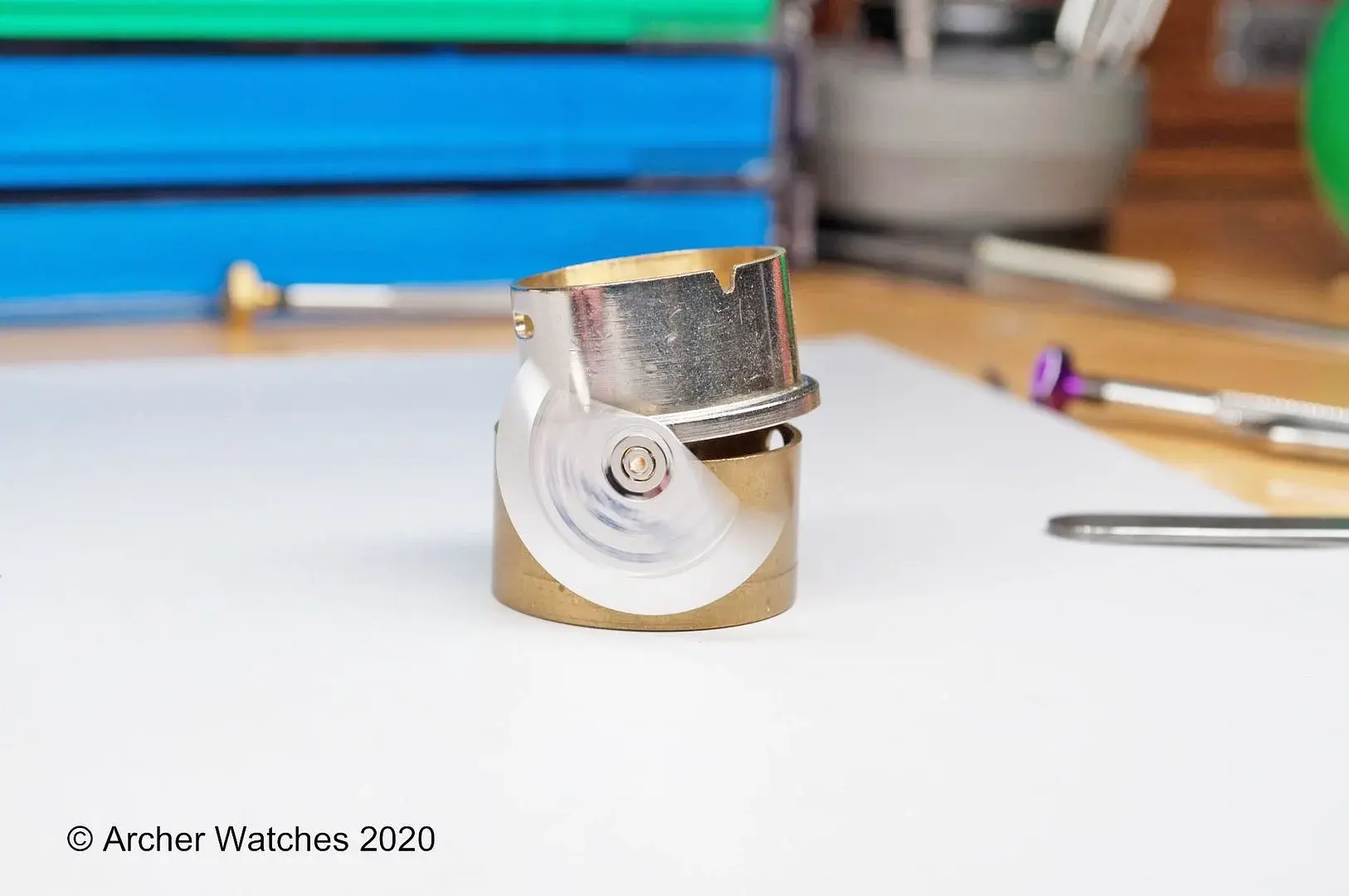
I turn the rotor 90 degrees from hanging, like above, and then let it swing:


You watch the rotor closely as it swings, and time how long it takes to come to a full stop. For the 2892 rotor, it should swing at least 30 seconds. If it does, then I would apply the smallest drop of 9010 that you can to the bearing, and then do the test again and make sure it still swings for at least 30 seconds.

If it does not pass this test, you would demagnetize and clean the rotor (run it through the cleaning machine), then try it again. If it fails a second time, I personally try cleaning one more time. If it fails the third time around, the bearing gets replaced.

If there is one criticism of the 2892 that I could make, it's that the rotor isn't as good at winding as it is on some other calibers. This is one reason why the 1120 was redesigned in this area, and as an aside instead of 30 seconds for the damping test as the 2892 has, the 1120 requires a minimum of 45 seconds, and the 7750 is 1 minute. This reflects that these rotors swing for longer periods of time based on how the weight is distributed. So the 2892 is more sensitive to the rotor bearing condition than many other movements are.
 
Posts
49
Likes
53
In my experience the #1 culprit with your problem description is the rotor bearing.

You need to check the condition of the bearing - this is done by using a damping test. As you have already done, you mount the rotor on something (I typically use peg wood) and place that peg wood between two movement holders to support it. This is with a 7750 but it gives you an idea - the rotor must be able to swing and hang freely:


I turn the rotor 90 degrees from hanging, like above, and then let it swing:


You watch the rotor closely as it swings, and time how long it takes to come to a full stop. For the 2892 rotor, it should swing at least 30 seconds. If it does, then I would apply the smallest drop of 9010 that you can to the bearing, and then do the test again and make sure it still swings for at least 30 seconds.

If it does not pass this test, you would demagnetize and clean the rotor (run it through the cleaning machine), then try it again. If it fails a second time, I personally try cleaning one more time. If it fails the third time around, the bearing gets replaced.

If there is one criticism of the 2892 that I could make, it's that the rotor isn't as good at winding as it is on some other calibers. This is one reason why the 1120 was redesigned in this area, and as an aside instead of 30 seconds for the damping test as the 2892 has, the 1120 requires a minimum of 45 seconds, and the 7750 is 1 minute. This reflects that these rotors swing for longer periods of time based on how the weight is distributed. So the 2892 is more sensitive to the rotor bearing condition than many other movements are.
Thank you Archer, I appreciate your help. I’ve stripped the winding bridge, ultrasonic cleaned with new fresh fluid. Rebuilt using hp1300, and one drip of 9010 on one ball in the weight bearing. Demagnetised and built back into the movement. Feels no different and seems to struggle even when winding from full let-down

Removed the weight and set on a mandrel in a horizontal chuck. Displaced 90 degrees and released. Oh my! Oscillated three times then decelerated to an absolute halt all of 3 seconds at most. I think you’ve highlighted the issue.

I’m going to order a new bearing and bolt fitting tool, and also the reverser from cousins UK.

I’ll report back the findings to you all for future information to others who may have same issues.

Once again thank you for your time and effort to take the pictures for clarity. Much appreciated.

Kind regards
Darren
 
Posts
49
Likes
53
I’d suggest you remove the auto-wind system, strip it, check each and every component, re-clean it, and re-lube as you re-assemble it. It will be easier for you to trouble shoot the problem than it would be for anyone else since you have the watch.

You say it quits after two days on the wrist, after a full manual wind. Sounds to me as though the automatic winding system isn’t winding at all.

There is no need to open a new thread each time you follow up your post. Simply return to a post you have made and hit the REPLY button.
Thank for your help Canuck. I just replied to Archer too, and pretty much satisfies exactly what you suggested I do. Thanks for your help, it’s appreciated

Kind regards Darren
 
Posts
29,141
Likes
75,305
Thank you Archer, I appreciate your help. I’ve stripped the winding bridge, ultrasonic cleaned with new fresh fluid. Rebuilt using hp1300, and one drip of 9010 on one ball in the weight bearing. Demagnetised and built back into the movement. Feels no different and seems to struggle even when winding from full let-down

Removed the weight and set on a mandrel in a horizontal chuck. Displaced 90 degrees and released. Oh my! Oscillated three times then decelerated to an absolute halt all of 3 seconds at most. I think you’ve highlighted the issue.

I’m going to order a new bearing and bolt fitting tool, and also the reverser from cousins UK.

I’ll report back the findings to you all for future information to others who may have same issues.

Once again thank you for your time and effort to take the pictures for clarity. Much appreciated.

Kind regards
Darren
One thing I'll mention is that you should see the rotor get down to very small oscillations in this test just before it stops. Even if it passes for the time, if I see the distance these swings take go from a few mm's to zero very fast, I will clean the bearing again. It should almost sort of shimmer right in the last second before it stops.
 
Posts
49
Likes
53
One thing I'll mention is that you should see the rotor get down to very small oscillations in this test just before it stops. Even if it passes for the time, if I see the distance these swings take go from a few mm's to zero very fast, I will clean the bearing again. It should almost sort of shimmer right in the last second before it stops.
Hello Archer. Thanks for this info. 👍

No, the one I have is nothing like that. The bearing is very damped and swung 3 or 4 times then came to a halt after about 3 seconds. Given that, and the fact that I can displace it 180 degrees and get it to balance inverted in against gravity is indicative that it’s worn and not fit for function any longer.

I happened to have a good 7750 weight and bearing and the difference in freedom of movement in the same test is chalk and cheese. I’ve ordered a new part from cousins now and treated myself to the ‘cousins grade’ fitting tool with multi heads as well. Essential i would imagine? Also ordered the reverser wheel, relatively low cost and wouldn’t make sense to not change it at this stage - I wasn’t aware they were only a few pounds.

Thank you for all your help today🙂

KR , Darren