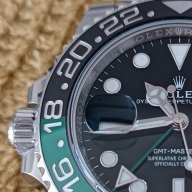
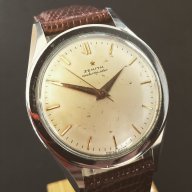
IMO it is a nice catch in general, huge congrats !
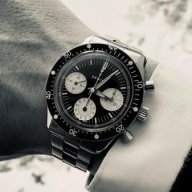
the GF bracelet signed 1/69 is definitly too early for this watch, but may be they put this on a later watch ...
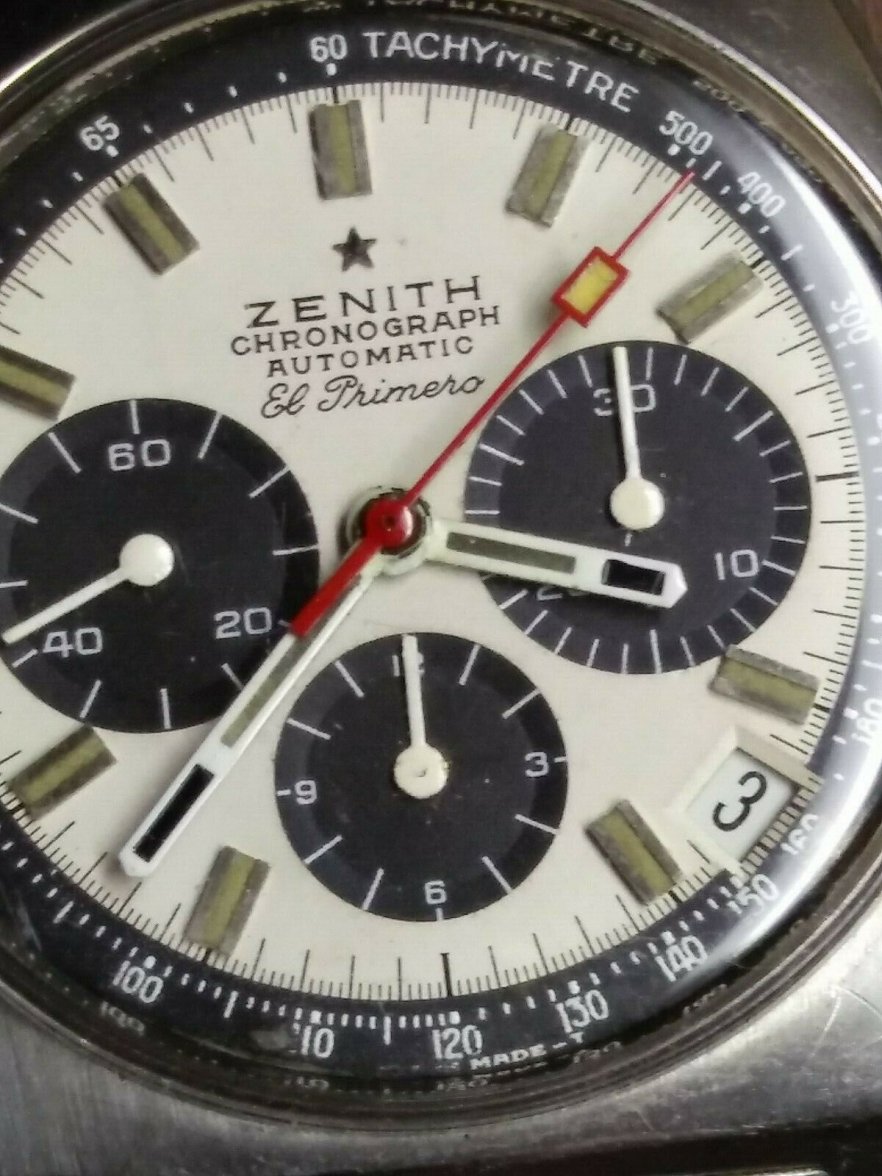
IMO you should alslo treat the subdial Hands in the second and minute counter subdials, because they look totally off with this overpainting.
Good luck
Actually the whole El Primero serial number system remains somewhat of a mystery. Lou S at WUS did a post some years back and they found that serial numbers only identified batches of production. I believe this serial puts it in the second batch. They also found that GF bracelet dating seemed to have no functional use for dating the watch because it seems Zenith used bracelets in no particular order (maybe a 68 on a 71 watch, etc). It makes sense since Zenith was buying these from another company.
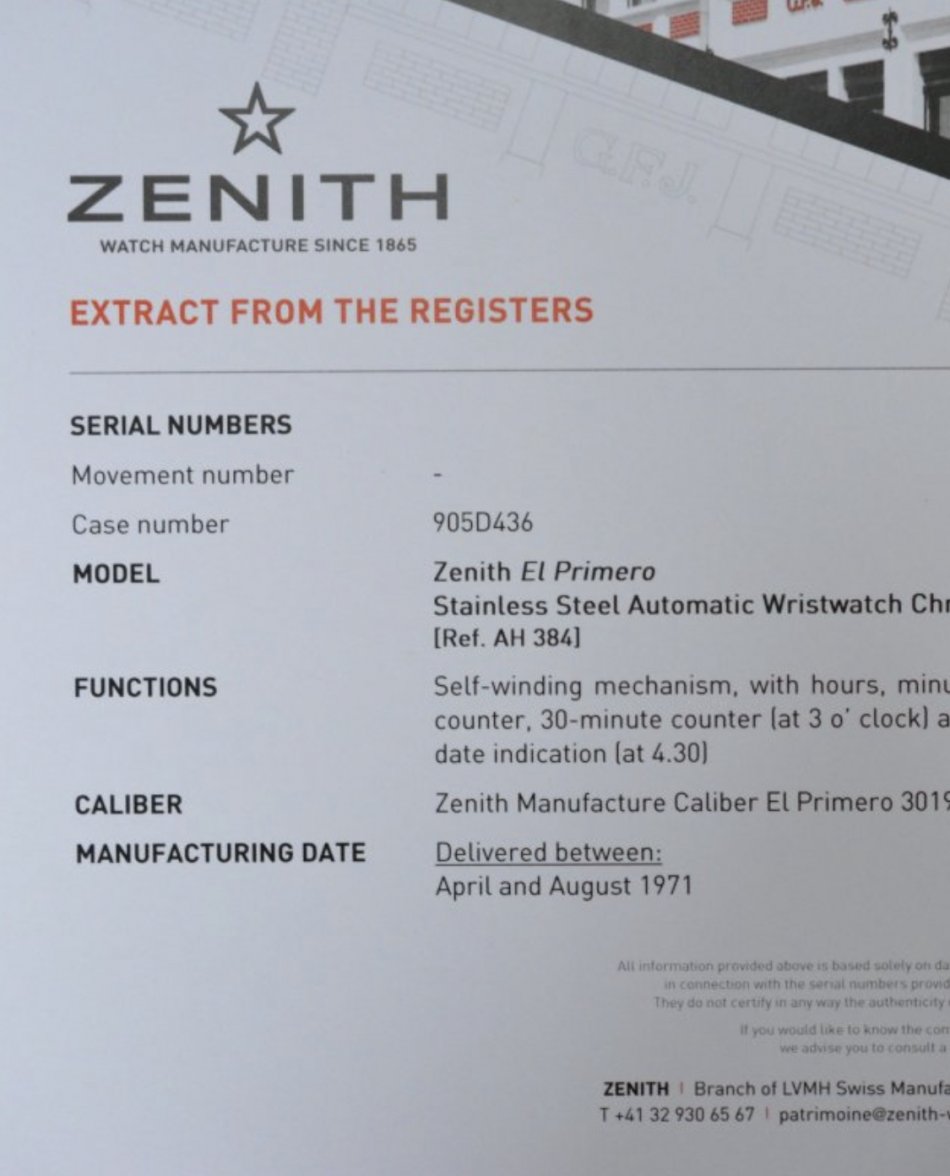
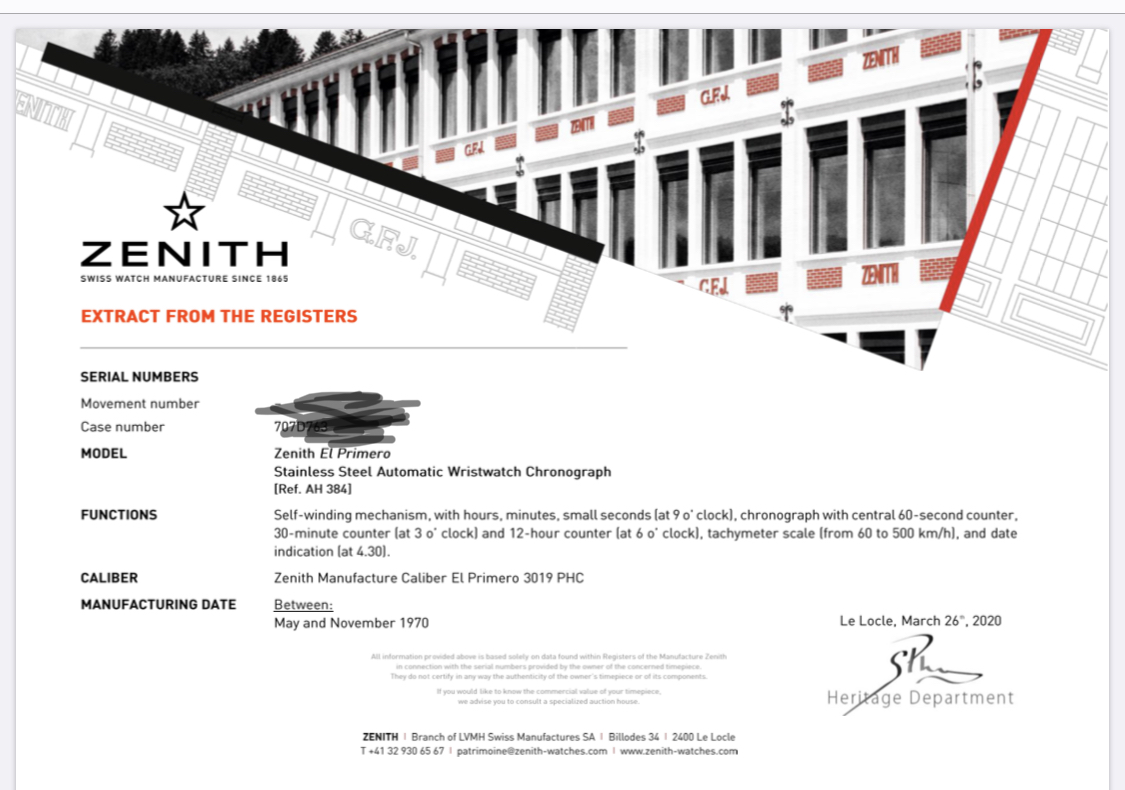
Also looking back on a former a384 for sale on our own Omegaforums by Bernarddevos, his extract of a 905DXXX watch shows it may have been delivered in April 1971. Perhaps I’ll get an extract too but if a 707DXXX was made in April 1970 (for example) then a bracelet from 1/69 is not so strange.
“Here are the results of the vintage Primero caseback project, and possibly the driest post ever. The data is a bit of a mess, although it has its interesting aspects. Please chime in if you see patterns that I have not. Sempervivens, I'm counting on you to reconcile the production number data with your own calculations.
Background: We all know Zenith dropped movement serial numbers before the Primero came out, clouding production sequence and batching, and forcing us to rely on Roessler for production figures. What we do have are case numbers. So I set out to collect caseback numbers with three goals:
1) verifying production numbers in Rossler 2) ascertaining production sequences and batching and 3) seeing if it is possible to arrive at an approximate absolute dating of case numbers.
Methods: Data from the early El Primero references (A
384-385-386, A
3817-3218, A 3822, A
781-782-783, A 787-788, A 7817, 01.0140.415, G
381-382-383, G
581-582-583, G 7810, G 7813, G 20809) were compiled by solicitation of members of this forum, the vintage forum at Orologi & Passioni and from my own image database in December 2012. Data included primarily caseback numbers and secondarily, clasp dates on Gay-Freres bracelets when available, any other means of dating, plain or NATO casebacks, and for the A 385, silver or white subdials. Sources of error include casebacks switched among cases, bracelets switched among cases (which I regard as highly likely), dial swaps, etc.. By the nature of the primary data, conclusions can only be drawn regarding case production, as cases and movements were not necessarily married in sequence.
Results: 94 individual watches are identified, of which 90 had useable caseback numbers (first three numbers and letter legible). They break down as follows:
A 384: 10 A 385: 11 A 386: 14 A 3817: 4 A 3818: 8 A 781: 5 A 782: 5 A 783: 1 A 787: 8 A 788: 6 01.0140.415: 2 G 381: 2 G 382: 3 G 383: 1 G 581: 2 G 582: 6 G 583: 1 Batching : In parentheses, the first number is the number of watches from this batch in my database. The second number is
minimumproduction number, derived by subtracting lowest number from highest in the series.
STEEL: Batch 1: 538 D 4xx to 538 D 6xx (3/201) - all A 386s. The single Gay-Freres date we have for the batch is dated 3[SUP]rd[/SUP] Quarter 1969. Curiously, all have plain casebacks. This clearly distinct group is unusual in that the case numbers for the first three references tend to be commingled in other batches.
Batch 2: 706 D xxx to 708 D 4xx (14/1076 )- mixed A 384 (7), A 385 (5) and A 386 (1). The A 386 has a plain caseback, the remainder all have NATO star casebacks.
There are 7 associated GF bracelets, dated from 2-68 to 1-71. That first date demonstrates to me rather well how little we can rely on the GF bracelet dates for absolute dating.”