Early Explorer 1016, with a Twist

Posts
494
Likes
239
Back room re-engraving of serial numbers doesn't explain the lightly engraved 'Stainless Steel' on the case back in question. Arguably, there's no reason anyone would add 'Stainless Steel' text to a case back where it's not seen as an authentication. This engraving isn't, to my knowledge, known to add any value, so what's the advantage of someone adding it to case back after it left the factory?

TLDR; if the caseback engraving isn't real, why TF is is there?

Well, why are people hand engraving unit-numbers, serial numbers, movement numbers, "to my first wife with love" etc. on the caseback or on the case itself?
I've seen pretty much every kind of engraving on pretty much every kind of watch... Why people do that? Don't know.
If you like I could engrave your watches with whatever engraving you like. I got pretty shaky hands - so I could guarantee you that "Rolex factory" look. 😉
 
Posts
494
Likes
239
Also, notice something important above? Every single watch with those unique 20% "Rolex factory" engravings has serious pitting between the lugs. Almost like you could imagine it to be really hard to still recognize a serial number at all - if it wouldn't be extra special "Rolex factory" engraved... 🍿
 
Posts
6,832
Likes
13,797
I Have never seen anything like it. I have had 60’s Rolex and nothing seemed to be done by a nervous 5 year old on caffeine.

It is still a great watch, but I think somewhere along the line it got serviced by a watch maker that thought he should “help” the engravings a little.
Edited:
 
Posts
963
Likes
1,251
I Have never seen anything like it. I have had 60’s Rolex and nothing seemed to be done by a nervous 5 year old on caffeine.

It is still a great watch, but I think somewhere along the line it got serviced but a watch maker that thought should “help” the engravings a little.

I still don't understand, why would anyone add the words 'Stainless Steel' to the caseback? It doesn't read like a personalization.
 
Posts
8,097
Likes
28,528
I still don't understand, why would anyone add the words 'Stainless Steel' to the caseback? It doesn't read like a personalization.

They would do so if they somehow believed, no matter how absurdly, that it might add "authenticity" to the watch.

There is zero chance that Rolex was responsible for it.
 
Posts
8,097
Likes
28,528
After further research, I think that I may have found a "factory original" dial from the same source...

 
Posts
1,567
Likes
2,677
Congratulations on the nice acquisition! One question, though:


"factory applied"? Surely that cannot be accurate...

rlx76.png

Steel Rolex ovettones and early Explorers did typically have this light engraving for "Registered Design/Modele Depose" on the caseback exterior. The font is quite similar, so I would think it's fairly plausible the engraving is original given the provenance.
 
Posts
8,097
Likes
28,528
Steel Rolex ovettones and early Explorers did typically have this light engraving for "Registered Design/Modele Depose" on the caseback exterior. The font is quite similar, so I would think it's fairly plausible the engraving is original given the provenance.

Some examples, please?

I do see that Rolex didn't always stamp "stainless steel" inside the case backs, which may help to support some claims, but not this one. In any case, I still can't believe that such poor quality originated in a factory - any factory.
Edited:
 
Posts
1,567
Likes
2,677
I do see that Rolex didn't always stamp "stainless steel" inside the case back, which helps to support the claim. But I still can't believe that such poor quality originated in a factory - any factory.
/responding to the edit:

CNC machines didn't exist in the 60s. Pantographs and other engraving tools could be extremely accurate, sure, but watches weren't held to the same high standard that they are today as luxury products. It's very easy to forget that these were just regular timepieces built to a high standard, as does everyone who claims a dial is fake or redone because of a minutely misaligned index, etc.

Rolex only shifted it's entire appeal towards luxury in the 70s/80s.
 
Posts
8,097
Likes
28,528
Scroll to the bottom.

I see engravings that look nothing like the OP's through that link (they are much finer). Can you provide any that are similar to the OP's, and that you also believe to be "factory original"?

CNC machines didn't exist in the 60s. Pantographs and other engraving tools could be extremely accurate, sure, but watches weren't held to the same high standard that they are today as luxury products. It's very easy to forget that these were just regular timepieces built to a high standard, as does everyone who claims a dial is fake or redone because of a minutely misaligned index, etc.

We're not talking about anything remotely close to high standards in this instance - we're talking about a lack of any standards. And I'm not being flippant.

Are you aware of any Rolex collector, or dealer, etc. ever having received authentication from Rolex for a watch with such terrible quality engravings?

I'm with @kelev_ra (and Occam's Razor) in believing that the simplest and most likely explanation is that some sellers who had watches with degraded case backs or mid-cases chose to re-engrave, and failed miserably.

Also, consider how many Explorers were produced up to the early '60s, and have circulated over the decades. The handful that have been used as supporting evidence would represent only a tiny fraction of those produced.
 
Posts
3,998
Likes
9,018
Also, consider how many Explorers were produced up to the early '60s, and have circulated over the decades. The handful that have been used as supporting evidence would represent only a tiny fraction of those produced.

So, there seems a conflation going on now.

There have been many watch examples posted (or linked to) with some *fairly* shoddy engraving work on any number of parts of watches.

Then there has separately been a watch with *extremely* shoddy engraving work on the caseback.

Am I right that we've now turned a corner to using the latter to disprove the legitimacy of even the former?

It seems to me one (more difficult) thing to out of hand discount the perhaps *surprising* degree of quality variation of early engraving when placed under macro.

It seems another (separate) thing to talk about the specific caseback in question?
 
Posts
8,097
Likes
28,528
So, there seems a conflation going on now.

I don't think so. I am skeptical of all of the markings on the OP's watch, and any that are extremely shoddy found on other examples. Yes, I find the case back to be even more dubious, and have no problem discussing it separately, but I am still awaiting anything like what I would consider to be compelling evidence that either of them are likely to be original.
 
Posts
3,998
Likes
9,018
I don't think so. I am skeptical of all of the markings on the OP's watch, and any that are
extremely shoddy found on other examples. Yes, I find the case back to be even more dubious, and have no problem discussing it separately, but I am still awaiting anything like what I would consider to be compelling evidence that either of them are likely to be original.

Fair enough, but I guess to put it differently:

Your line of argument seem to be (please allow some hyperbole for effect 😁): factories make things nearly perfect, so wildly bad things are unlikely

And I'm just noting that this line of reasoning seems to ignore the numerous examples of things not leaving the factory perfectly and being *sort of* shoddy, which means it's not such a stretch to believe in terrible outliers.

I dont take a position on the caseback in question, and I'm also interested to see more confirmation or otherwise.

Afterall 😁

Rolex-Defected-Watch-GQ-05212019_3x2.jpg
 
Posts
8,097
Likes
28,528
Your line of argument seem to be (please allow some hyperbole for effect 😁): factories make things nearly perfect, so wildly bad things are unlikely

And I'm just noting that this line of reasoning seems to ignore the numerous examples of things not leaving the factory perfectly and being *sort of* shoddy, which means it's not such a stretch to believe in terrible outliers.

Like you, I am well aware of variations in quality that occurred back then (e.g. IWC dial signatures, etc.), so I have no expectations of perfection, or anything really close. What I do expect, though, is a reasonable floor to the flaws that manufacturers, and especially major ones, made. I cannot recall ever have seen anything so shockingly poor as the scratches on the subject watch. It is beyond my comprehension how or why QC at Rolex might have allowed such work to reach the market.

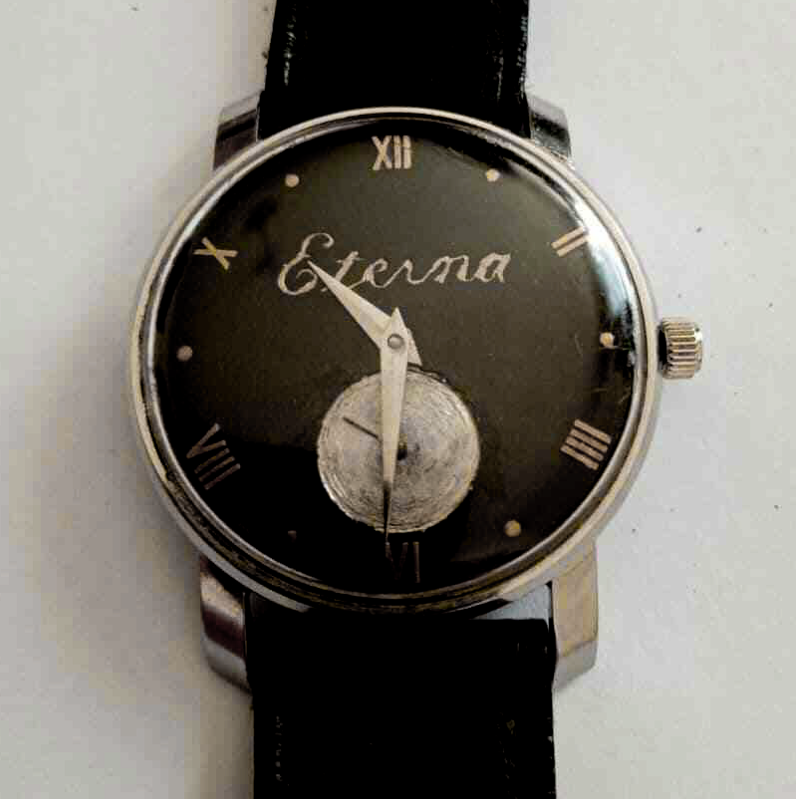
I posted the obviously redialed Eterna not only as a joke, but also to suggest that I really can't think of any close analogue to the subject engravings. Have you ever seen work anywhere near that poor, from any major brand?

I can't comment on the contemporary examples that you posted, as they appear to be graphic representations of dials, rather than actual ones.
 
Posts
6,193
Likes
21,198
The following is complete conjecture and not based on history, i.e. a supposition.

Agreeing that this wasn't factory, why would anyone add "stainless steel?"

Consider pre-internet, pre-collecting, before watch as jewelry with precious metals (yes, there were some, but did the general population desire these?)

Is it just as simple that a few guys added it and it caught on?

There was a time before Marks and sub-Marks, when a Rolex was just a nicer watch and people had no thought about calibers.

Sometimes things happen without a plan or coordination. This is an interesting discussion and I would like to know the actual history of the poor engravings, but it makes sense to me it was random and just happened. Engraving to cover up pitting makes sense. Stainless steel used to be special and modern, so why not?
 
Posts
8,097
Likes
28,528
Engraving to cover up pitting makes sense. Stainless steel used to be special and modern, so why not?

First, because "stainless steel" is stamped on the inside of the case back, and in the quality that one would expect. So why on earth would the same company have employed someone to also scratch a terrible, redundant message by hand on the case back?
 
Posts
6,193
Likes
21,198
First, because "stainless steel" is stamped on the inside of the case back, and in the quality that one would expect. So why on earth would the same company have employed someone to also scratch a terrible, redundant message by hand on the case back?

Sorry, I was unclear. I don't believe it was either the company or a company agent. It makes more sense to me that it was done by a watchmaker or watchmakers who at best were motivated to spice up or make nicer a clients watch. The idea that a watchmaker would add a an engraving to hide or fix a disfigured area (as has been suggested) makes sense to me, more so than that it was done so by the factory.

As to why they put SS, I was speculating that SS was still a neat feature that could be reasonable to engrave if someone were searching for what to put there.
 
Posts
1,567
Likes
2,677
Like you, I am well aware of variations in quality that occurred back then (e.g. IWC dial signatures, etc.), so I have no expectations of perfection, or anything really close. What I do expect, though, is a reasonable floor to the flaws that manufacturers, and especially major ones, made. I cannot recall ever have seen anything so shockingly poor as the scratches on the subject watch. It is beyond my comprehension how or why QC at Rolex might have allowed such work to reach the market.

I posted the obviously redialed Eterna not only as a joke, but also to suggest that I really can't think of any close analogue to the subject engravings. Have you ever seen work anywhere near that poor, from any major brand?

I can't comment on the contemporary examples that you posted, as they appear to be graphic representations of dials, rather than actual ones.

🙄
 
Posts
8,097
Likes
28,528
Sorry, I was unclear. I don't believe it was either the company or a company agent. It makes more sense to me that it was done by a watchmaker or watchmakers who at best were motivated to spice up or make nicer a clients watch

Ah, sorry. I agree.