Broken dial feet

Posts
647
Likes
1,603
Good morning,
Another question I would really appreciate your experienced advice.
I have a vintage watch with a broken dial foot which I like to repair or have repaired.
I've read about several methods, but am unsure what my next step would be.
Soldering new brass feet, using specialized adhesive, or using dial dots, what is my best option?
Does anyone have advice on which watchmaker to go with this in the Netherlands? Or is there an easy way to fix this myself?
Thanks in advance.
Jan

 
Posts
1,047
Likes
2,616
Dial dots is the answer I received when I asked the same question here years ago. Too much risk soldering new feet, and dial dots are perfectly effective. That is what the watchmaker who serviced the watch wound up doing, and they've held up well for ~5 years since the service was performed.
 
Posts
24,585
Likes
54,592
This depends so much on personal preference. What is your risk tolerance? How much do you trust your watchmaker's experience? Does he have the right equipment to solder with minimum heating? Do you want the "correct" repair, or is it sufficient to bring the watch back into working condition?

By the way, what is the watch? The rarity and value might impact your decision.
 
Posts
647
Likes
1,603
Thank you guys, I appreciate it! It is a vintage Heuer autavia, which I will receive soon. So it is quite valuable, but I can live with the fact that it is not perse the "correct" repair, and I am affraid for dial damage with solder option. The both safest and easiest manner seems to be with the dial dots, do you agree?
 
Posts
24,585
Likes
54,592
Yes, dial dots are safest and easiest IMO.
 
Posts
479
Likes
1,188
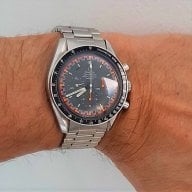
For whatever it's worth, I had a very experienced jeweler friend laser weld a dial foot onto a Speedmaster dial—it was, in his opinion, the least-risky option—and there was, in the end, a very small blemish on the dial from that. I'd be curious what others have experienced, but I've yet to know of a safe way to attach a dial foot without leaving some sort of mark on the dial.
 
Posts
770
Likes
1,433
FWIW, I generally use a dial feet milling tool instead of dial dots when playing around with watch mods (e.g. converting a seiko dial for an ETA-compatible movement). I don't have the expertise to solder, but using actual dial feet is more precise and probably more durable than dots. Dial dots are definitely easier, though, if precise alignment isn't critical.
 
Posts
24,585
Likes
54,592
For whatever it's worth, I had a very experienced jeweler friend laser weld a dial foot onto a Speedmaster dial—it was, in his opinion, the least-risky option—and there was, in the end, a very small blemish on the dial from that. I'd be curious what others have experienced, but I've yet to know of a safe way to attach a dial foot without leaving some sort of mark on the dial.
It can be done without leaving a mark. I have had feet reattached to two dials, and was lucky both times. But it requires an experienced person and/or a special tool. And as you learned, even an experienced person can sometimes damage the dial.

I'm pretty sure there are other threads where this topic was discussed in detail. At one point, I purchased low temperature eutectic solder for this purpose.
 
Posts
29,880
Likes
77,290
It's a difficult question, because there are just so many variables. What you might get away with in terms of applying heat on a thicker black dial, you will not get away with on a white dial, or a dial that is thinner.

I've looked into soft soldering with a torch - a jeweller friend tried this for me on an old dial and it left heat marks. Same with laser welding. Resistance welding is often iffy with the results in terms of the solder not holding the new dial foot securely.

Thankfully it's an issue I don't come across often, and I have not had to repair one for a long time now. But if I did, I would probably lean towards the milling a recess on the back of the dial and using adhesive.

Dial dots are not ideal, but in some circumstances they are the best "do no harm" option available until another approach that is more permanent but less risky can be used.
 
Posts
13,281
Likes
23,061
I’m sure I’ve seen someone use epoxy to attach a new dial foot somewhere to avoid heat marks.
 
Posts
2,220
Likes
2,433
I have used a cheap foot mill + adhesive foot solution a handful of times. The biggest danger is milling 'too deep' and getting into the face of the dial, but as long as you avoid that, its pretty trivial and safe. No heat involved (beyond the curing of an epoxy).

The hardest part is getting hte foot in the right place, but if you have an existing 'nub' of the previous foot, that part is actually really easy.

I for one hate dial dots. I've seen quite a few fail in my projects (particularly bad in watches where the dial is used in part to support the movement against the crown!) in ways that made the watch worse for it.
 
Posts
770
Likes
1,433
The hardest part is getting hte foot in the right place, but if you have an existing 'nub' of the previous foot, that part is actually really easy.
I use these templates.
 
This website may earn commission from Ebay sales.
Posts
647
Likes
1,603
Thank you for all the great advice! I ordered some dial dots to see if that works, if not, I will try one of the other options.
 
Posts
92
Likes
20
Dial dots can make another trouble and mostly not straight away
On complicated watches even small extra distance can slow down the watch for example
I am using this dots on cheap watches only
My personal recommendation is dial soldering only
You will find affordable Bergeon tool alternative today and it does the job absolutely the same way

Make sure you will play on it with some other donor watches and you will find how simple it is
 
Posts
808
Likes
1,497
Marshall on wrist watch revival does what archer said, mill it down and glue in a new dial foot. Only issue is if you mill too deep it shows on the other side. Until you figure it out, dial dots are your friend for a temp solution. Find a master at it and have them mill it.