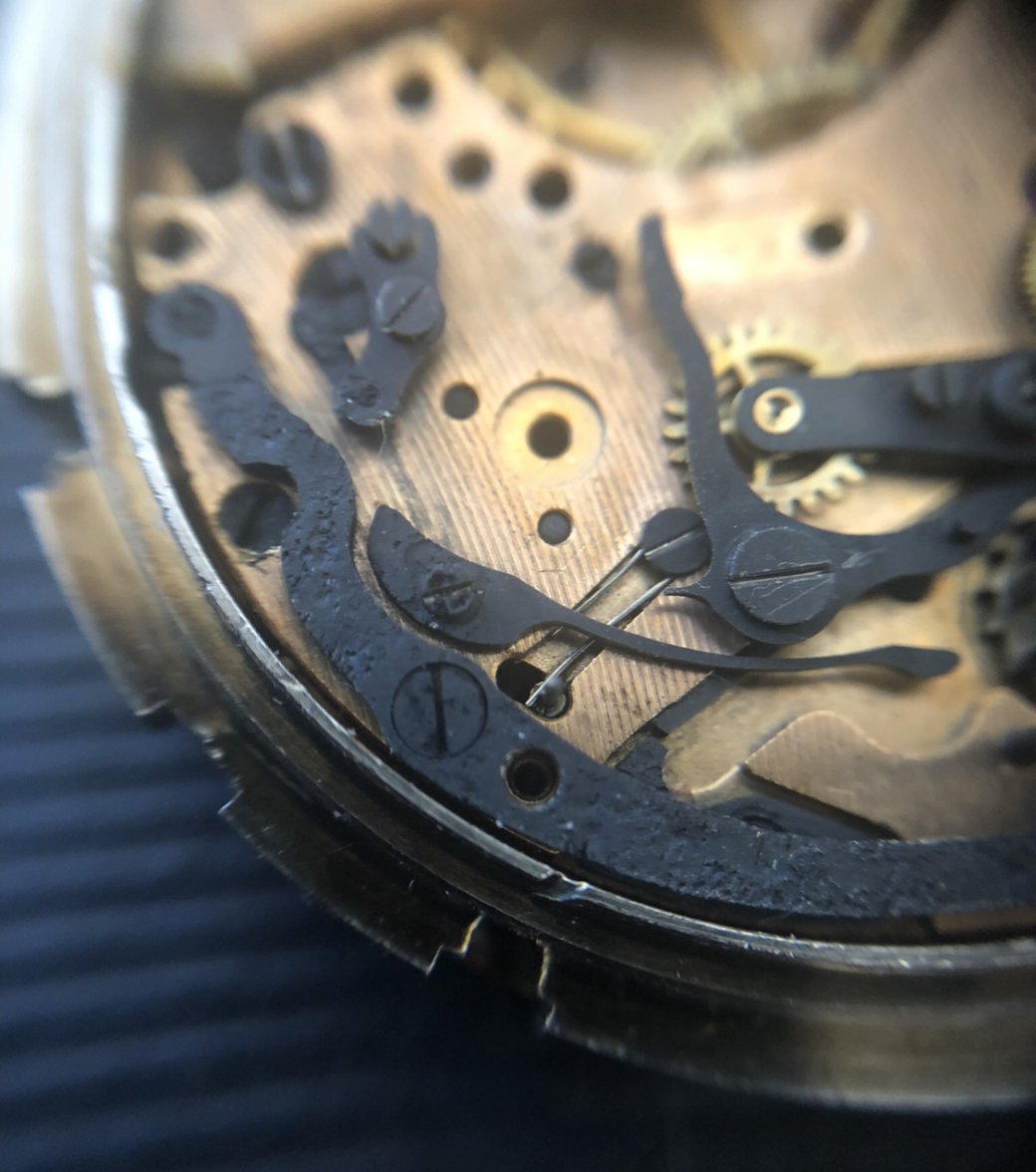
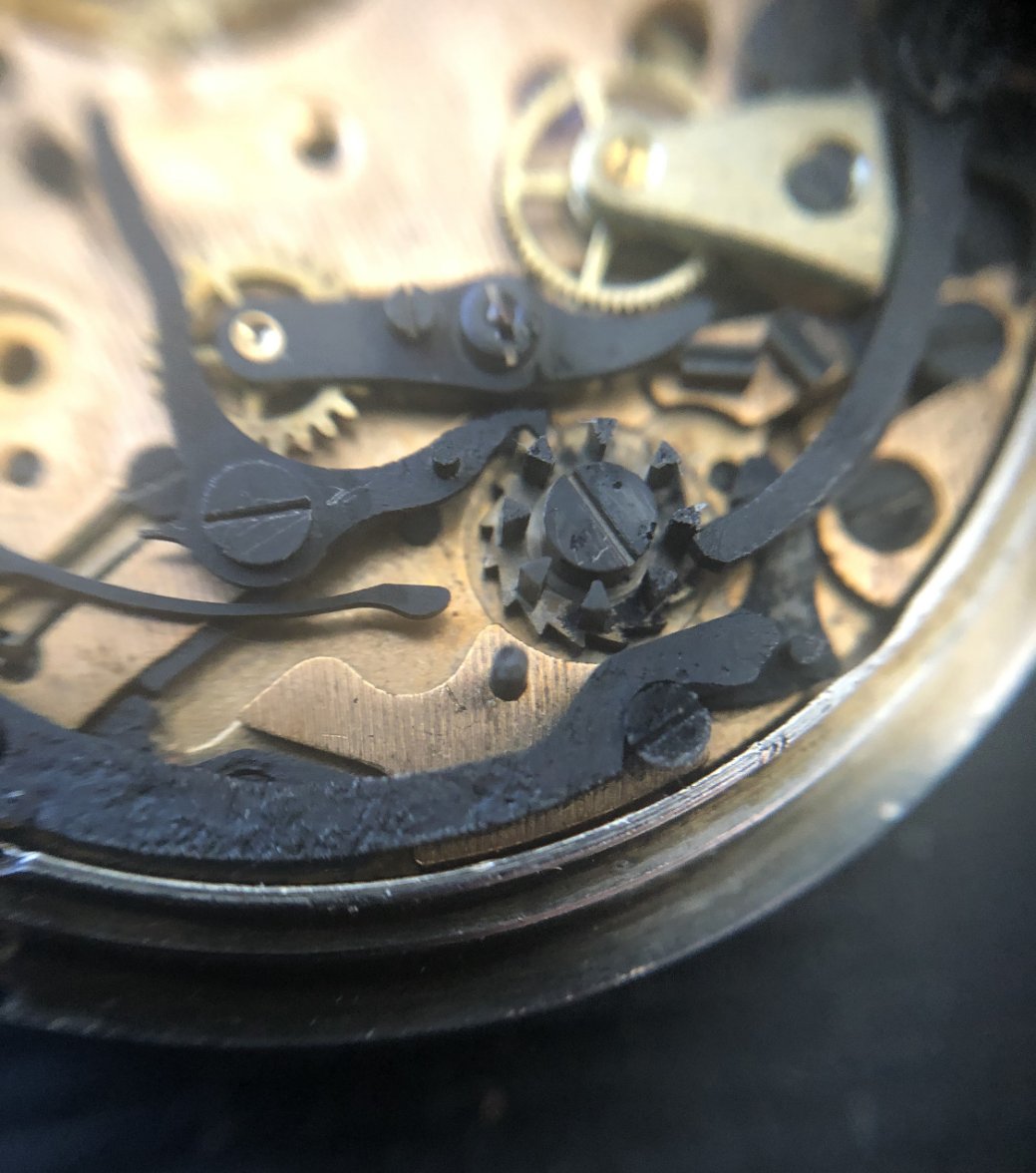
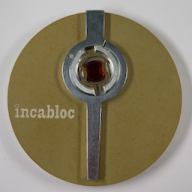
This happens if you leave parts for too long in evapo-rust. Don't ask me how I know.
I think it has something to do with how Evap-O-rust works. Some of the Iron oxides on Mars are black and not red. It gives mars the distinct features visible that were once though to be seas.
When I was researching Evap-O-rust, there were indications it would discolor parts. I have tried leaving the AS movement in for different times. It pretty much discolors the part where the rust was no matter how long the exposure is.
The color of the rust may also relate to the hardness of the steel. I noticed on the Heuer, the screws are more black. Screws that are heat treated a certain way become blackish blue. I notice they retain the shine where polished. If one polishes them the blue disappears, So in some cases this may be a desirable oxide.
Your parts look pitted. which is s sign of major damage. If I was working with them I would probably do some lapping polish on glass using diamatine. That would remove the loose stuff.
I am not a metallurgist. I think my friend John who had the tool and die shop was. Wish I had him around to ask this question. It is easy for accessible knowledge to get lost. He would worry about that.
Some of the modern bridges over the bay or rivers are treated to naturally rust. This also looks black. The 100 and decade or so old railway over the river has also rusted black.
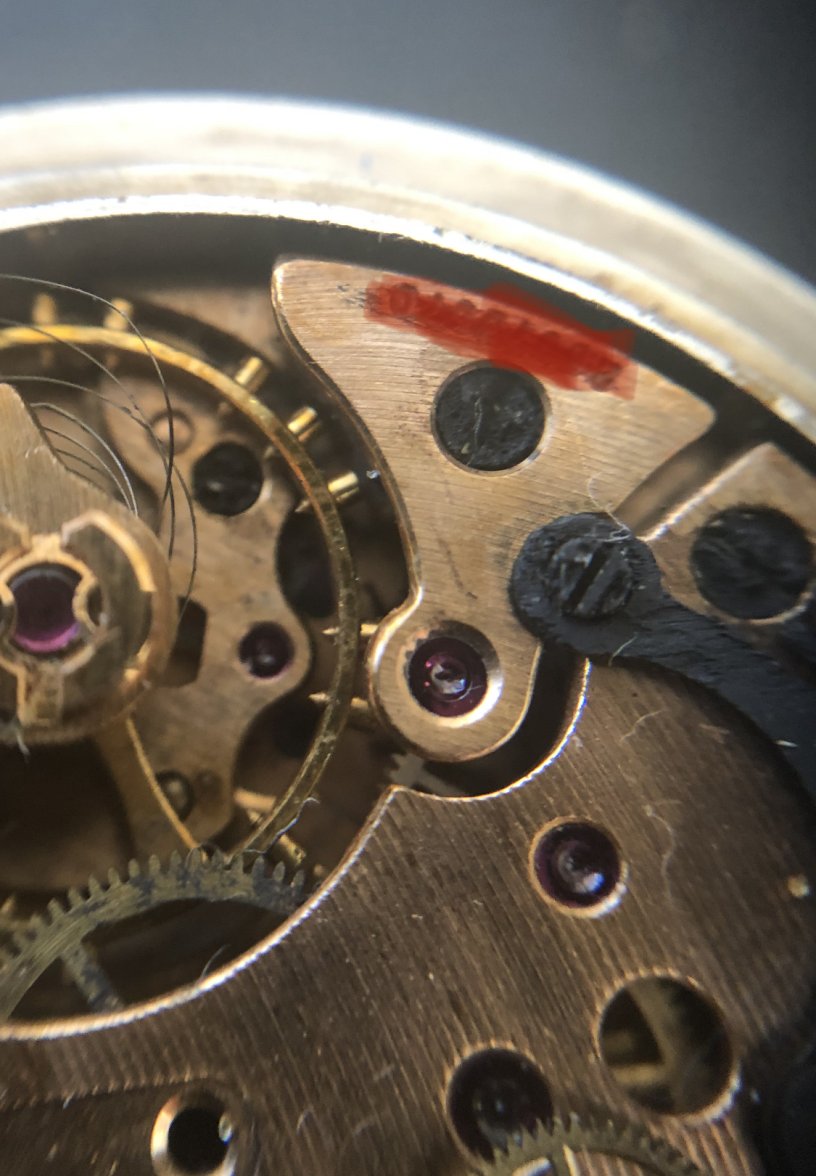
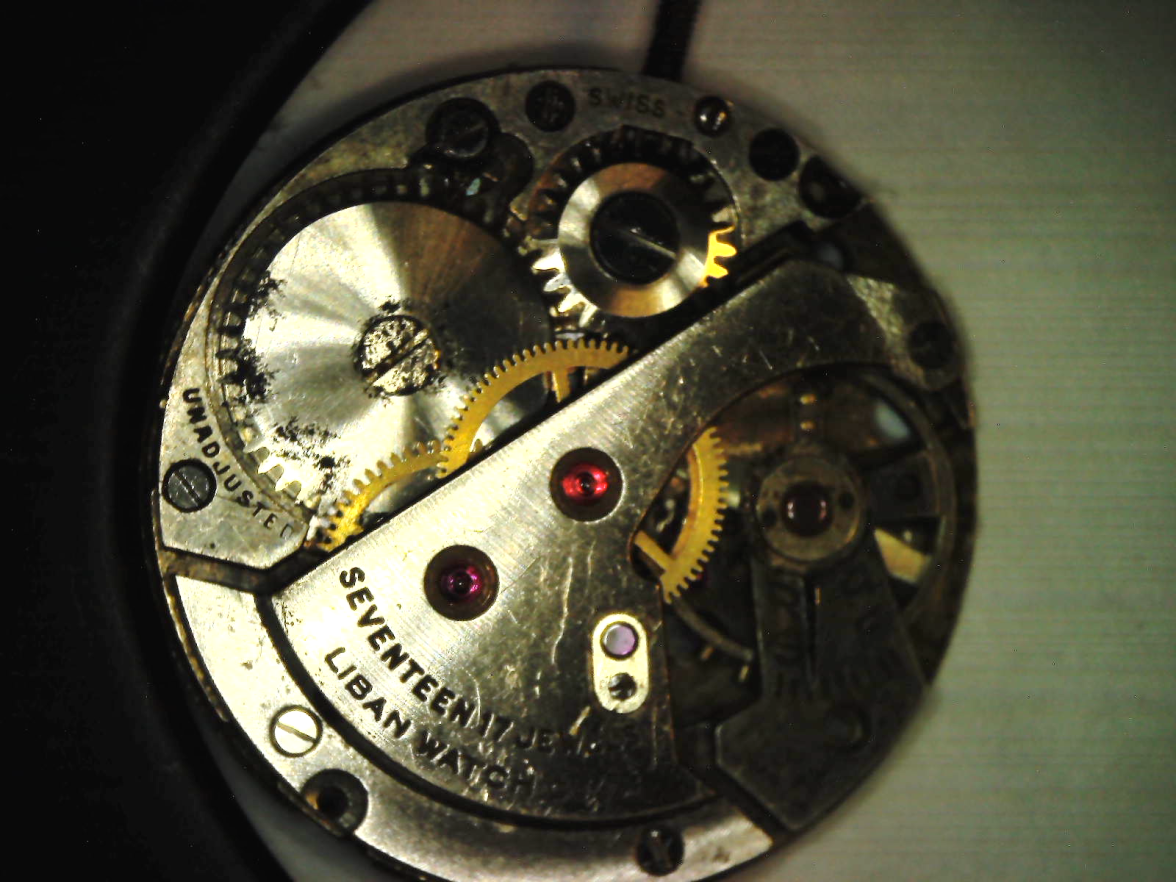
Part of the reason I got the GW watch was to experiment with the Evap-O-Rust. Here is a treated watch that was similarly treated. I could not remove the screw until after the treatment. Notice how the polished winding gear shows discoloration. This is amplified by the narrow depth of field of the microscope.
I also noticed that when I took some rusted iron filings I wanted to use to attempt to read some magnetic recording, That after I washed he filing in alcohol the red parts that looked like dirt were not magnetic, and the magnetic ones were black. It could be that the black comes from the alloyed carbon in the steel. Again I am just guessing.
Coal and crude oil are black, not sure if they have iron in them or not. Pure carbon is also black until the lattice aligns to form diamond. Other patterns form tubes or soccer ball shapes known as buckyballs after R. Buckminster Fuller and the Geodesic dome. These are really hard. One lecture I attended at a trade show stated working with carbon tubes are carcinogenic, as the open ends of the tubes are so small they can enter cell structures and break DNA strands. The other interesting thing is while these structures have only been known for 30 years. They are found in soot and have been for ever. Especially candle soot, which is where they were first found using statistical methods of purification. The balls are why soot is so slippery.
There are even more weird things that happen with scotch tape (weak bonds.) When the tape is released X-rays are produced. If pure carbon is taped, The tape will remove a single layer of atoms in a hexagon pattern. One way of producing carbon re-enforced sheeting. John's Son in Law made carbon fiber golf clubs for the luxury trade. The ERPS rocket club of which I am the ex president of has looked into manufacturing our own carbon fiber tanks. I have personally witnessed the making of the Falcon-9 nose cones in the Hawthorn factory. These are all resin processes, which has something to do with how light affects the resins.
More interesting is these processes were known to the Egyptians. Resin is bismuth, and a coal-tar product found naturally. Jewelers have been using metal etching for millennia. The bismuth protects the parts the acid will etch away.
Again, I am not a materials scientist. I just like connecting things in made up ways. Sort of the way legos can connect to form different patterns. But I play with ideas instead of blocks. And I am also often wrong or misunderstand things. Even when I think I am right.