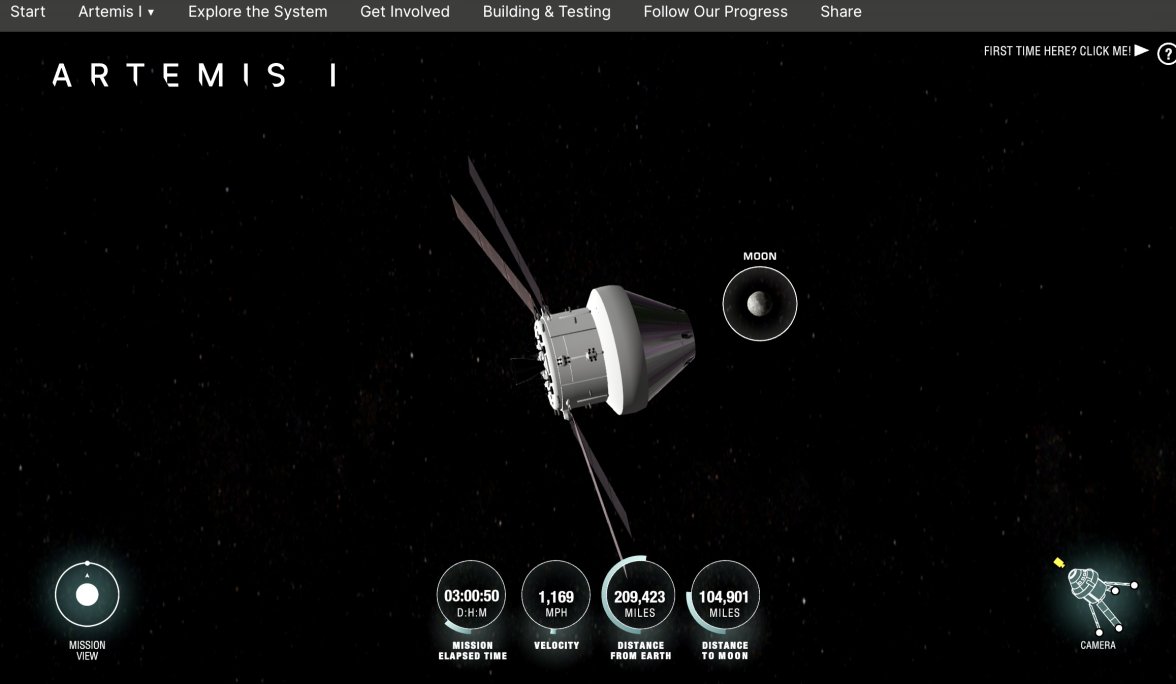
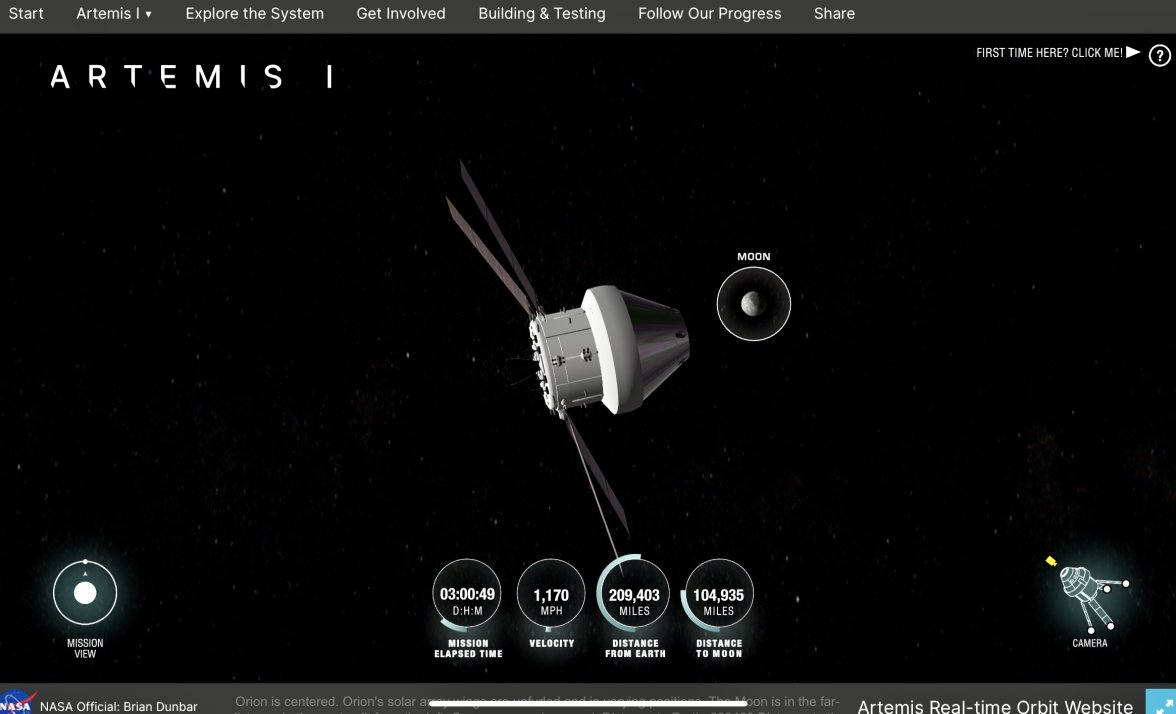
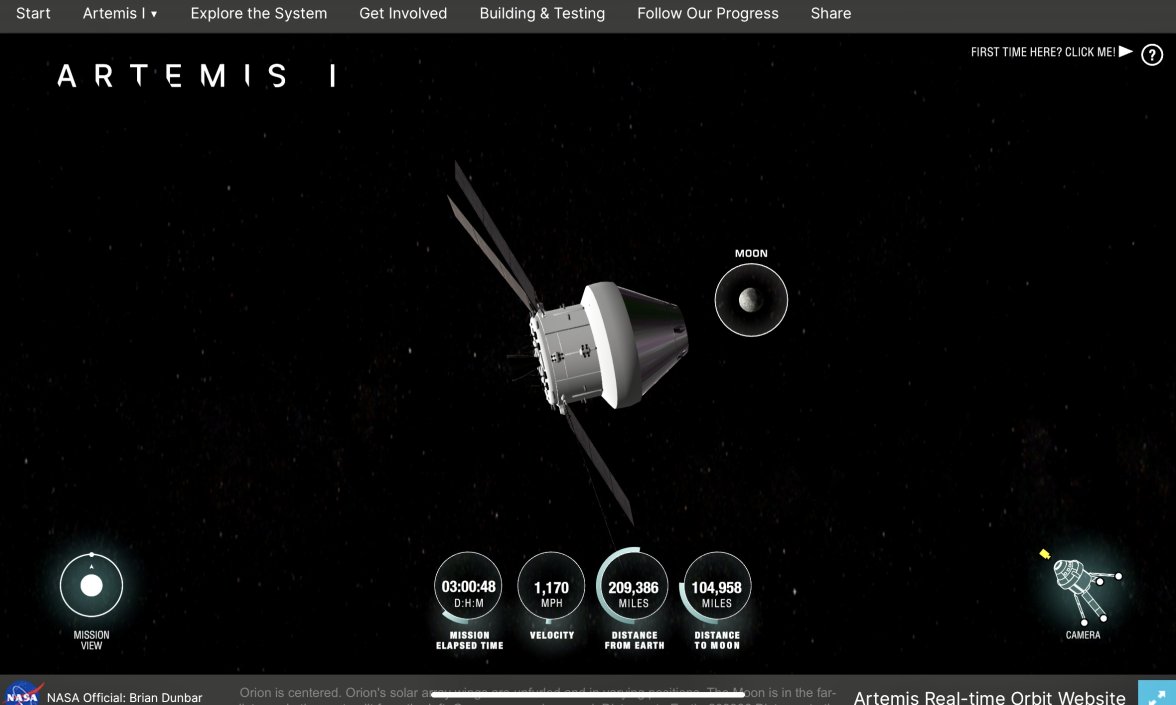
I was interested to see the capsule is travelling a lot slower than Apollo. I wonder if that will be the same on the manned missions, The solar panels certainly remove some battery time pressures. If they could take more fuel or improve propulsion then an 8 hour transit does sound more attractive and reduces radiation exposure time (although you need to slow down as well :0). Looking at the tracking site it’s funny to see how the earth and moon distances change. Elliptical orbits are hard to envisage sometimes. Would be nice to see a live shot from inside the capsule / get the pilots view,
Historically, most lunar missions have taken about three days to reach the moon, assuming the moon is at an ideal distance of
240,000 miles (386,243 kilometers) away. This means astronauts travel roughly 3,333 mph (5,364 kph) on their journey to the moon.
Some uncrewed missions have taken longer in an attempt to save on fuel weight (such as China's Chang'e missions which have taken
four to five days each). The fastest-ever mission to the moon was the very first one: 1959's unmanned Luna 1 took just
36 hours at a speed of roughly 6,500 mph (10,500 kph). In 2006, New Horizons zoomed past the moon on its way to Pluto just
eight hours and 35 minutes after launch and at a speed of 36,373 mph (58,536 kph).
.