Aged care in Australia

Posts
30,168
Likes
77,895
My wife is Australian (also Canadian) and her mother and family is in Australia. She is getting up there in age and currently has a broken hip that is getting taken care of soon we hope.

My brother in law (in Australia) is looking into care homes for her - hopefully not needed right away but we anticipate it will be eventually. The system he is describing is very different from what we have here in Canada. I'm looking for some insight from any Aussie who might have some experience with this.

A kind member here directed me to this site:

https://bestagedcareaustralia.com.au/aged-care-cost/ballarat/

On that site there is this summary:
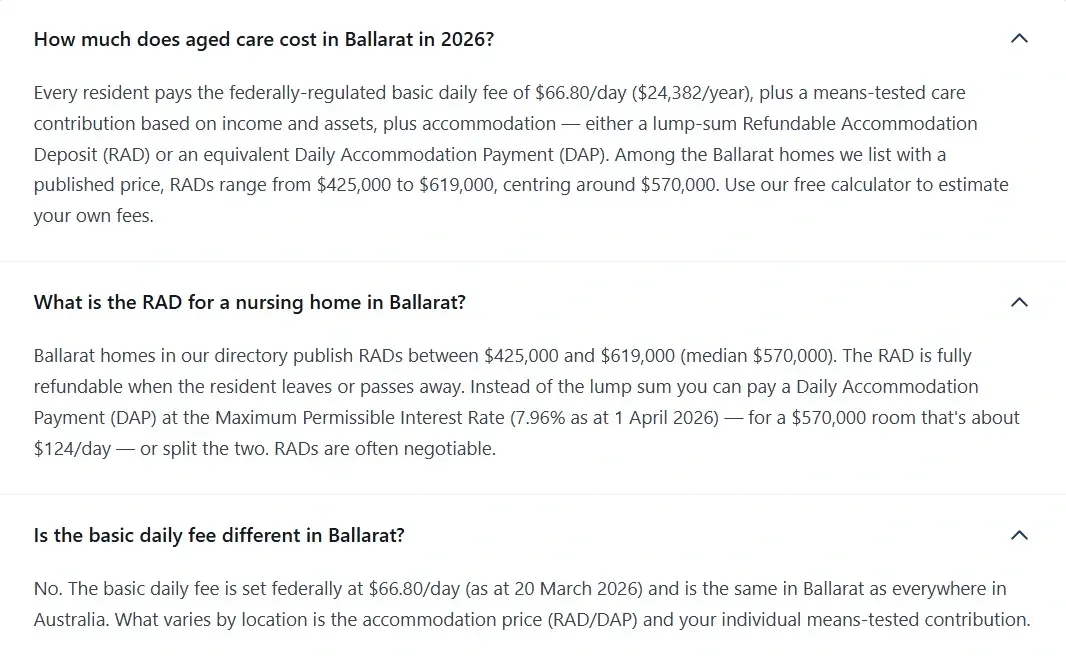


So from what I gather there are 3 costs:

1 - The mandated daily rate of $66.80 per day.
2 - Some unknown fee based on income and assets.
3 - The large (!) refundable down payment - I have no idea what this is actually for - it says it's fully refundable when the person moves out or dies.

The last two numbers could be sort of balanced out to maybe have less of a lump sum down payment, and more of a daily payment.

For anyone who has experience, does that sound about right?

The lump sum has really caught us off guard, as no such requirement exists here - I just visited my 96 year old step-father in his retirement home last night, and he pays about $112 a day, which includes his accommodation and all meals. The only thing he pays extra for is phone/internet. This isn't nursing care, just a place to live with meals, which is what we are looking at for my wife's mother also.

I understand that the way retirement payments are made in Australia are very different from here, with the Australian Superannuation giving people a chunk of money. It seems like this requirement for a several hundred thousand dollars down payment is there to sort of take advantage of that lump sum that people tend to get on retirement.

The problem is, my mother in law was a housewife for most of her life, so has no lump sum. All the money she has is tied up in her current retirement community "unit" that she owns but is more of a condo than a house. She has said that with the fees they are charging her if she sold it she wouldn't get much money. She is able to scrape by on whatever small government pension she gets.

Thanks for any input or clarification - we are hoping to find some sort of alternative, such as having people help her in her current home.

 
Posts
30,168
Likes
77,895
Is the lump sum mandatory? According to this, there should be an option to either pay the daily room charge on a daily basis, or as the lump sum acting as a pre-paid deposit. If paid as a lump sum, the daily room charge is then deducted from the deposit amount.

https://www.myagedcare.gov.au/understanding-aged-care-home-accommodation-costs
Thanks for the link - if nothing else this seems to give me more of an idea what this huge downpayment is for - they appear to make interest off that money and that subsidizes the cost of the room?


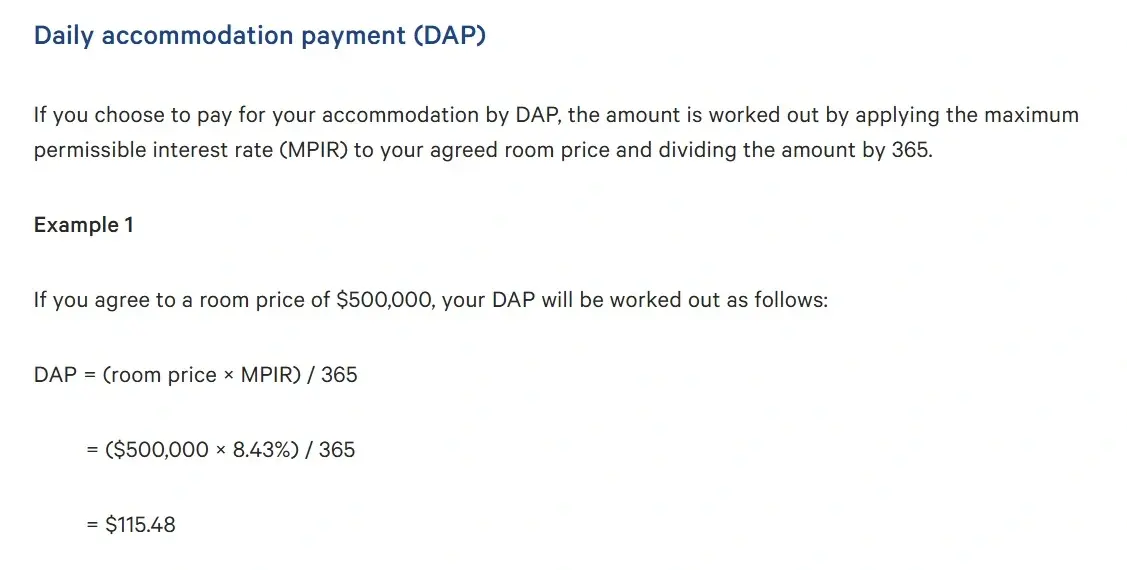
Not sure who is paying 8.43% interest...but it seems this number goes up twice per year and is set by the government.

So if I read all this right, using their example, I would have a daily rate for the room comprised of the following:

1 - The mandated daily rate of $66.80 per day.
2 - Some unknown fee based on income and assets - to be determined.
3 - The DAP - $115.48

So without knowing #2, it looks like the total so far for a $500k room paid daily, would be at least $182,28, so over $66k per year.

I guess this explains why some of our friends who have elderly parents are bringing in people to care for them at their parent's homes, or taking them into their own homes.

Again if anyone has first hand experience, please share.
 
Posts
599
Likes
3,200
Good luck with this mess!

I had to place my mother into a facility a few years ago and the language used, the various components and the payment for them is confusing and at times unfathomable.

There is a tiered system with different levels of care. It really depends on whether she will be able to return to semi-independent living
The lowest is the retirement village where you purchase a right to live in a unit of a building. Usually ( and especially for the church or charity runs ones, which in my opinion are often the best) the entry price is much less than unit that you would buy in the free market. The down side is that you must sell it back to the building owner. They will take out a percentage each year for the first number of years, so that you will get less back than you put in. The upside is that they maintain everything. There are usually meals available, community facilities, outings and activities. Many friendships are made.

The higher level is aged care facility, often co-located with the villages. These are the ones that have daily fees mandated by government with optional add-ons for at extra cost. We could transfer the value in the independent unit into this as the entry price. For those who dont have the entry money the daily fee is higher.

Yes the entry purchase cost is to subsidise the ongoing daily cost.

Even after 2 years of this I barely could comprehend how the money moved around and what was actually going on

James
 
Posts
970
Likes
4,483
It is a complicated system that I had a bit to do with for a few years. It definitely needs to be overhauled but is basically a very good system.

There are advisers - professional ones and those employed by the large not-for-profit aged care organisations - available to take families through the system, taking into account their specific aged care needs and their financial situation.

If a person has only an aged care pension with little or no assets, places are available in aged care sites at no capital cost at all - it is a government requirement of the aged care provider's licence to operate. The resident allocates most of their pension to the provider to pay for accommodation and meals, and retains around 13% for personal expenditure. That means that no pensioner in Australia should miss out on aged care.

In my experience running a large community health organisation, the large not-for-profit providers are much better value than commercial aged care providers, who are after all out to make a buck. If dementia is part of the picture or likely to become so in time, the not-for-profit organisations will do the hard yards. My own father was in that category and the care he received was excellent.
 
Posts
958
Likes
515
So sorry to hear of your family's current predicament.
The following goes on for a bit, so strap yourself in for the long haul.

It seems like forever now that my Father and i had to come to terms with having my Mother placed after she had a serious stroke which rendered her in a "high care" situation and unable to return to our family home.
Much has changed with the scene since then and she was initially in a privately run outfit that was supposed to be high end. We couldn't get her out of there quick enough.
The care was abismal, in our opinion, and we moved her just down the road from there within the first 2 weeks from when she was placed.
The first of many lessons and we were very fortunate to be able to have her moved there in such short notice.
She went to a state government run facility where her care was fantastic and the diversional therapy/therapist was well suited to her and her personality, with it being much more one on one.
That facility eventually closed due to the fact it could no longer meet the federal government's newly introduced accreditation criteria as the layout was essentially not deemed to be appropriate.
So we were able to move her again into another facility which was closer to home. That was great as my Father visited her and spent a large amount of time with her every day to feed her lunch and dinner after her initial placement following the stroke. It became a lifestyle thing for him so she had that constant support until he became too unwell.
The diversional therapy programme was different due to the fact that it was an entirely different kind of facility and more group focused but not best for my Mother so she kind of languished in her own way.
But the key take aways from that whole experience was that price doesn't necessarily determine suitability.
And it's important that the level of care and support is appropriate.
Last but not least.
Social activities, the quality of them and access to them are also crucial to overall quality of living.
It was all covered by a war service pension that they were receiving with no large deposit required
So there's that.

Now my Father in law had a very long downward spiral suffering from Dimentia over a good many years.
Eventually he had to be placed.
I'm not entirely across the financials but i think it was along the lines of the path that you are seemingly going down with regard to the large deposit arrangement.
This is the model we are anticipating having to go along with, when it comes to placing my Mother in law if necessary. So we are factoring that in somehow and most recently there is something hanging over her head in terms of health which has come to the fore.
They were/are entirely self funded retirees and do not qualify for any pension.
That is unless my Mother in law has serious eyesight problems in the future for some unknown reason. God forbid.
Then she will possibly qualify for "the blind pension" which will make things easier.
For the record and incase you are unaware.
The Blind pension is the gold standard from my understanding and through previous experience with other people. The reason why, is there's just more perks with it. It's not really the money.

Depending on your Mother in law's health outcome around this.
Perhaps she may qualify for a disability pension?

A kind word of caution Al.
Please be aware that broken hips can be particularly nasty things.
I'm not trying to put any kind of dampener on things, but be prepared for adverse outcomes around this.
It's a complex thing and a common cause for a downward spiral with older people, it's so serious.
Why do i know this?
My Lovely wife is a dedicated career nurse who had reached lofty heights. Litteraly all her friends are nurses or doctors.
I've lost count of the sad stories i've heard of older people with broken hips.
Your Mother in law will likely need a great deal of support.

Now more recently there's Michael, who lived with his Mother for a very long time as her significant support person because she had a disability in her old age.
They were living in a small government run complex that was focused on budget accomodation and on pensions of one kind or another.
All sorts lived there. So i'll leave it at that except to say that one really wouldn't want a loved one to end up living in that kind of environment.
He continued to live there after his Mother had passed until he had a health issue of his own that saw him hospitalised.
The staff had noticed there were concerns around his cognitive capacity and his capacity to return home to continue living independently despite the fact that he was "on a government package" which is graded and based on needs, where there are services available to people like general house cleaning, bathing, etc, etc.
All of it is not cheap. In fact it's the very opposite and it comes out of the relevant government package. Especially since the people involved are not necessarily interested in delivering the outcomes one would hope for or expect.
Michael was ultimately diagnosed with Dimentia whilst in hospital and deemed to be not fit to live independently even with this "help" coming in to assist with his basic living requirements.
We helped a close family friend(Pat), who knew him through their church circle of friends get him placed near to where he was living and close to where Pat can visit and attend to his affairs as he has no children or relatives.
He is currently doing quite well with getting 3 square meals a day, washing, ironing and no housework with a view to him potentially moving rooms if he choses when the opportunity arises, or perhaps even moving to another nursing home where he may enjoy the environment better there.
So ultimately Pat was granted authority by the court to be his "Enduring Power of Attorney" which grants certain legal status to the Attorney under certain circumstances.
I don't know if your family are aware, but an Enduring Power of Attorney, is different from an Ordinary Power of Attorney.

May i suggest you all get things lined up in that regard if not currently in place through your family's solicitor.
I say these things in case your family are not entirely across it all. It may save an entire world of pain(god forbid) in the event things go south with your Mother in law.

My apologies for sounding like a worry wart but broad experience has shown all these things i've spoken about above to be very real and when things go south we can all be caught flat footed as a family.
Forewarned is forearmed.
Plenty to think about which sits well outside and also close to the situation your family currently finds itself in.

Speaking for our own family's position. Mother in law, myself and my wife.
We are committed to staying at home and living as independently and as well as possible no matter what life throws at us. But we are on the fully self funded roundabout.
The aged care sector in OZ and living well into advanced years can be problematic.
It's worse if one is carrying an injury or is spiraling downward due to the injury or other issues. Whether it be in a controlled decent or not, not to mention a potential rapid decent.
You need to factor in the flexibility to help move your Mother in law if possible to better accomodation. It's not necessarily set in stone that she will end up where she starts out.
So many variables to fully factor in with health and the potential legalities as one necessarily doesn't want to be in a position where things are taken out of one's hands.
Lord knows that comes eventually anyway.
But it's good to have some control while ever it's still possible.take from this what you will and leave the rest.
I wish you all the very best navigating your way through it all.

If you will Al.
Please keep us posted as to how it's going with the situation?
With you, we shall remain.
Cheers
Edited:
 
Posts
958
Likes
515
It is a complicated system that I had a bit to do with for a few years. It definitely needs to be overhauled but is basically a very good system.

There are advisers - professional ones and those employed by the large not-for-profit aged care organisations - available to take families through the system, taking into account their specific aged care needs and their financial situation.

If a person has only an aged care pension with little or no assets, places are available in aged care sites at no capital cost at all - it is a government requirement of the aged care provider's licence to operate. The resident allocates most of their pension to the provider to pay for accommodation and meals, and retains around 13% for personal expenditure. That means that no pensioner in Australia should miss out on aged care.

In my experience running a large community health organisation, the large not-for-profit providers are much better value than commercial aged care providers, who are after all out to make a buck. If dementia is part of the picture or likely to become so in time, the not-for-profit organisations will do the hard yards. My own father was in that category and the care he received was excellent.

Agreed.
Yes, the care in the public sector can be fantastic. And it can be a very different experience from one state to the next.
Whilst the framework for the funding models is pretty well set down federally.
The care is influenced by state based factors.
Matron always says it's the more dedicated kinds of nurses and doctors that seem to gravitate toward the public sector, as opposed to those who want to chase the bucks and or status through the private sector.
This often seems to be the case looking at it from an outsiders(such as myself) perspective.
Of course there's no absolute hard and fast rules here either and it can be a lottery as well, but the numbers don't lie. To add that, the numbers, critical timelines, the type of treatment and so on are so important with this whole broken hip thing.

One can only imagine what Matron and her cohorts talk about when they get together.
There is a system that exists outside of the norm of everyday lives, yet it touches all of us as individuals and our respective families whether we are fully aware or not.
Between them, they know the best doctors for this and that, also the clinicians, surgeons, specialists, etc. That part of it is a godsend having inside knowledge to draw from.

There are so many moving parts to all this that Al and his family are going to have to piece together and make fit as best they can to suit his Mother in law's circumstances as it unfolds for her.
Thank god treatments and technologies are improving at a great rate of knots from what i can see.
Edited:
 
Posts
30,168
Likes
77,895
Thanks for all the input folks. What complicates this for my wife and I are that we are half way around the world from where this is happening, so my wife’s brother is sort of spearheading this whole effort.

I am aware that broken hips in the elderly can turn an independent person into a person needing a lot of care, and it can lead to a quick deterioration in health.

Right now my mother in law is back in her home in South Australia for a few days on her own as a trial to see how she gets along. She still has a broken hip, so not quite sure how long it will take to get that sorted, but when she does and needs care after the surgery, my wife is considering taking a trip to help take care of her for a couple of weeks, and would hopefully be able to get more involved directly in this aged care process then.

As it stands we are hoping her mother can live independently for at least a few more years, but we don’t know what state she will be in when this immediate issue gets fixed. She might be fine or might be spiralling down…we just don’t know.

She had to be taken to hospital in Victoria by ambulance so that is over $2k since her insurance for that didn’t cover out of state costs. My wife’s sister said she is working on a way to get that covered somehow.

It sounds like parts of the system there are quite similar to Canada, but others very different…

Thanks again for all the input and I’ll keep you posted.

Cheers, Al
 
Posts
18,716
Likes
38,844
I am aware that broken hips in the elderly can turn an independent person into a person needing a lot of care, and it can lead to a quick deterioration in health.
On the bright side Al, my 96 year old MIL suffered a broken hip and follow-up surgery a few months ago. She still lives at home with a family member and has a weekly carer visit. It has slowed her down a bit, but she's still enjoying life, although in the slow lane now.
 
Posts
958
Likes
515
Thanks for all the input folks. What complicates this for my wife and I are that we are half way around the world from where this is happening, so my wife’s brother is sort of spearheading this whole effort.

I am aware that broken hips in the elderly can turn an independent person into a person needing a lot of care, and it can lead to a quick deterioration in health.

Right now my mother in law is back in her home in South Australia for a few days on her own as a trial to see how she gets along. She still has a broken hip, so not quite sure how long it will take to get that sorted, but when she does and needs care after the surgery, my wife is considering taking a trip to help take care of her for a couple of weeks, and would hopefully be able to get more involved directly in this aged care process then.

As it stands we are hoping her mother can live independently for at least a few more years, but we don’t know what state she will be in when this immediate issue gets fixed. She might be fine or might be spiralling down…we just don’t know.

She had to be taken to hospital in Victoria by ambulance so that is over $2k since her insurance for that didn’t cover out of state costs. My wife’s sister said she is working on a way to get that covered somehow.

It sounds like parts of the system there are quite similar to Canada, but others very different…

Thanks again for all the input and I’ll keep you posted.

Cheers, Al

Good to know you're all working through it.
Thank god for families that are basically functional hey.

Talking about your predicament with Matron.
She always says that surgery much much earlier or even immediately following a broken hip leads to better outcomes. Like within 24 hrs into the chop shop.
I don't know how that unfolds for normal people under normal circumstances but there you go.
Also the statistics used to be that one can expect an average of 12 months life expectancy after the fall.
But hopefully outcomes have improved with new developments in treatment.
Though Matron says people can get lucky too and we all hold out hope.
Jiminoz Mother in law has possibly won the lottery.
 
Posts
970
Likes
4,483
Thanks for all the input folks. What complicates this for my wife and I are that we are half way around the world from where this is happening, so my wife’s brother is sort of spearheading this whole effort.

I am aware that broken hips in the elderly can turn an independent person into a person needing a lot of care, and it can lead to a quick deterioration in health.

Right now my mother in law is back in her home in South Australia for a few days on her own as a trial to see how she gets along. She still has a broken hip, so not quite sure how long it will take to get that sorted, but when she does and needs care after the surgery, my wife is considering taking a trip to help take care of her for a couple of weeks, and would hopefully be able to get more involved directly in this aged care process then.

As it stands we are hoping her mother can live independently for at least a few more years, but we don’t know what state she will be in when this immediate issue gets fixed. She might be fine or might be spiralling down…we just don’t know.

She had to be taken to hospital in Victoria by ambulance so that is over $2k since her insurance for that didn’t cover out of state costs. My wife’s sister said she is working on a way to get that covered somehow.

It sounds like parts of the system there are quite similar to Canada, but others very different…

Thanks again for all the input and I’ll keep you posted.

Cheers, Al
Al
Your brother-in-law could try Silverchain in SA (https://www.silverchain.org.au/rdns-is-now-called-silverchain.) It took over the Royal District Nursing Service of SA in 2011.. When I was in Adelaide prior to that, RDNS was an outstanding provider of nursing and other home care services, specialising in aged care. However I have been in other states since then and cannot comment on Silverchain - but it is definitely worth a try.
 
Posts
13,882
Likes
54,046
Al. I’d reccomend that you find a consultant in OZ to help you sort this. I found one, Sheri Samotin ..Life Bridge Solutions LLC in the US who helped our family immensely with my mom’s care. I have to believe she has peers in OZ. You might reach out to see if she can refer you.
 
Posts
18,716
Likes
38,844
Silverchain in SA
I was about to suggest the same. No experience with the organisation but tI saw a local ad and thought it may be another lead to follow.