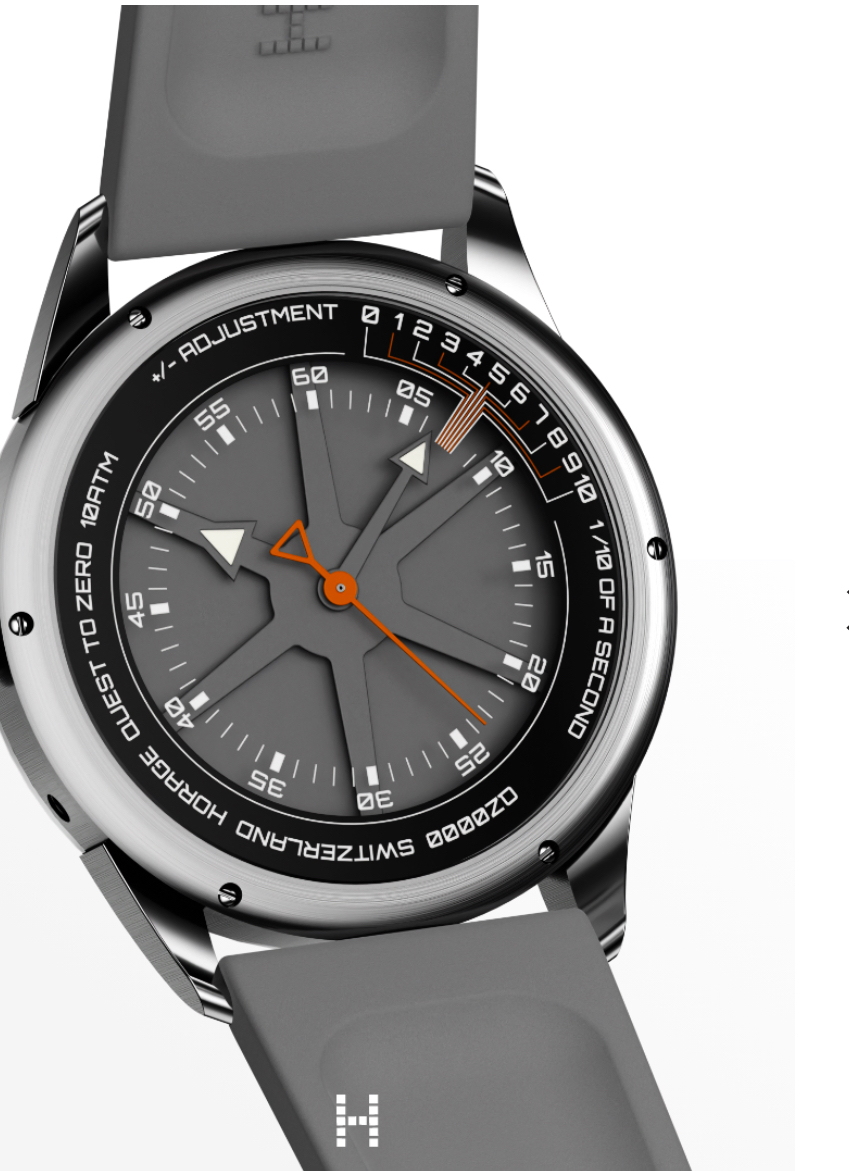
A Revolutionary Invention

Posts
638
Likes
1,511
Interesting, looks like they're trying to accomplish the same thing as Omega's Spirate System; easy microregulation. The idea of being able to regulate your own watch is cool, but should in theory not be necessary and is unlikely to be a good idea at the mass market level.
 
Posts
1,615
Likes
3,859
Fun thingy.. I have a higher grade citizen Adorex from the 70s that allows adjusting the hairspring regulator from the crown (4th position after quickset).
 
Posts
29,681
Likes
76,840
Yep - nothing new in terms of having external adjustment, but I guess a different way of doing it.

A bit like the new Rolex gadget the AD's have for measuring your wrist size...when a piece of string works just fine.
 
Posts
193
Likes
161
I see it as a solution to a non-existing problem for most. But if I have OCD, I could have a lot of fun with it. If the rate of my watch changes due to my activities, I would regulate it right before my daily exercise, then regulate it back to my office work setting, and again regulate it after work. If the rate in the 1st 12 hours is different than the 2nd 12 hours, I may regulate it to one setting in the morning, and re-regulate it to the night setting before I go to bed ...
 
Posts
2,844
Likes
4,537
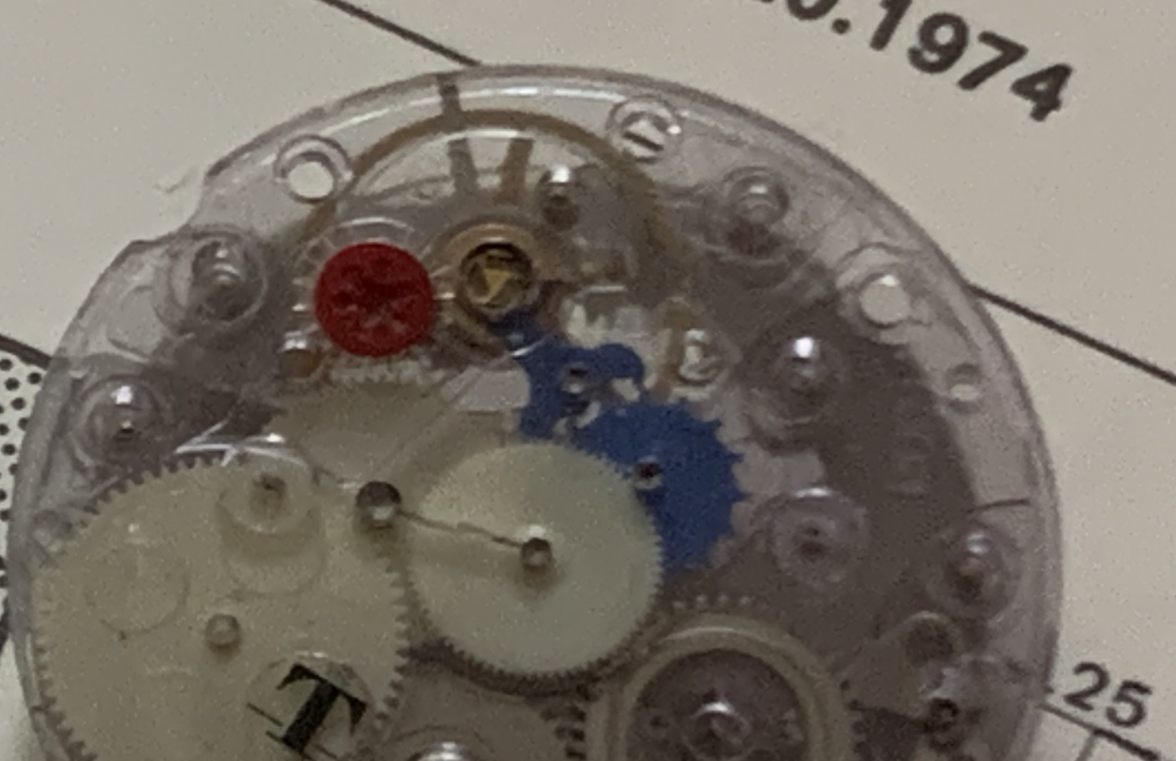
The big red button on the Plastic Tissot movements allows for external regulation. Have not put one of these on a timer to see how precise one can the them.

Given the top graphic, perhaps it is time to revive plastic movements. Even it they do look like a learn about watches toy.
 
Posts
1,542
Likes
3,188
I like it a lot !
Good evolution on earlier ideas , typical for the watch industry ? , with a far more practical and precise execution. Just a small electric pulse to move a bimetalic ? thingy and go + 0.1. Or minus. No more case opening and risk of scratching or changing gaskets.
Or sending it away to ever more scarce and expensive hands.....

Joy !
 
Posts
869
Likes
3,632
Cool idea but looks gimmicky and over-engineered to me. I would call it revolutionary if it somehow made the adjustment automatically.

What I couldn't figure out is what you are measuring against since it doesn't tell you the accuracy like a timegrapher or similar device. Also, wouldn't the accuracy of the movement change based on the position? The tool seems to be used with dial down position only.
 
Posts
193
Likes
161
What I couldn't figure out is what you are measuring against since it doesn't tell you the accuracy like a timegrapher or similar device. Also, wouldn't the accuracy of the movement change based on the position? The tool seems to be used with dial down position only.
My understanding is that you can use any reference that is more accurate than your watch (ie. a quartz clock or Watchcheck APP). Since each press of the '+' or '-' changes by 0.1spd, if your watch is +2.7 seconds after 24 hours, you just press the '-' button 27 times, and hopefully, tomorrow, it will be closer to 0 sec. That is, if you go through the same activities tomorrow as you did today as the rate of mechanical watches are very dependent on the position orientation and wrist movement.
Edited:
 
Posts
638
Likes
1,511
I personally use the website time.is if I want precision, like if I'm performing timing tests on a watch. It quickly shows true time, tells you the margin of error for accuracy (Can be relevant for phones that take a while to load it) and how off your system clock was.

For actual day to day setting of the watch, my watch runs about +4 s/d so I usually just hack it for the morning to be -2 s off whatever the nearest reasonably accurate clock is, whether it be a quartz watch or just my phone clock app.
 
Posts
29,681
Likes
76,840
Okay, finally read the article. This is either a paid advertisement, or is written by someone for whom the basics are not well understood.

Not ragging on the watch or the company here, as much as the article and it's real lack of clarity.

This line in particular shows a real lack of understanding of what certification is all about (and maybe what makes up watch accuracy as well).

"It is a revolutionary advancement that has the potential to reshape the future of horology. Even the importance and relevance of accuracy certifications, like COSC and METAS, could be at stake. When the final, personally preferred accuracy adjustment is up to the wearer anyway, does a watch’s certification even matter?"

This seems to imply that the only thing being checked during certification is the regulation of the final rate, which is not true at all. These certifications are also looking at positional variation, variation in different states of wind, and even temperature variation - all of these things have to meet certain standards to pass, and those things are in fact the basis of the watch being able to maintain the range of daily rates they are being certified for. They are the backbone of the accuracy.

The article mentions "adjustment and regulation" at least once, but doesn't really tell you anything about what the difference is, or what the impacts of each are. They talk at length about the toils of regulating - it's actually not difficult or time consuming at all - on the type of calibers shown, it's just moving a lever, and it typically takes seconds to do, then a few minutes to confirm the timing change is stable, and you are done. It isn't some vastly laborious process as the article implies.

What does take time is adjusting - this is minimizing all the variations that they talk about when the watch is being worn. Again this is what enables you to regulate the watch to stay within a given accuracy range, and without it, all the regulating in the world isn't going to make your watch accurate.

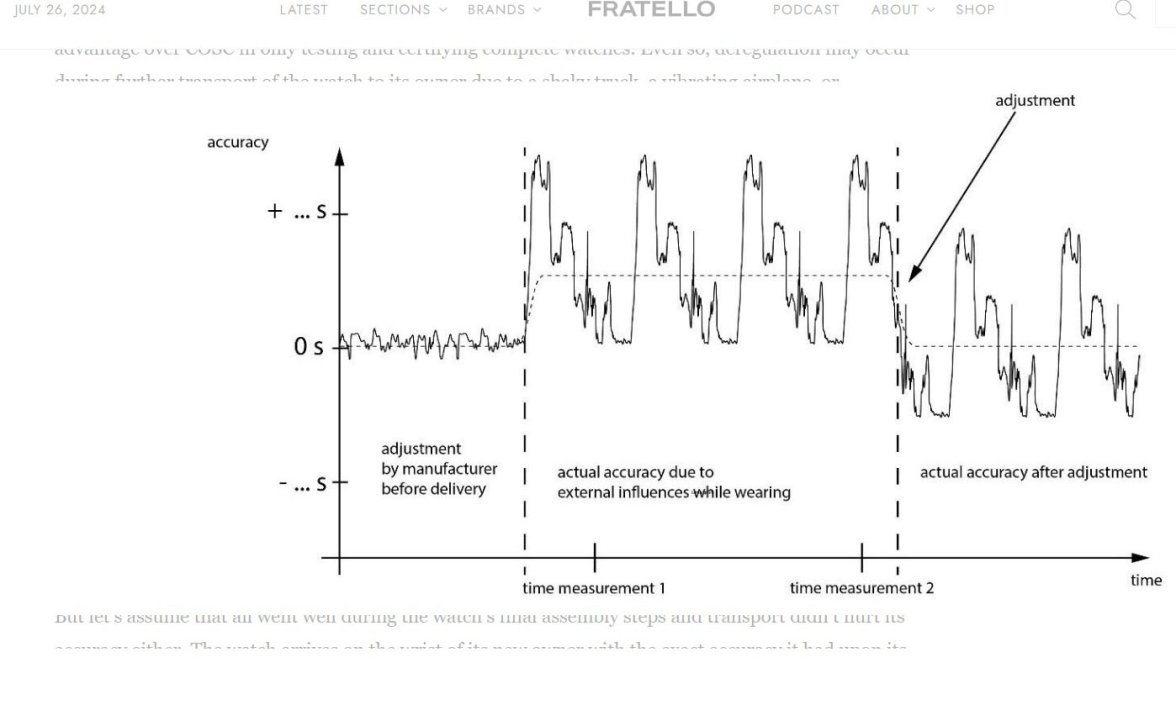
This graph really makes no sense:


If the time variation goes from the very flat graph at the start of this chart, to the wild swings seen right after, then there are two possibilities. One is that the first part of the graph is representing the watch in just one position. If so, that is very misleading - the watch may be regulated while sitting in one position, but that doesn't reflect the variation the watch has over say 6 positions. So if this is what the chart is showing, it's comparing apples to oranges.

The other option is that the adjustment work done to the watch was very poorly done. When I adjust a watch, in particular a modern watch that is new or a new movement, I do not expect the variation I see on the timing machine to be significantly different than what I get in real world tests, and when the customer wears the watch. If it is as is shown in this chart, something is wrong. So if I see a Deta of say 10 seconds over 6 positions on the timing machine, when I measure that in real life in different positions for 24 hours, or have it on the test winder, I don't see a delta that is 40 seconds - it should be 10 seconds or very close to it.

They talk about the regulator moving during transport - while that's possible, I have shipped literally thousands of watches all over the world, and I can't ever recall having a customer tell me the timing was way off when they received their watch. If you pack the watch properly, this is just not a concern. In addition, the regulator is held in place with friction, and usually that friction is enough that inadvertent knocks are certainly not going to make it move.

One the companies web site, it asks this question:

"The question is how we solve this disconnect between Regulation and Reality, whilst maintaining the values, and integrity of a purely mechanical watch."

My answer is, adjust the watch so you don't have wild swings in timing, as companies have been doing for many decades. They chose a different route, which is fine, but it's not my preferred route certainly. This will appeal to gadget lovers, but there's a reason that watches with the ability to regulate without opening were tried and fell by the way side eventually. I don't see this as some new revolution that will end all certifications, as the author of the article implies. Far from it.

The article asks the question if certifications are even necessary anymore...well here's your answer:


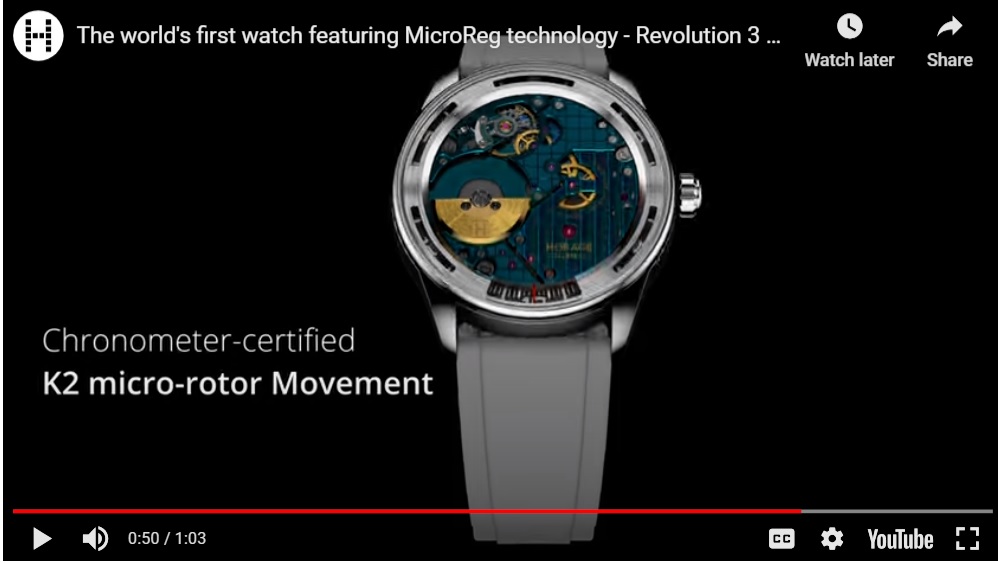
The movement is a chronometer...😁
 
Posts
5,082
Likes
15,701
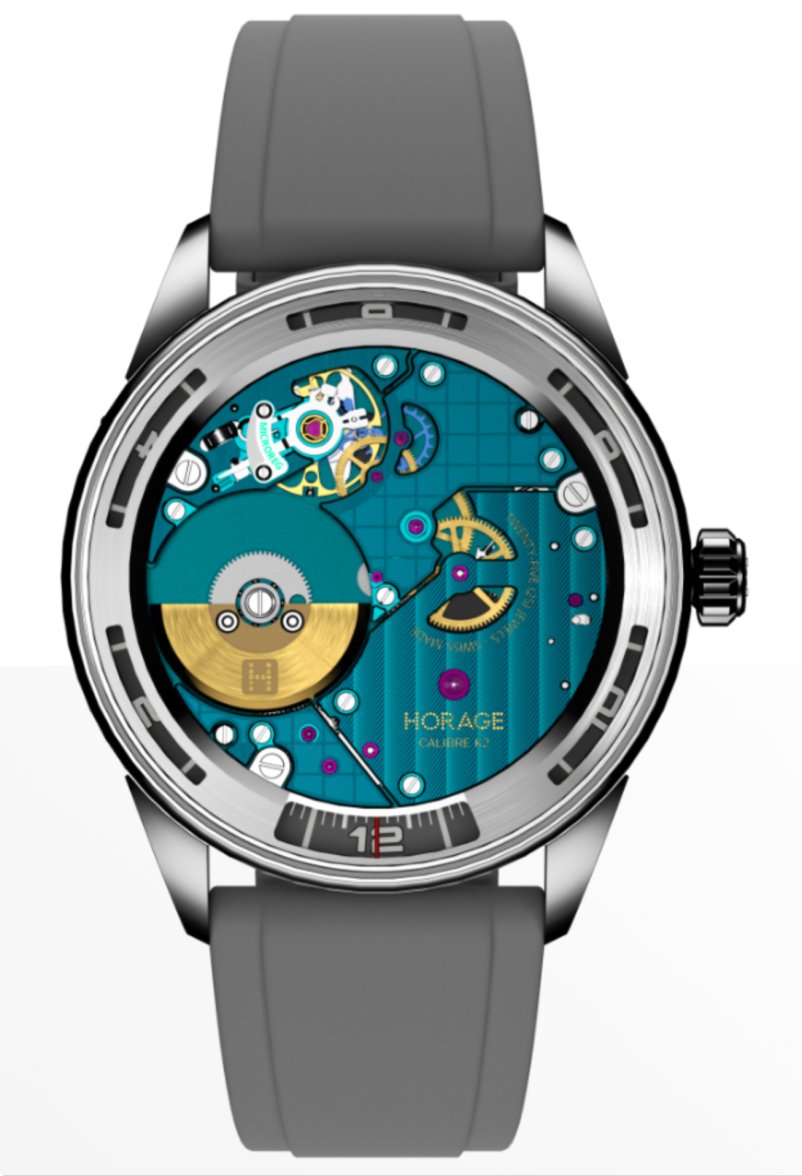
This watch could be the most accurate in history, but it doesn’t matter if it doesn’t display…um…the time


You have to take off the watch to look at the hard to read dial on the back? 😕

 
Posts
2,980
Likes
8,744
This watch could be the most accurate in history, but it doesn’t matter if it doesn’t display…um…the time


You have to take off the watch to look at the hard to read dial on the back? 😕


Time to let the engineers back into the design studio and chase out the hippies.
 
Posts
193
Likes
161
This watch could be the most accurate in history, but it doesn’t matter if it doesn’t display…um…the time


You have to take off the watch to look at the hard to read dial on the back? 😕

That's what your smartphone is for. The watch is only to be used in emergency, when you forget to charge the phone.
 
Posts
6,195
Likes
21,200
Time to let the engineers back into the design studio and chase out the hippies.

It's not the hippies. Hippies didn't make watches. It's kids of the hippies. 😁
 
Posts
2,980
Likes
8,744
It's not the hippies. Hippies didn't make watches. It's kids of the hippies. 😁

Neo hippies then?

I tend to use the term too broadly.
 
Posts
638
Likes
1,511
That's what your smartphone is for. The watch is only to be used in emergency, when you forget to charge the phone.

But if my phone is dead, how can I validate the 0.1 s/d accuracy!?