- Posts
- 6,999
- Likes
- 12,897
SpeedyPhill
·60 years ago on January 23, 1960 mankind reached the lowest point on Earth's seabed as the bathyscaphe "Trieste" touched the ocean floor in the 10911 m deep Mariana trench in the West Pacific Ocean.
On board were Swiss oceanographer Jacques Piccard (son of Swiss physicist Auguste Piccard - on whom professor Calculus in Tintin was based) and US Navy officer Don Walsh. In fact the Trieste was Auguste Piccard third design for a blimp-shaped submersible capable of reaching the ocean floor. It had a spherical cabin with a single window, which was shaped like an Apollo capsule.
Talking about Apollo, the astronauts spent about 300 hours on the Moon but oceanographers only spent about 3 hours at the deepest places on the Ocean floor. This scientific adventure always fascinated me as a child and later on I learned which items Piccard had taken onboard the historic dive (e.g. Swiss flag).
Of course watch enthusiasts know about the Rolex DSS - Deep Sea Special, a ruggedized Rolex prototype diving watch with domed bubble glass, of which only 6 pieces were made. Jacques Piccard had been testing Rolex diving watches and attached the Rolex DSS n° 3 to the outside rails of the Trieste bathyscaphe. The Rolex performed flawlessly during the whole 9 hours of the diving adventure.
.
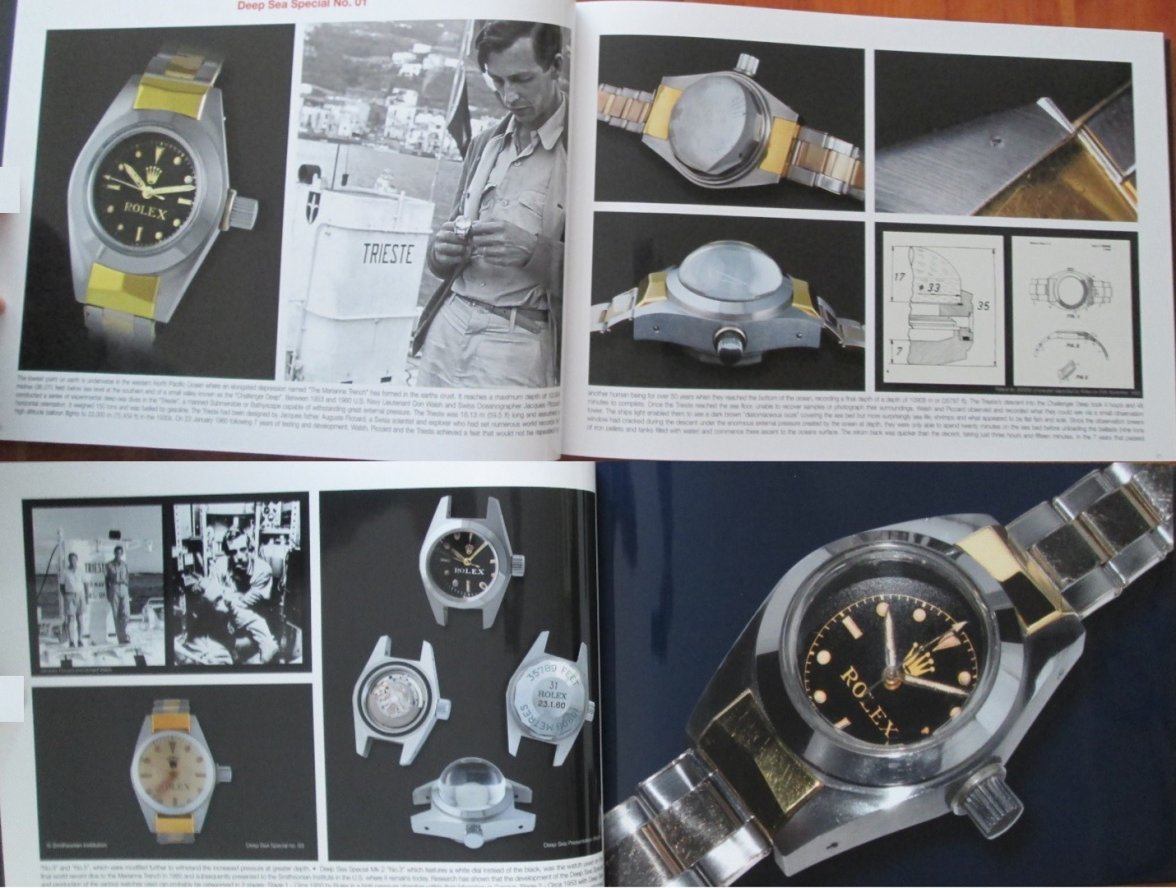 Remarkably some Rolex DSS experimental diving watches are in private collections. Italian author and watch collector John Goldberger showcased the DSS n° 1 in his outstanding book "Journey In to the Deep" with some amazing detailed images and photographs of the 1960 Trieste adventure.
.
Since then the dive has been done by film maker turned deepsea explorer James Cameron in March 2012. Cameron also attached a Rolex diving watch to the outside of his Kawasaki-green Deep Sea Challenger submersible... an experimental Rolex Sea Dweller... commercialized in the Rolex Sea-Dweller Deepsea series.
Of course meanwhile Omega has also demonstrated its dive watches as retired Naval officer Victor Vescovo took an Omega Seamaster Planet Ocean Ultra Deep Professional aboard his DSV - Deep Submergence Vehicle to a depth of 10927 m in April and May 2019, becoming the first person to reach the Mariana trench deepest point twice...
On board were Swiss oceanographer Jacques Piccard (son of Swiss physicist Auguste Piccard - on whom professor Calculus in Tintin was based) and US Navy officer Don Walsh. In fact the Trieste was Auguste Piccard third design for a blimp-shaped submersible capable of reaching the ocean floor. It had a spherical cabin with a single window, which was shaped like an Apollo capsule.
Talking about Apollo, the astronauts spent about 300 hours on the Moon but oceanographers only spent about 3 hours at the deepest places on the Ocean floor. This scientific adventure always fascinated me as a child and later on I learned which items Piccard had taken onboard the historic dive (e.g. Swiss flag).
Of course watch enthusiasts know about the Rolex DSS - Deep Sea Special, a ruggedized Rolex prototype diving watch with domed bubble glass, of which only 6 pieces were made. Jacques Piccard had been testing Rolex diving watches and attached the Rolex DSS n° 3 to the outside rails of the Trieste bathyscaphe. The Rolex performed flawlessly during the whole 9 hours of the diving adventure.
.
.
Since then the dive has been done by film maker turned deepsea explorer James Cameron in March 2012. Cameron also attached a Rolex diving watch to the outside of his Kawasaki-green Deep Sea Challenger submersible... an experimental Rolex Sea Dweller... commercialized in the Rolex Sea-Dweller Deepsea series.
Of course meanwhile Omega has also demonstrated its dive watches as retired Naval officer Victor Vescovo took an Omega Seamaster Planet Ocean Ultra Deep Professional aboard his DSV - Deep Submergence Vehicle to a depth of 10927 m in April and May 2019, becoming the first person to reach the Mariana trench deepest point twice...